Car Insurance Deductible Guide
Master car insurance deductibles: definitions, calculations, choices, and strategies to balance premiums and out-of-pocket costs effectively.

Car insurance deductibles represent a fundamental aspect of auto policies, determining the initial out-of-pocket expense policyholders face before coverage activates. Understanding this mechanism empowers drivers to make informed decisions that align financial responsibilities with risk tolerance.
Defining the Car Insurance Deductible
A car insurance deductible is the predetermined amount you must pay from your own funds toward repairs or losses from a covered incident before your insurer contributes the balance. This applies primarily to specific coverages like collision and comprehensive, where you select the deductible level at policy inception.
Unlike liability coverage, which pays others without a deductible, these protections for your vehicle involve this shared cost structure. Common amounts range from $100 to $2,000, with $500 being the most frequent choice among drivers.
Operational Mechanics of Deductibles in Claims
When filing a claim under deductible-applicable coverage, the process unfolds as follows: assess damages, subtract your deductible from the total approved cost, and receive payment for the remainder. You typically settle the deductible directly with the repair shop or via deduction from the insurer’s payout.
- If damages fall below your deductible, you cover the full amount—no claim payout occurs.
- For claims exceeding the deductible, insurers handle the excess after your contribution.
- In total loss scenarios, the deductible subtracts from the vehicle’s actual cash value settlement.
Practical Calculation Examples
Consider a collision repair costing $4,200 with a $1,000 deductible: you pay $1,000, insurer covers $3,200. For comprehensive theft loss of $1,800 at $500 deductible: your cost is $500, insurer pays $1,300.
| Scenario | Deductible | Total Damage | Your Payment | Insurer Payment |
|---|---|---|---|---|
| Collision Accident | $500 | $3,000 | $500 | $2,500 |
| Comprehensive (Deer Hit) | $300 | $1,200 | $300 | $900 |
| Theft Claim | $500 | $1,500 | $500 | $1,000 |
| Total Loss | $1,000 | $10,000 (ACV) | $1,000 | $9,000 |
These illustrations, drawn from standard industry practices, highlight consistent application across providers.
Distinguishing Collision from Comprehensive Deductibles
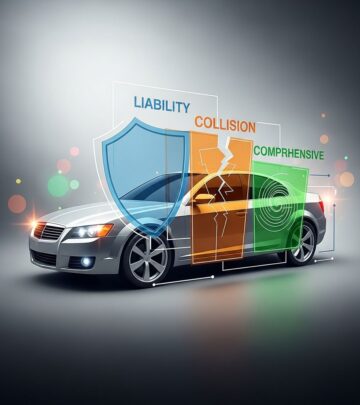
Auto policies often feature separate deductibles for collision and comprehensive coverages, allowing customization based on risk exposure.
Collision Deductible: Activates for damage to your vehicle from colliding with another car or object, regardless of fault. Essential for at-fault accidents.
Comprehensive Deductible: Covers non-collision events like theft, vandalism, fire, hail, or animal strikes. Sometimes waivable for minor glass repairs in certain states.
Other coverages like uninsured motorist or personal injury protection may include deductibles, but liability does not.
Balancing Deductibles with Premium Costs
Deductible selection directly influences premium rates: higher deductibles reduce premiums by shifting more risk to you, while lower ones increase premiums for greater insurer responsibility.
- Low Deductible ($100-$500): Higher premiums but minimal upfront claim costs—ideal for those with limited savings or frequent claims.
- High Deductible ($1,000+): Lower premiums but substantial claim payouts—suitable for safe drivers with emergency funds.
Average deductibles hover between $500 and $1,000, balancing affordability and protection. Premium savings from raising deductibles can reach 10-20% or more, depending on insurer and profile.
Factors Influencing Optimal Deductible Selection
Choosing the right deductible requires evaluating personal finances, driving history, vehicle value, and lifestyle.
- Financial Cushion: Ensure you can cover the deductible without strain; build an emergency fund equivalent to 3-6 months of expenses.
- Vehicle Value: Higher deductibles suit older, lower-value cars where repair costs may not justify low deductibles.
- Driving Risk: Urban drivers or those in accident-prone areas may prefer lower deductibles.
- Claim Frequency: Frequent small claims erode no-claim discounts; higher deductibles discourage this.
Insurers provide deductible options during quoting—review quotes across levels to quantify trade-offs.
Scenarios Where Deductibles May Not Apply
Not all claims trigger deductibles. Liability pays third-party damages fully. Some policies waive comprehensive deductibles for windshield chips/cracks, especially in no-fault states.
First-party medical payments or rental reimbursement often lack deductibles. Always verify policy endorsements for waivers or zero-deductible perks on new vehicles.
Adjusting Deductibles Mid-Policy
Life changes like paying off a car loan, moving to a safer area, or bolstering savings warrant deductible reviews. Contact your agent for mid-term adjustments—premium changes apply immediately, often without fees.
Annual renewals offer prime opportunities to reassess based on updated risk factors and rates.
Common Misconceptions About Deductibles
- Myth: Deductibles reset yearly like health insurance. False—each claim incurs the full deductible anew.
- Myth: Not-at-fault accidents avoid deductibles. If using collision coverage, you pay regardless; seek reimbursement from the at-fault party later.
- Myth: Higher deductibles always save money. Only if claims are rare; frequent incidents amplify costs.
Strategies to Minimize Deductible Impact
Proactive steps reduce reliance on claims:
- Defensive driving courses for discounts.
- Telematics programs tracking safe habits.
- Parking in garages to cut comprehensive risks.
- Gap insurance for financed vehicles to bridge total loss shortfalls.
Compare multiple insurers annually; tools reveal deductible-premium sweet spots tailored to you.
Frequently Asked Questions (FAQs)
What happens if damage is less than my deductible?
You pay the entire amount out-of-pocket; filing a claim isn’t viable as no payout occurs.
Can I change my deductible after an accident?
Yes, but it applies to future claims only—not retroactively.
Does comprehensive always have a deductible?
Typically yes, but glass claims may waive it per policy/state rules.
How does deductible affect total loss payouts?
It’s subtracted from the actual cash value; e.g., $15,000 ACV minus $500 deductible = $14,500 check.
Are deductibles per claim or per policy year?
Per claim—each incident restarts the deductible.
Key Takeaways for Savvy Policyholders
Mastering deductibles optimizes auto insurance by aligning costs with capabilities. Regularly audit your policy against life changes, prioritize savings, and leverage waivers where available for comprehensive efficiency.
References
- Car Insurance Deductible Explained: What It Means And How It Works — Freedom Insurance NC. 2026-02. https://www.freedominsurancenc.com/blog/2026/02/car-insurance-deductible-explained-what-it-means-and-how-it-works
- Car Insurance Deductibles: Frequently Asked Questions (FAQs) — Liberty Mutual. N/A. https://www.libertymutual.com/insurance-resources/auto/car-insurance-deductibles-faqs
- Car Insurance Deductibles Explained – Progressive — Progressive. N/A. https://www.progressive.com/answers/car-insurance-deductible/
- Car Insurance Deductible Guide – GEICO — GEICO. N/A. https://www.geico.com/information/aboutinsurance/auto/car-insurance-deductibles/
- What Is A Car Insurance Deductible and How Does It Work? — Nationwide. N/A. https://www.nationwide.com/lc/resources/auto-insurance/articles/choosing-deductible-amount
- How Do Car Insurance Deductibles Work? — Mercury Insurance. N/A. https://www.mercuryinsurance.com/resources/auto/how-do-car-insurance-deductibles-work.html
Similar Articles








Read full bio of medha deb