Capitalization Rate: Definition, Formula & Calculation
Master cap rates: Learn how to calculate and use this essential real estate valuation metric for better investment decisions.
What Is a Capitalization Rate?
The capitalization rate, commonly referred to as the cap rate, is a fundamental real estate valuation metric used by investors to evaluate and compare different real estate investment opportunities. It provides a standardized way to assess the potential return on investment for a property based on its income-generating capacity. The cap rate represents the ratio between the annual net operating income produced by a real estate asset and its current market value, allowing investors to make informed decisions about whether a property is a worthwhile investment.
Real estate investors rely on cap rates as a quick and efficient tool to compare properties across different markets and property types. Rather than focusing solely on purchase price or subjective factors, the cap rate offers an objective, percentage-based comparison metric. Understanding cap rates is essential for anyone involved in real estate investment, whether you are a seasoned professional or a beginning investor evaluating your first property purchase.
Understanding the Basic Cap Rate Formula
The capitalization rate is calculated using a straightforward formula that divides the property’s annual net operating income by its current market value:
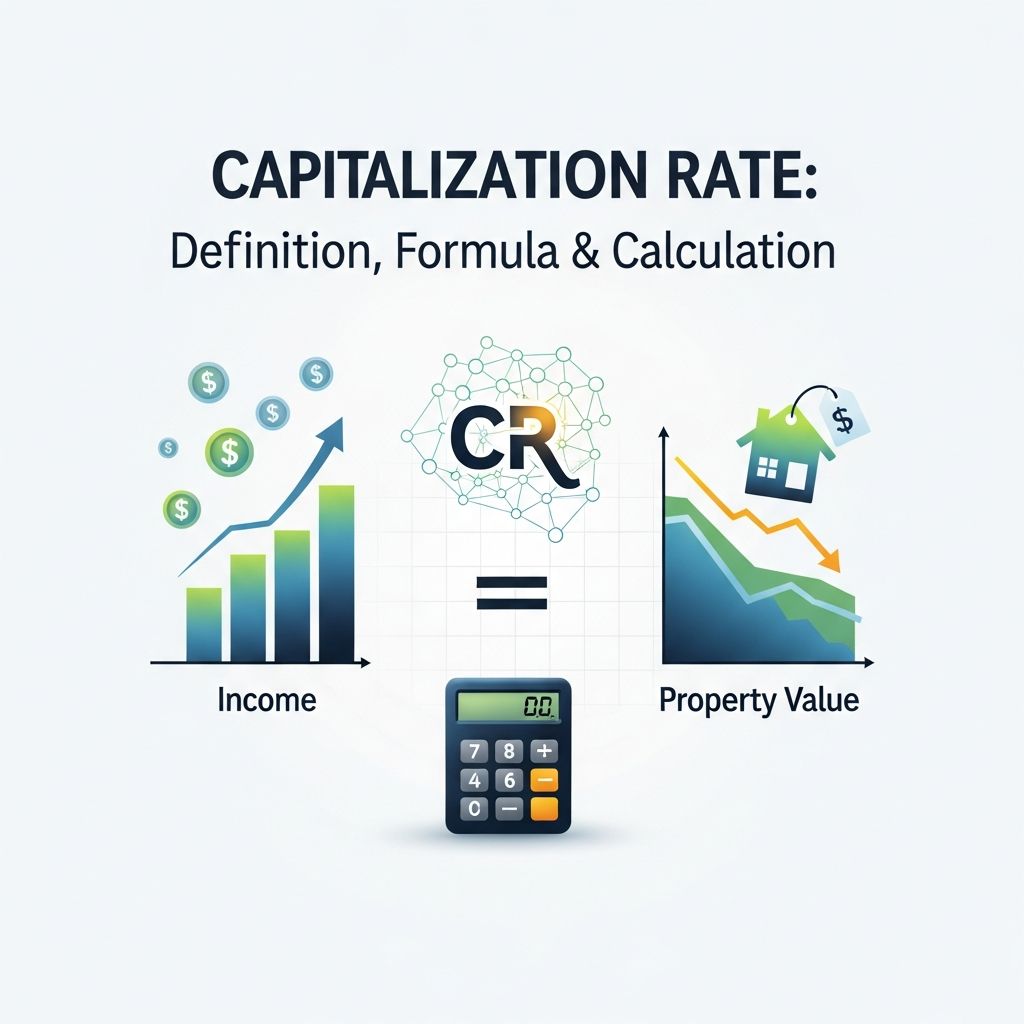
Capitalization Rate = Annual Net Operating Income ÷ Current Market Value
This formula produces a decimal figure that is then converted to a percentage. For example, if a property generates $25,000 in annual net operating income and has a current market value of $500,000, the cap rate would be calculated as follows: $25,000 ÷ $500,000 = 0.05, or 5%.
It is important to note that the formula uses current market value, not the original purchase price. This distinction is crucial because it reflects the true opportunity cost of keeping capital invested in the property. If an investor purchased a building twenty years ago for $200,000 but it is now worth $400,000 in the current market, the appropriate cap rate calculation uses the $400,000 figure, not the original $200,000 investment.
Net Operating Income (NOI) Defined
The numerator in the cap rate formula is the net operating income, which represents the property’s profitability before accounting for financing costs and taxes. NOI is calculated by subtracting all operating expenses from the gross rental income:
NOI = Gross Rental Income – Operating Expenses
Operating expenses typically include property management fees, maintenance costs, property taxes, insurance, utilities, and other recurring expenses necessary to operate the property. Importantly, NOI excludes mortgage interest, depreciation, and income taxes, as these are financing and tax considerations rather than operational expenses. This standardization allows investors to compare properties fairly regardless of their financing structure or tax situations.
How to Calculate Capitalization Rate: Step-by-Step
Calculating a cap rate involves gathering specific financial data about the property and performing a simple mathematical operation. Here is the process:
Step 1: Determine Gross Rental Income
Identify all potential rental income the property can generate annually. This includes lease payments from tenants, parking fees, storage unit rentals, or any other revenue streams directly related to the property.
Step 2: Calculate Operating Expenses
List all expenses required to operate and maintain the property. These include property management, insurance, maintenance, property taxes, HOA fees, and utilities. Do not include financing costs like mortgage payments or capital expenditures.
Step 3: Compute Net Operating Income
Subtract total operating expenses from gross rental income to determine the NOI. This figure represents the actual cash flow available to the property owner after all operational costs.
Step 4: Establish Current Market Value
Determine the property’s current fair market value. This can be established through professional appraisals, comparable sales analysis, or current listing prices for similar properties in the area.
Step 5: Apply the Formula
Divide the NOI by the current market value and multiply by 100 to convert to a percentage. This percentage is your cap rate.
Practical Example of Cap Rate Calculation
Consider an apartment building with the following financial characteristics:
– Annual gross rental income: $150,000
– Annual operating expenses: $45,000
– Net operating income: $105,000
– Current market value: $1,500,000
Using the cap rate formula: $105,000 ÷ $1,500,000 = 0.07, or 7%
This 7% cap rate indicates that the property returns 7% of its market value in annual net operating income. An investor interpreting this figure would understand that at the current market value and income level, the property would theoretically pay for itself in approximately 14 years (100% ÷ 7%).
Using Cap Rates for Property Valuation
Beyond comparing investment opportunities, cap rates serve as a powerful valuation tool. By rearranging the cap rate formula, investors and appraisers can estimate a property’s value based on its income generation and market cap rates:
Property Value = Net Operating Income ÷ Cap Rate
This approach is particularly useful when evaluating properties for purchase or determining asking prices for sale. For instance, if an investment property generates $80,000 in annual NOI and comparable properties in the market are trading at 8% cap rates, the estimated property value would be: $80,000 ÷ 0.08 = $1,000,000.
This valuation method relies on identifying comparable properties that have recently sold and determining their cap rates. By averaging the cap rates of similar properties, investors establish a market cap rate that can be applied to the subject property’s income to derive its value.
Interpreting Cap Rates: What Do Different Rates Mean?
Higher Cap Rates
A higher cap rate (for example, 10% versus 5%) generally indicates a greater annual return on the investment. However, higher cap rates often correlate with higher risk. Properties with higher cap rates are frequently located in less desirable areas, have aging structures requiring significant maintenance, or face uncertainty regarding tenant stability and income growth.
Lower Cap Rates
Lower cap rates typically indicate lower risk but also lower returns. Prime real estate locations, newly constructed buildings, and properties with stable, long-term tenancies generally exhibit lower cap rates. While the annual return is smaller as a percentage, the reduced risk and potential for property appreciation may justify the investment.
Market Context
Cap rates must be interpreted within their market context. A 5% cap rate for a property in a thriving metropolitan area might represent an excellent opportunity, while the same rate in a declining rural market might be concerning. Economic conditions, interest rates, local demand, and market sentiment all influence prevailing cap rates in different regions and property types.
Cap Rate Applications in Real Estate Investment
Comparing Investment Opportunities
The primary use of cap rates is comparing multiple properties to identify which offers the best return relative to risk. By calculating cap rates for several potential investments, an investor can rank them objectively and identify which aligns best with their financial goals and risk tolerance.
Determining Purchase Price
Cap rates help investors establish reasonable purchase offers. If market conditions suggest a 7% cap rate is appropriate for a property type and location, and the property generates $70,000 in NOI, an investor might justify an offer around $1,000,000.
Identifying Value-Add Opportunities
By analyzing the relationship between actual rents charged and market rents, investors can identify properties where rents are below market rates. Increasing rents to market levels would increase NOI without changing the purchase price, thereby improving the cap rate and the investment’s attractiveness. Similarly, reducing operating expenses improves NOI and the cap rate.
Assessing Investment Performance
Tracking how a property’s cap rate changes over time helps investors assess whether their investment is performing as expected. If market values increase faster than NOI, the cap rate declines, which may indicate the property is becoming overvalued.
Limitations and Considerations for Cap Rate Analysis
While cap rates are valuable tools, they have important limitations that investors must understand:
Ignores Capital Appreciation
The cap rate formula only considers current cash flow and does not account for potential property appreciation or depreciation. A property with a 4% cap rate but expected 3% annual appreciation delivers a true 7% total return. Conversely, a property with an 8% cap rate in a declining market may produce poor overall returns when depreciation is considered.
Excludes Financing Impact
Cap rates do not reflect the impact of leverage or debt financing. Two investors purchasing identical properties at the same cap rate will achieve different cash-on-cash returns depending on how much debt they use and the debt’s interest rate.
One-Year Snapshot
Cap rates represent annual income relative to current value and do not project future income growth or market changes. A property’s cap rate next year may differ significantly based on rent increases, expense reductions, or value changes.
Dependent on Accurate Data
Cap rate calculations are only as reliable as the financial data used. Overestimated NOI or understated market value produces misleadingly high cap rates that could lead to poor investment decisions.
Cap Rates Versus Other Real Estate Metrics
Sophisticated investors use cap rates alongside other metrics for comprehensive property analysis. The gross rent multiplier compares property price to annual gross rental income without accounting for expenses. Cash-on-cash return measures the actual cash profit relative to cash invested, incorporating financing terms. The debt service coverage ratio assesses the property’s ability to cover debt obligations from generated income. While cap rates provide a quick standardized comparison, combining them with these additional metrics produces a more complete investment picture.
Market Cap Rates and Economic Conditions
Prevailing market cap rates fluctuate based on broader economic conditions and real estate market dynamics. When interest rates rise, investors demand higher cap rates to compensate for increased borrowing costs. When capital is abundant and competition for properties increases, cap rates compress (decline) as investors accept lower returns for perceived stability. Understanding current market cap rates for your property type and region is essential for making competitive offers and pricing properties for sale.
Frequently Asked Questions About Capitalization Rates
Q: What is a good capitalization rate for real estate investment?
A: There is no universally “good” cap rate as it depends on risk tolerance, location, and market conditions. Generally, cap rates between 5% and 10% are common for stabilized properties, with higher-risk or lower-quality properties commanding higher rates. Your target cap rate should reflect your required return and risk profile.
Q: Why should I use current market value instead of my original purchase price?
A: Current market value reflects the true opportunity cost of your capital. If you sold the property today at market value and invested the proceeds elsewhere, that opportunity cost should determine your required return, not your historical purchase price.
Q: Can I use projected future NOI in cap rate calculations?
A: While some investors use projected NOI, using actual or normalized current NOI is more conservative and reliable. Projections introduce assumptions and uncertainty into the analysis. You can separately analyze potential rent growth impacts.
Q: How do cap rates affect property financing?
A: Cap rates directly influence lending decisions and terms. Properties with lower cap rates may qualify for better financing terms because they represent lower risk to lenders. Cap rates also help lenders establish appropriate loan amounts relative to a property’s income-generating capacity.
Q: What is the relationship between cap rates and property appreciation?
A: Cap rates and appreciation are generally inverse. Lower-cap-rate properties (typically in prime locations) often appreciate faster. Higher-cap-rate properties may appreciate more slowly or even depreciate. Your total return combines the cap rate (current income) plus or minus appreciation/depreciation.
References
- Capitalization Rate — Wikipedia. Accessed November 29, 2025. https://en.wikipedia.org/wiki/Capitalization_rate
- Capitalization Rate – Definition, Formula, Investing Guide — Corporate Finance Institute. Accessed November 29, 2025. https://corporatefinanceinstitute.com/resources/valuation/capitalization-cap-rate/
- Cap Rates, Explained — JPMorgan Chase. Accessed November 29, 2025. https://www.jpmorgan.com/insights/real-estate/commercial-term-lending/cap-rates-explained
Similar Articles








Read full bio of Sneha Tete