Capitalization: Understanding Financial and Accounting Concepts
Master capitalization in finance: from market cap to accounting principles explained.
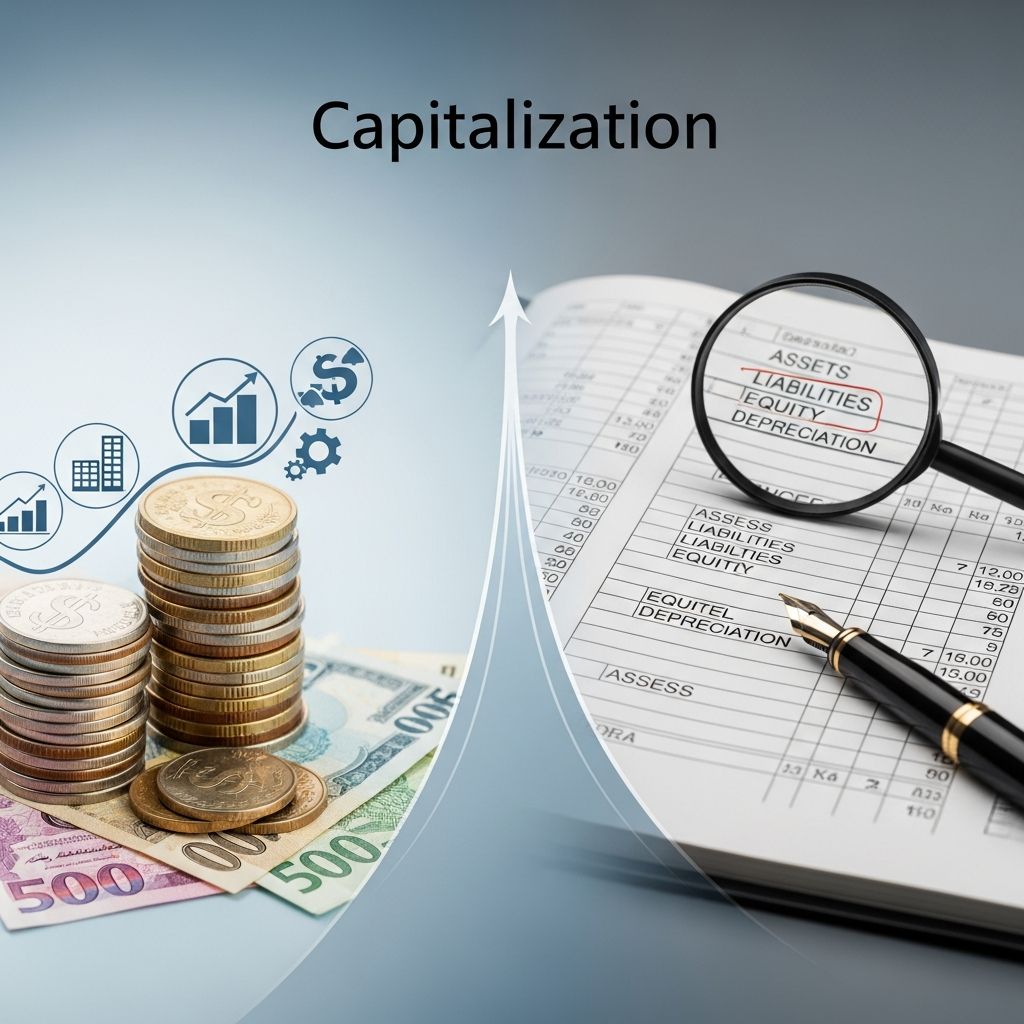
Capitalization is a fundamental concept in finance and accounting that refers to the process of recording a cost as an asset rather than an expense. The term has multiple applications in the financial world, each with distinct implications for financial reporting, valuation, and business operations. Understanding capitalization is essential for investors, business owners, accountants, and financial professionals seeking to interpret financial statements accurately and make informed investment decisions.
What Is Capitalization?
In its broadest sense, capitalization refers to the treatment of costs in accounting and financial contexts. When a company capitalizes an expense, it records that expense as an asset on the balance sheet rather than as an immediate expense on the income statement. This approach is fundamentally different from expensing, where costs are immediately deducted from revenues to calculate net income.
The distinction between capitalizing and expensing has significant implications for financial reporting. A capitalized cost appears as an asset and is gradually recognized as an expense through depreciation or amortization over its useful life. This method aligns the cost with the periods in which the asset generates revenue, following the matching principle of accounting.
Types of Capitalization
Capitalization manifests in several important forms within the financial landscape:
Market Capitalization
Market capitalization, commonly referred to as market cap, is perhaps the most widely recognized use of the term. It represents the total market value of a company’s outstanding shares of stock. Calculated by multiplying the current share price by the total number of outstanding shares, market capitalization provides investors with a snapshot of a company’s size and value as perceived by the market.
Market cap is categorized into three general tiers:
- Large-Cap: Companies with market capitalizations typically exceeding $10 billion. These are established, well-known companies with stable businesses and investor recognition.
- Mid-Cap: Companies with market capitalizations between $2 billion and $10 billion. These firms offer a balance between growth potential and relative stability.
- Small-Cap: Companies with market capitalizations below $2 billion. These organizations often represent higher-growth opportunities but come with greater volatility and risk.
Market capitalization serves multiple purposes in investing and financial analysis. It helps classify companies, guides portfolio diversification decisions, and influences inclusion in various stock indices. However, market cap reflects market perception rather than intrinsic value, so it should be considered alongside other financial metrics.
Asset Capitalization
Asset capitalization involves recording significant purchases as assets rather than expenses. When a company acquires an asset expected to provide benefits over multiple years—such as equipment, buildings, or technology systems—the cost is capitalized. This capitalized amount is then systematically expensed through depreciation or amortization over the asset’s useful life.
The decision to capitalize versus expense a cost depends on several factors, including the asset’s expected useful life, cost threshold, and the nature of the expenditure. Generally, costs that benefit multiple periods are capitalized, while costs that benefit only the current period are expensed immediately.
Capital Structure
Capital structure refers to the composition of a company’s financing, including debt and equity. This form of capitalization is critical to corporate finance, as it affects financial leverage, cost of capital, and overall financial risk. Companies must balance debt and equity financing to optimize returns while managing financial obligations.
Accounting Treatment of Capitalized Costs
The accounting treatment of capitalized costs follows specific principles and guidelines established by accounting standards such as Generally Accepted Accounting Principles (GAAP) and International Financial Reporting Standards (IFRS).
Recognition Criteria
For a cost to be capitalized, it must generally meet these criteria:
- The expenditure is expected to provide economic benefits beyond the current accounting period
- The cost can be reliably measured
- The cost meets any specific asset recognition thresholds established by the company
- The asset is controlled by the company
- Future economic benefits are probable
Depreciation and Amortization
Once an asset is capitalized, its cost is systematically recognized as an expense through depreciation (for tangible assets) or amortization (for intangible assets) over the asset’s estimated useful life. This process ensures that costs are matched with the periods in which the assets generate revenue, adhering to the matching principle of accounting.
The depreciation method selected—straight-line, declining balance, or units of production—affects the timing and amount of expense recognition. Different methods produce different expense patterns and financial statement presentations.
Capitalization vs. Expensing
Understanding the distinction between capitalization and expensing is crucial for financial analysis and interpretation:
| Aspect | Capitalization | Expensing |
|---|---|---|
| Timing | Cost recognized over multiple periods | Cost recognized immediately |
| Balance Sheet Impact | Appears as an asset | Does not appear as an asset |
| Income Statement Impact | Partial recognition through depreciation/amortization | Full impact on current period net income |
| When Used | Long-term benefits expected | Current period benefits only |
| Example | Purchasing equipment, building | Office supplies, monthly utilities |
The choice between capitalization and expensing significantly affects financial statements. Capitalizing costs increases reported assets and net income in the short term, while expensing reduces current period net income but improves cash flow presentation. This decision is subject to accounting standards and internal company policies.
Capitalization Threshold
Most companies establish a capitalization threshold—a minimum dollar amount above which expenditures are capitalized. Expenditures below this threshold are typically expensed immediately. Thresholds vary by company and industry, ranging from $500 to $5,000 or more.
This threshold approach is practical for several reasons. It simplifies accounting procedures by avoiding the administrative burden of tracking and depreciating numerous small items. It maintains consistency in financial reporting and aligns with materiality concepts in accounting. Companies must disclose their capitalization policies in financial statement notes for transparency and comparability.
Examples of Capitalized Costs
Common examples of costs that are typically capitalized include:
- Purchase of manufacturing equipment or machinery
- Construction or acquisition of buildings and facilities
- Development of software systems for internal use
- Vehicle purchases for business operations
- Technology infrastructure and network equipment
- Capitalized interest on debt incurred during asset construction
- Acquisition of patents or intellectual property
- Leasehold improvements that extend asset useful life
Impact on Financial Analysis
Capitalization decisions significantly influence financial ratios and analytical metrics used by investors and creditors. Companies that capitalize more costs report higher assets and potentially higher net income in early periods compared to companies that expense costs immediately. This can distort comparisons between companies with different capitalization policies or between periods within a single company.
Analysts must adjust for capitalization differences when comparing companies. Understanding a company’s capitalization policies and estimates of useful lives helps investors assess financial performance more accurately and identify potential red flags in financial reporting.
Regulatory Considerations
Capitalization decisions are governed by accounting standards established by regulatory bodies. Public companies in the United States follow GAAP as established by the Financial Accounting Standards Board (FASB). International companies may follow IFRS as established by the International Accounting Standards Board (IASB). These standards provide specific guidance on when and how to capitalize costs.
Additionally, tax regulations may differ from accounting standards regarding capitalization. The Internal Revenue Service (IRS) maintains specific rules for capitalizing versus expensing costs for tax purposes, which may differ from GAAP treatment. Companies must understand both accounting and tax implications when making capitalization decisions.
Frequently Asked Questions
Q: What is the difference between capitalization and expensing?
A: Capitalization records a cost as an asset on the balance sheet, recognized over multiple periods through depreciation or amortization. Expensing records the entire cost immediately on the income statement as an expense in the current period. Capitalization applies to long-term assets, while expensing applies to costs benefiting only the current period.
Q: How does market capitalization affect investment decisions?
A: Market capitalization indicates company size and risk profile. Large-cap stocks typically offer stability but slower growth, mid-cap stocks provide balance, and small-cap stocks offer growth potential with higher volatility. Investors use market cap to diversify portfolios appropriately and identify investment opportunities aligned with their risk tolerance.
Q: What is a typical capitalization threshold?
A: Capitalization thresholds vary by company and industry, typically ranging from $500 to $5,000. Costs exceeding this threshold are capitalized as assets, while costs below are expensed immediately. Companies disclose their specific thresholds in financial statement notes.
Q: How do depreciation and amortization work with capitalized costs?
A: After capitalization, asset costs are systematically expensed through depreciation (tangible assets) or amortization (intangible assets) over the asset’s useful life. This matches the cost with revenue-generating periods, following accounting principles and providing a more accurate representation of profitability.
Q: Can capitalization decisions vary between companies?
A: Yes, within accounting standards, companies establish their own capitalization policies including thresholds, useful life estimates, and depreciation methods. These policies are disclosed in financial statements, allowing investors to understand company-specific practices and make appropriate analytical adjustments when comparing companies.
Q: What are the implications of improper capitalization?
A: Improper capitalization can misstate financial statements significantly. Capitalizing costs that should be expensed inflates assets and overstates profitability, potentially misleading investors. The SEC and accounting authorities actively monitor capitalization practices to ensure compliance with standards and detect financial statement manipulation.
References
- Accounting Standards Codification (ASC) Topic 360: Property, Plant, and Equipment — Financial Accounting Standards Board (FASB). 2024. https://www.fasb.org/
- International Accounting Standard (IAS) 16: Property, Plant and Equipment — International Accounting Standards Board (IASB). 2024. https://www.ifrs.org/
- SEC Manual of Publicly Available Telephone Interpretations (MOPAIT): Capitalization — U.S. Securities and Exchange Commission. 2023. https://www.sec.gov/
- Market Capitalization Definitions and Ranges — MSCI Inc. 2024. https://www.msci.com/
- Capital Assets and Depreciation Handbook — U.S. Government Accountability Office (GAO). 2023. https://www.gao.gov/
Similar Articles








Read full bio of Sneha Tete