Capitalism vs Free Market: Key Differences Explained
Understanding the crucial distinctions between capitalism and free market economics.
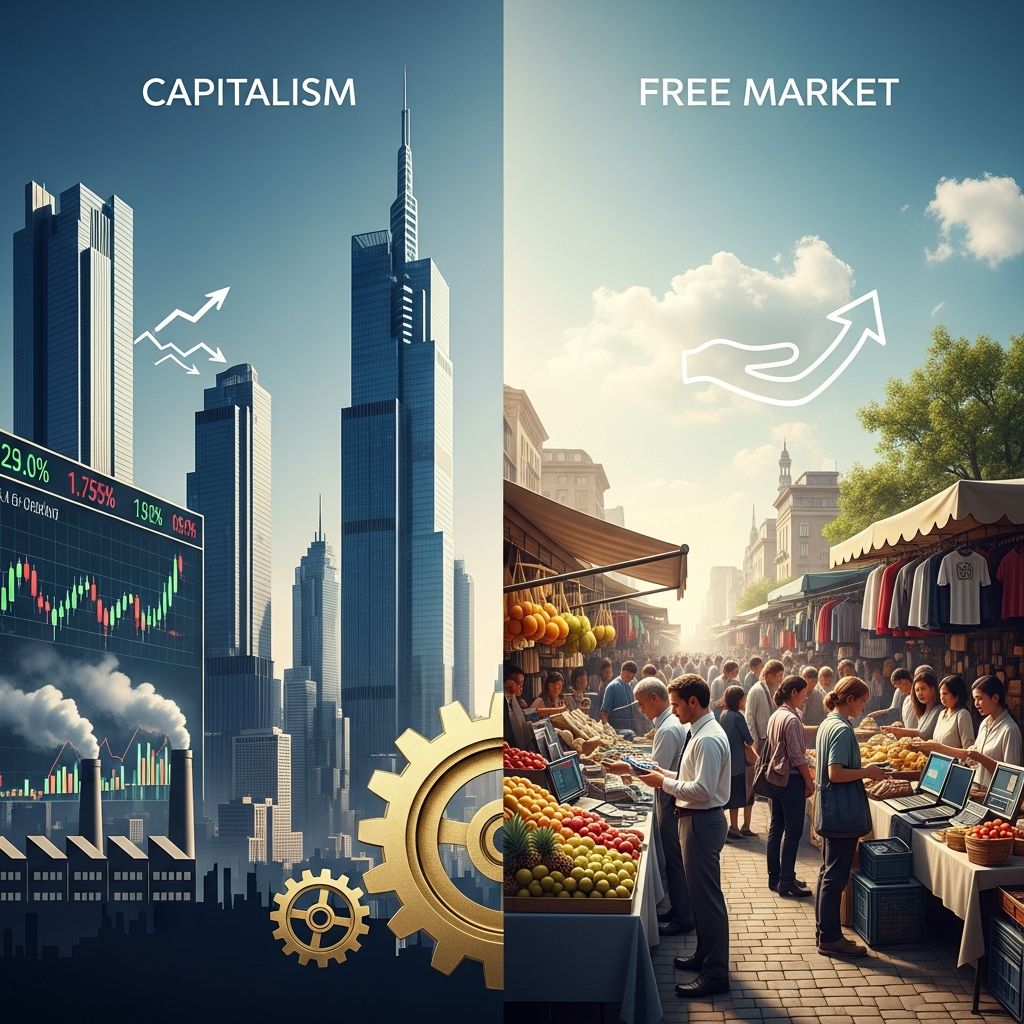
Capitalism vs Free Market: Understanding the Fundamental Differences
In discussions about economic systems, the terms “capitalism” and “free market” are often used interchangeably, yet they represent distinct concepts with important differences. Understanding these distinctions is crucial for grasping how modern economies function and the various forces that shape them. While both systems emphasize private ownership and market-based allocation of resources, capitalism and free markets operate on different principles and have different implications for economic organization and outcomes.
What Is Capitalism?
Capitalism is an economic and political system in which a country’s trade and industry are controlled by private owners for profit, rather than by the state. In a capitalist system, individuals and corporations own the means of production—factories, land, equipment, and capital—and use these assets to generate wealth and returns on investment.
The fundamental characteristic of capitalism is the pursuit of profit. Capital owners invest money into production processes with the explicit goal of earning more money than they invested. This creates what economists call the “M-C-M’ model,” where an investor starts with money (M), invests it in commodities or production (C), and seeks to end up with more money (M’) than they started with. The prime symbol on the final M is crucial because it represents the profit motive—the drive to accumulate capital and wealth.
In capitalism, the means of production are privately owned, and individuals have the right to use their capital as they see fit. Property rights are protected, contracts are enforced, and people are free to engage in voluntary economic transactions. The system inherently encourages innovation, efficiency, and the accumulation of wealth, as individuals and companies strive to maximize profits and outcompete their rivals.
What Is a Free Market?
A free market is an economic system in which prices for goods and services are determined by open market forces—specifically, the laws of supply and demand—without government intervention. In a purely free market, consumers and producers interact directly, exchanging goods and services based on mutual agreement and voluntary exchange.
The free market operates on the principle that individual self-interest, guided by market signals (prices), leads to efficient resource allocation. When demand for a product increases, its price rises, signaling producers to increase supply. Conversely, when demand falls, prices drop, and producers reduce supply. This price mechanism coordinates economic activity without requiring central planning or government direction.
A true free market is characterized by the absence of government intervention. There are no price controls, no subsidies, no tariffs, and no regulations that distort the natural operation of supply and demand. Competition is fierce and unregulated, allowing the most efficient and innovative producers to thrive while inefficient ones fail.
Key Differences Between Capitalism and Free Markets
Ownership and Control
While both systems emphasize private ownership, capitalism focuses on the concentration of capital in the hands of owners who control the means of production. A free market, by contrast, emphasizes the distribution of economic power across many participants—producers, consumers, and workers—who all have agency in making economic decisions. In a pure free market, no single entity has disproportionate control over prices or production decisions.
Government Intervention
Capitalism, as practiced in real-world economies, often involves significant government intervention to protect property rights, enforce contracts, and maintain order. Governments may also intervene to support capitalist interests through subsidies, bailouts, tax breaks, and favorable regulations. A free market, by definition, minimizes or eliminates government intervention entirely. The government’s role in a free market is limited to enforcing property rights and contracts, but not to manipulating prices, controlling production, or favoring particular businesses.
Profit Motive vs. Exchange
The driving force in capitalism is profit accumulation. Capitalists use their existing wealth to invest in production, extract value, and increase their capital. This creates an incentive for continuous growth and capital accumulation, which can lead to wealth concentration. In a free market operating under simple exchange (what economists call the “C-M-C model”), people produce goods they need or want, exchange them for money, and use that money to purchase other goods. The goal is not profit accumulation but rather the satisfaction of needs and wants through voluntary exchange.
Wealth Concentration
Capitalism’s profit motive inherently leads to wealth concentration. As capital accumulates in the hands of successful investors and large corporations, these entities gain increasing economic and political power. This concentrated wealth can be used to influence government policies, create barriers to competition, and establish monopolies. A truly free market, in theory, prevents such concentration because success depends on meeting consumer needs efficiently, not on accumulating existing capital. New competitors can enter markets and challenge established players based on superior products or services.
Competition and Monopolies
Free markets rely on vigorous competition to allocate resources efficiently and keep prices reasonable. In a free market, no single producer can dominate prices because consumers have the freedom to choose alternatives. Capitalism, however, does not necessarily prevent monopolies. Large corporations with substantial capital can use their resources to buy out competitors, lobby for favorable regulations, or create barriers to entry that prevent new competitors from challenging their market dominance. This is sometimes called “crony capitalism,” where wealthy interests work with government to maintain their advantages.
Capitalism in Practice: The Reality of Modern Economies
No modern economy operates as a pure free market or pure capitalism. Instead, most developed economies are mixed systems that incorporate elements of both, along with varying degrees of government regulation and intervention.
The United States is often cited as the world’s leading capitalist economy, yet it is not a pure free market. The government heavily regulates financial institutions through laws like the Dodd-Frank Act, subsidizes agriculture and energy production, provides bailouts to large corporations during crises, and uses tariffs and trade policies to protect domestic industries. Large corporations wield significant political influence, and government contracts and regulatory decisions often favor established players over newcomers.
In such systems, wealthy capitalists and large corporations often have outsized influence over government policy. This creates what some observers call a “revolving door” phenomenon, where politicians move into lucrative positions on corporate boards after leaving office, creating incentives to favor corporate interests while in government. Government intervention that benefits large corporations—through subsidies, favorable regulations, or contracts—is common, while the same interventions are rarely available to small businesses or ordinary citizens.
The Libertarian Perspective
Libertarians argue that there are two distinct forms of capitalism: free-market capitalism and crony capitalism. Free-market capitalism, they contend, allows businesses to trade freely with minimal state interference, which leads to natural equilibrium where monopolies, inequality, and injustice cannot persist because markets will self-correct. According to this view, with genuine free-market capitalism, democracy thrives because power is distributed widely rather than concentrated in government.
Crony capitalism, in the libertarian framework, occurs when wealthy individuals corrupt the political system and forge alliances between the state and large corporations. The government then uses its power to support these connected businesses through subsidies, favorable contracts, protective tariffs, and regulations designed to exclude competitors. Libertarians argue that shrinking the state and removing government intervention would eliminate crony capitalism and allow true free-market capitalism to flourish.
The Alternative Perspective
Critics counter that the libertarian distinction between free-market capitalism and crony capitalism misses a fundamental point: concentrated wealth will inevitably lead to concentrated political power. Even without formal government intervention, those with substantial capital can create institutions and structures that function like governments—establishing rules, enforcing standards, and using coercion to protect their interests. International institutions like the World Trade Organization and International Monetary Fund exemplify this, creating a framework that benefits capital-owning interests while constraining the choices available to workers and smaller producers.
Furthermore, the process of capital accumulation itself—the core mechanism of capitalism—tends to concentrate wealth in fewer hands over time. Once wealth becomes concentrated, those who possess it can use it to manipulate markets, influence regulations, and prevent genuine competition. From this perspective, capitalism inevitably tends toward crony capitalism, not as a corruption of the system but as its natural outcome.
Growth Imperatives and Sustainability
Another crucial difference between capitalism and free markets relates to growth. Capitalism’s profit motive creates an inherent growth imperative. To generate returns on investment, capitalists must continually expand production, find new markets, and increase consumption. This perpetual growth requirement can conflict with environmental sustainability and resource conservation.
A free market based on simple exchange (C-M-C) has no such growth imperative. People can produce and exchange what they need without continuously seeking to expand production and consumption. This distinction has significant implications for ecological sustainability and long-term resource management. While free markets can theoretically operate at stable levels of production and consumption, capitalism requires continuous growth to satisfy investor returns.
Innovation and Incentives
Capitalism’s profit motive does create strong incentives for innovation. Capitalists have reason to develop better products, more efficient production processes, and new technologies—because these innovations can generate higher profits and competitive advantages. Someone operating in a capitalist M-C-M’ framework has strong incentive to build a better mousetrap and sell it at a premium price.
However, free markets also reward innovation. In a competitive free market, producers who develop superior products can attract customers and increase their exchange value. The difference is that in pure free markets, innovation serves the goal of meeting needs and wants, while in capitalism, innovation primarily serves profit maximization. These can align, but they can also diverge—capitalists may suppress innovations that threaten their market position, or they may pursue innovations that increase profits but don’t necessarily benefit consumers or society.
Frequently Asked Questions
Q: Can capitalism exist without free markets?
A: Yes. Capitalism can exist with significant government intervention. In fact, most modern capitalist economies include substantial regulation, subsidies, and other government policies that distort free market operations. This mixed approach combines capitalist ownership structures with managed markets.
Q: Can free markets exist without capitalism?
A: Theoretically yes. Cooperatives, small-scale producers, and non-profit enterprises can operate in free markets. However, pure free markets with no capital accumulation motive are rare in modern economies and exist mainly in theory or in small-scale, localized contexts.
Q: Why do capitalists oppose free markets?
A: Large capital owners often prefer government intervention when it benefits them—through subsidies, contracts, tariffs, or regulations that exclude competitors. Free markets expose them to competition and prevent them from using government power to maintain advantages. Crony capitalism allows capital owners to have both private profit AND government protection.
Q: What economic system is best?
A: This depends on societal values and goals. Pure free markets promote efficiency and decentralized decision-making but may not address equity concerns. Capitalism drives innovation and investment but can concentrate wealth and power. Most successful modern economies use mixed approaches, balancing market mechanisms with regulation to address market failures and equity concerns.
Q: How does money creation affect capitalism vs free markets?
A: Modern money systems, where money is created as debt at interest by banks, create a locking mechanism that reinforces capitalist M-C-M’ dynamics. This increases pressure for perpetual growth and capital accumulation, making it nearly impossible to escape capitalist imperatives even if free market principles are theoretically present.
References
- What’s the difference between capitalism and a free market? — Low Impact. https://www.lowimpact.org/posts/capitalism-free-market/
- Capitalism vs Free Market — Economic Education Video. https://www.youtube.com/watch?v=MkbbDo0ZkOc
- Free Market Economy and Capitalism — Semantic Scholar Academic Database. https://pdfs.semanticscholar.org/386f/041ede79a4a7c44acf49406d96bbca2e2962.pdf
- How is a Capitalist System Different Than a Free Market System? — TGJU Financial Markets Education. https://help.english.tgju.org/financial-markets/how-is-a-capitalist-system-different-than-a-free-market-system/
- Capitalism Is Not the Market System — Truthout. https://truthout.org/articles/capitalism-is-not-the-market-system/
Similar Articles








Read full bio of Sneha Tete