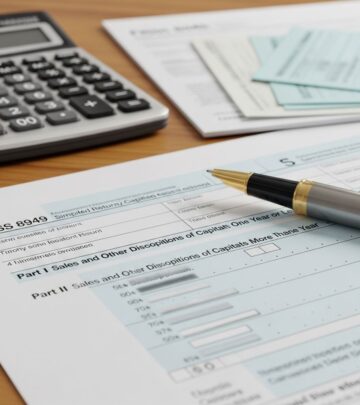
Capital Gains Worksheet: Calculate Your Tax Liability
Master capital gains calculations with our comprehensive worksheet guide for investors and homeowners.

Understanding Capital Gains Worksheets and Tax Calculations
When you sell an investment or property at a profit, you may owe capital gains tax on that profit. A capital gains worksheet helps you systematically calculate the exact amount of tax you owe by organizing all relevant information about your transaction. Whether you’re selling stocks, bonds, real estate, or other investment property, understanding how to complete a capital gains worksheet is essential for accurate tax filing and effective tax planning.
The capital gains worksheet serves as a crucial tool for investors and homeowners alike. It simplifies what might otherwise be a complex calculation by breaking down the process into manageable steps. By completing this worksheet accurately, you ensure that you report the correct amount of capital gains to the IRS and avoid potential audit issues or overpayment of taxes.
What Is a Capital Gain?
A capital gain is the profit you make when you sell an asset for more than you paid for it. The difference between your purchase price and your selling price represents your capital gain. However, the calculation isn’t quite that simple—you must account for various costs associated with both the purchase and sale of the asset.
Capital gains can be categorized into two types: short-term and long-term. Short-term capital gains occur when you hold an asset for one year or less before selling it. Long-term capital gains result from selling assets you’ve held for more than one year. The distinction between these two types is crucial because they receive different tax treatment. Long-term capital gains typically enjoy preferential tax rates ranging from 0% to 20%, while short-term capital gains are taxed at your ordinary income tax rates, which can be as high as 37%.
The Four-Step Process for Calculating Capital Gains
The capital gains worksheet breaks down the calculation into four essential steps that build upon one another:
Step 1: Determine Your Basis
Your basis is the foundation of your capital gains calculation. It represents the total amount you invested in the asset. Your basis typically includes your purchase price plus any commissions or fees you paid when buying the asset. For real estate, your basis also includes closing costs such as attorney fees, transfer taxes, and inspection fees. Additionally, if you reinvested dividends from stocks into the same security, those reinvested amounts increase your basis. If you’ve made capital improvements to real property, such as adding a room or installing a new roof, the cost of these improvements also increases your basis. Repairs and maintenance, however, do not increase your basis—only improvements that add value to the property qualify.
Step 2: Determine Your Net Proceeds
Your net proceeds represent the actual amount of money you receive from the sale after accounting for selling expenses. To calculate net proceeds, take your sale price and subtract any commissions, fees, or other transaction costs you incurred. For real estate sales, this might include real estate agent commissions, title transfer costs, legal fees, inspection costs, and any repairs or improvements you made specifically to prepare the property for sale. The key distinction is that only costs directly related to the sale reduce your net proceeds—not general maintenance or repairs you’ve made to the property over time.
Step 3: Calculate the Difference
Once you’ve established your basis and net proceeds, subtract your basis from your net proceeds to determine your capital gain or loss. This straightforward mathematical step reveals whether you’ve made a profit or experienced a loss on your investment. If the result is positive, you have a capital gain that may be subject to taxation. If the result is negative, you have a capital loss that can potentially offset other gains or up to $3,000 of ordinary income in a single year, with the ability to carry forward unused losses to future years.
Step 4: Determine Your Tax Rate
The final step involves determining which tax rate applies to your capital gain. Your applicable tax rate depends on two primary factors: whether your gain is short-term or long-term, and your overall income level. Short-term capital gains are taxed at your ordinary income tax rates, which depend on your tax filing status and total taxable income. Long-term capital gains receive preferential treatment with rates of 0%, 15%, or 20%, depending on your income bracket and filing status. Taking time to understand these rates ensures you can accurately project your tax liability.
Understanding Short-Term vs. Long-Term Capital Gains
The distinction between short-term and long-term capital gains significantly impacts your tax calculation. The determining factor is how long you held the asset before selling it.
Short-Term Capital Gains
Short-term capital gains result from the sale of assets held for one year or less. These gains are taxed at your ordinary income tax rates, which range from 10% to 37% depending on your tax bracket, filing status, and total taxable income. If you’re in the 24% tax bracket and have a $10,000 short-term capital gain, you would owe approximately $2,400 in federal tax on that gain (before considering state and local taxes). This less favorable treatment means that frequent traders and short-term investors often pay significantly more in taxes compared to long-term investors holding the same investments.
Long-Term Capital Gains
Long-term capital gains result from selling assets held for more than one year (specifically, more than one year plus one day). These gains receive preferential tax treatment with rates of 0%, 15%, or 20%. A taxpayer in the 24% tax bracket who holds an investment for more than one year would pay only 15% federal tax on the long-term capital gain—6% less than the short-term rate. Using the same $10,000 example, this taxpayer would owe only $1,500 in federal tax, saving $900 compared to short-term treatment. The ability to qualify for these lower rates makes strategic holding periods an important consideration in investment planning.
Capital Gains Tax Rates for 2025
The capital gains tax rates for 2025 vary based on your filing status and total income. Understanding these brackets helps you anticipate your tax liability.
Long-Term Capital Gains Tax Brackets (2025)
| Tax Rate | Single Filers | Married Filing Jointly | Head of Household |
|---|---|---|---|
| 0% | Up to $48,350 | Up to $96,700 | Up to $64,750 |
| 15% | $48,351 to $533,400 | $96,701 to $600,050 | $64,751 to $566,700 |
| 20% | $533,401 or more | $600,051 or more | $566,701 or more |
Short-Term Capital Gains
Short-term capital gains are taxed as ordinary income using the same tax brackets that apply to wages, interest income, and other ordinary income sources. These brackets range from 10% to 37% depending on your income level and filing status.
How to Report Capital Gains on Your Tax Return
Once you’ve completed your capital gains worksheet and calculated your gain or loss, you need to report this information to the IRS using the proper tax forms. The reporting process varies depending on the number and complexity of your transactions.
Form 8949: Sales of Capital Assets
For most taxpayers, reporting begins with Form 8949 (Sales of Capital Assets). You should complete this form for each transaction that resulted in a capital gain or loss during the tax year. This form requires you to enter detailed information about each transaction, including the date acquired, date sold, proceeds from the sale, cost basis, and the resulting gain or loss. Form 8949 helps the IRS match your reported information with Forms 1099-B they receive from your broker or investment institution.
Schedule D: Capital Gains and Losses
After completing Form 8949, you transfer the information to Schedule D (Capital Gains and Losses). This form summarizes all your capital gains and losses for the tax year. Schedule D allows you to net your short-term gains and losses separately from your long-term gains and losses, then combine these two amounts to determine your overall capital gain or loss position. If you have both short-term and long-term gains, Schedule D ensures they receive appropriate tax treatment based on their holding period.
Form 1040: U.S. Individual Income Tax Return
Finally, you transfer the net capital gain or loss from Schedule D to line 7 of Form 1040 (U.S. Individual Income Tax Return). This line item combines your capital gains or losses with your other income to determine your total taxable income for the year. If you have a net capital loss, it offsets your other income, up to $3,000 per year, with the ability to carry unused losses forward to future tax years.
Special Considerations for Different Asset Types
While the basic capital gains calculation remains the same, certain asset types require special consideration when using a capital gains worksheet.
Real Estate Capital Gains
Real estate transactions involve many costs that affect your basis and net proceeds calculations. When purchasing property, include not just the purchase price but also closing costs such as attorney fees, title insurance, survey costs, and transfer taxes. When selling, subtract commissions (typically 5-6% of the sale price), title transfer costs, attorney fees, inspection costs, and any repairs or improvements you made specifically to prepare the property for sale. Additionally, if you’ve lived in the home as your primary residence for at least two of the past five years before selling, you may qualify for the primary residence exclusion, which allows you to exclude up to $250,000 of gains (or $500,000 if married filing jointly) from taxation.
Investment Securities
When calculating gains on stocks, bonds, and other securities, include brokerage commissions and fees in both your basis and net proceeds. If you received dividend reinvestment, add those reinvested amounts to your basis. If you purchased securities through multiple transactions at different prices, you must specifically identify which shares you’re selling to ensure accurate gain or loss calculation. Some investors use first-in-first-out (FIFO) accounting, while others use specific identification to potentially minimize their tax liability through strategic selection of which shares to sell.
Using the Capital Gains Worksheet to Optimize Tax Planning
Beyond simple calculation, your capital gains worksheet becomes a powerful tax planning tool. By understanding your current gains and losses, you can make strategic decisions about which positions to sell and when to sell them. If you have significant unrealized gains, you might consider harvesting losses from underperforming investments to offset these gains. If you’re close to a higher tax bracket, you might defer selling highly appreciated assets until the following year. The worksheet helps you visualize these scenarios and their tax consequences.
Frequently Asked Questions
Q: What if I have both short-term and long-term capital gains in the same year?
A: You calculate each category separately on Schedule D, then combine them. Short-term gains are taxed at your ordinary income rates, while long-term gains receive preferential treatment. Your overall tax liability reflects the appropriate taxation of each category of gains.
Q: Can I use capital losses to offset other income?
A: Yes, you can use capital losses to offset capital gains dollar-for-dollar. If your losses exceed your gains, you can deduct up to $3,000 of capital losses against ordinary income in a single year. Any unused losses carry forward to future years indefinitely.
Q: Do I need to complete a capital gains worksheet for every investment I sell?
A: While technically every sale should be calculated, many brokers report cost basis directly to the IRS on Form 1099-B. You may be able to simplify your reporting by using Form 1099-B information directly on Schedule D in certain circumstances, though most complex situations still benefit from detailed worksheet preparation.
Q: How does the holding period affect my tax rate?
A: The holding period determines whether your gain qualifies as short-term or long-term. Assets held more than one year receive long-term treatment with preferential rates of 0%, 15%, or 20%. Assets held one year or less are short-term and taxed at ordinary income rates up to 37%, making the holding period a critical tax planning consideration.
Q: What adjustments can I make to my cost basis?
A: Beyond the initial purchase price and commissions, you can adjust basis by adding reinvested dividends, capital improvements to real property, and certain other qualifying expenses. You cannot increase basis for repairs, maintenance, or general upkeep, only for improvements that add value or prolong the asset’s useful life.
References
- How to Calculate Capital Gains Tax — H&R Block. 2025. https://www.hrblock.com/tax-center/income/investments/how-to-figure-capital-gains-tax/
- 2025 and 2026 Capital Gains Tax Rates and Rules — NerdWallet. 2025. https://www.nerdwallet.com/taxes/learn/capital-gains-tax-rates
- Guide to Schedule D: Capital Gains and Losses — TurboTax by Intuit. 2025. https://turbotax.intuit.com/tax-tips/investments-and-taxes/guide-to-schedule-d-capital-gains-and-losses/
- 2024 Instructions for Schedule D – Capital Gains and Losses — Internal Revenue Service (IRS). 2024. https://www.irs.gov/pub/irs-prior/i1040sd–2024.pdf
- Worksheet: Calculate Capital Gains — National Association of Realtors. 2025. https://www.nar.realtor/magazine/tools/client-education/handouts-for-sellers/worksheet-calculate-capital-gains
Similar Articles








Read full bio of Sneha Tete