CAPE Ratio: Understanding Cyclically Adjusted Price-to-Earnings
Master the CAPE ratio: A comprehensive guide to valuing stocks and predicting long-term market returns.
What Is the CAPE Ratio?
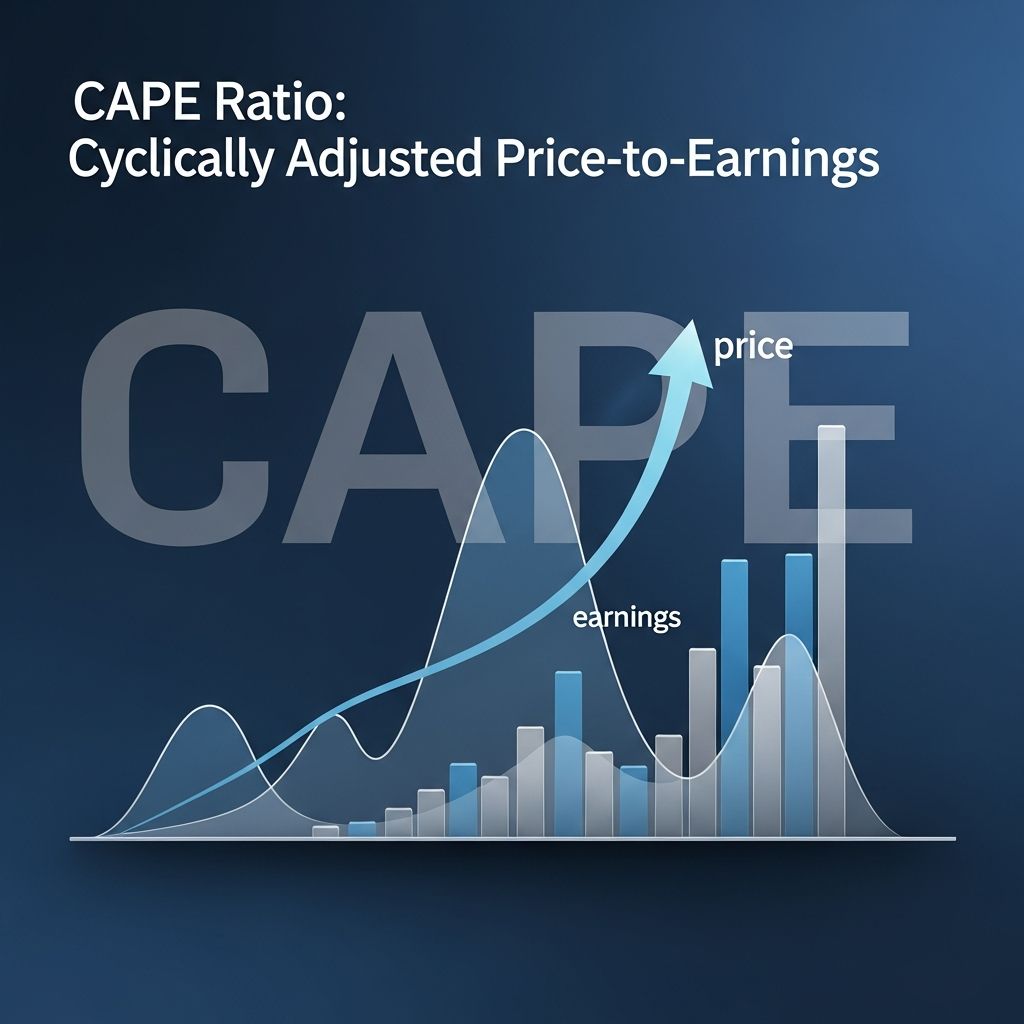
The CAPE ratio, short for Cyclically Adjusted Price-to-Earnings ratio, represents a comprehensive stock valuation metric that provides investors with a more nuanced perspective on market valuations. Also known as the Shiller P/E or P/E 10 ratio, this financial measure is calculated by dividing a company’s or market index’s stock price by the average of earnings over the previous ten years, adjusted for inflation. Unlike traditional price-to-earnings ratios that use only the most recent earnings data, the CAPE ratio smooths out the effects of business cycles and economic fluctuations, offering a clearer picture of sustainable earning power over extended periods.
The CAPE ratio was developed by Nobel Prize-winning economist Robert Shiller as an improvement upon standard valuation metrics. By incorporating a decade of historical earnings data, the CAPE ratio provides a more stable and reliable indicator for assessing whether equities are trading at reasonable valuations relative to their long-term earning capacity. This approach proves particularly valuable for investors seeking to understand market conditions over 10 to 20-year investment horizons.
Understanding How the CAPE Ratio Works
To comprehend the mechanics of the CAPE ratio, it’s essential to understand its fundamental calculation methodology. The ratio takes the current stock price or index level and divides it by the average earnings per share from the previous ten years, with those historical earnings adjusted for inflation using the Consumer Price Index. This inflation adjustment ensures that earnings comparisons remain meaningful across different time periods, as it accounts for changes in purchasing power.
The primary advantage of using a ten-year average lies in its ability to normalize earnings data across multiple business cycles. During economic expansions, corporate earnings typically rise substantially, while recessions lead to earnings contractions. By averaging earnings over a full decade, the CAPE ratio eliminates the distortions created by these cyclical swings, providing what economists refer to as a more “cyclically adjusted” view of valuations. This smoothing effect enables investors to identify whether markets are genuinely overvalued or undervalued on a normalized basis.
When the CAPE ratio is relatively low, it suggests that stock prices are modest relative to normalized earnings, potentially indicating attractive valuations and higher expected future returns. Conversely, elevated CAPE ratios indicate that prices have climbed substantially above normalized earnings levels, suggesting potential overvaluation and potentially lower future returns.
Historical Context and Significance
The historical evolution of the CAPE ratio reveals important patterns about market cycles and valuation extremes. Throughout the 20th century, the average CAPE value for the S&P 500 Index hovered around 15.21, corresponding to average annual returns of approximately 6.6 percent over the subsequent 20-year periods. This historical baseline provides a valuable reference point for evaluating whether current valuations appear elevated or depressed relative to long-term norms.
Research conducted by Campbell and Shiller utilizing market data from 1881 forward demonstrated a clear inverse relationship between CAPE levels and subsequent market returns. Lower CAPE ratios have consistently preceded periods of stronger equity performance, while elevated ratios have preceded periods of more modest returns. This relationship has proven remarkably consistent across different market cycles and geographic regions.
CAPE Ratio and Market Bubbles
One of the most compelling aspects of the CAPE ratio involves its historical performance in identifying potential market bubbles. The metric has achieved particular notability for signaling market excesses before major corrections occurred. Shiller himself documented three instances where CAPE ratios exceeded 25, a level representing substantial deviation from historical norms:
- 1929: Before the Wall Street crash that initiated the Great Depression, CAPE ratios reached historically elevated levels, signaling severe market overvaluation
- Late 1990s: The dot-com bubble witnessed CAPE ratios climb to record heights as technology stocks reached astronomical valuations unsupported by earnings fundamentals
- 2007: Prior to the financial crisis and housing collapse, CAPE ratios again reached extreme levels, presaging the severe market correction that followed
These historical occurrences highlight the CAPE ratio’s utility in identifying periods when investor enthusiasm may have outpaced fundamental value creation. However, it’s important to note that while high CAPE values have preceded major market declines, the ratio should not be interpreted as a precise market timing tool that guarantees or predicts specific crashes.
CAPE Ratio Limitations and Criticisms
Despite its significant explanatory power, the CAPE ratio faces several important critiques that investors should understand. One major criticism involves the ratio’s reliance on historical, backward-looking data. Some financial analysts argue that forward-looking metrics, such as forward P/E ratios based on consensus analyst earnings estimates, may provide superior signals for identifying valuation extremes. However, forward-looking approaches carry their own vulnerabilities, as analyst estimates can change rapidly and may not consistently reflect fundamental realities.
Accounting standard changes represent another significant limitation. Critics, including economist Jeremy Siegel, argue that modifications to Generally Accepted Accounting Principles (GAAP) implemented in the 1990s altered earnings calculations in ways that make CAPE ratios appear more pessimistic than fundamental conditions warrant. These accounting changes may understate true earnings levels, potentially creating a distorted perception of market valuations.
Additionally, the CAPE ratio has been criticized for failing to account for prevailing risk-free rates of return. Some economists argue that the inverse CAPE ratio should be adjusted by dividing it by the yield on 10-year Treasury securities, a measure representing the minimal return available from low-risk investments. This adjustment would provide greater context for interpreting whether stock valuations appear reasonable relative to alternative investment opportunities.
Research has also documented that CAPE exhibits significant variation over time and has not always accurately signaled market tops or bottoms. The metric’s explanatory power, while meaningful over extended periods, proves less reliable for shorter-term market movements or for predicting the precise timing of corrections.
CAPE for Long-Term Return Forecasting
The primary utility of the CAPE ratio lies in its demonstrated ability to forecast long-term equity returns over 10 to 20-year horizons. Campbell and Shiller’s research established a robust negative relationship between CAPE levels and subsequent returns: lower CAPE values have corresponded with higher future returns, while elevated CAPE levels have predicted more modest long-term performance.
This relationship suggests that investors facing high CAPE ratios should anticipate more modest average annual returns over extended periods, while low CAPE environments historically have preceded periods of superior equity performance. However, financial experts emphasize that this relationship should be interpreted probabilistically rather than deterministically. Rather than expecting specific return outcomes, investors should understand CAPE levels as indicating the general probability distribution of potential returns.
Recent data illustrates current valuation perspectives across global markets. As of late 2023, CAPE earnings yields stood at approximately 3.5 percent for US equities, 5.5 percent for developed non-US markets, and 7.1 percent for emerging markets. These figures provide context regarding relative valuations across different geographic regions and suggest varying expected return prospects.
International Application of CAPE
While originally developed for the US S&P 500 Index, the CAPE ratio has subsequently been calculated and analyzed for 15 other major equity markets worldwide. Research by Norbert Keimling and others has demonstrated that the fundamental relationship between CAPE levels and future returns exists consistently across diverse international markets. This finding suggests that CAPE’s predictive power extends beyond American equities, providing a valuable tool for global investors seeking to identify attractive valuations across different regions.
The expansion of CAPE analysis to international markets enables investors to compare valuations across geographic regions and potentially identify markets offering superior expected return prospects. Some investors utilize cross-border CAPE comparisons to construct globally diversified portfolios that emphasize markets trading at more attractive valuations relative to their historical norms.
Market Timing Considerations
While CAPE ratios provide valuable information regarding expected returns and market valuations, research indicates that attempting to time markets based solely on CAPE levels frequently produces disappointing results. Studies examining dynamic asset allocation strategies based on valuation metrics have found that simple strategic diversification, maintained through disciplined rebalancing, typically outperforms tactical approaches attempting to shift allocations based on current valuations.
Financial analysts emphasize that valuations should inform baseline asset allocation decisions but should not drive frequent tactical shifts. Investors should establish target allocation percentages aligned with global market capitalization weights and rebalance toward these targets periodically, rather than attempting to overweight or underweight asset classes based on current CAPE levels. This disciplined approach acknowledges that valuations provide probabilistic information about future returns while avoiding the pitfalls of active market timing.
Recent Improvements: P-CAPE
Recognizing certain limitations in the original CAPE formulation, financial researchers have developed refinements designed to enhance forecasting accuracy. The P-CAPE metric, standing for payout and cyclically-adjusted earnings, addresses CAPE’s failure to account for earnings not distributed as dividends. Rather than assuming all earnings represent available returns to shareholders, P-CAPE acknowledges that companies reinvest substantial portions of earnings within their businesses or distribute capital through stock buybacks.
This refinement reflects the reality that retained earnings, when productively deployed, support future earnings growth and should ideally be incorporated into valuation models. By accounting for this earnings reinvestment dynamic, P-CAPE aims to provide more accurate long-term earning power assessments and superior return forecasts.
Frequently Asked Questions
What is the average CAPE ratio?
The historical average CAPE ratio for the S&P 500 Index throughout the 20th century was approximately 15.21. Current CAPE levels significantly above this range suggest valuations elevated relative to historical norms, while levels substantially below 15 may indicate attractive valuations.
How does CAPE differ from the traditional P/E ratio?
The traditional P/E ratio divides current stock price by the most recent year’s earnings, making it susceptible to distortion by cyclical business fluctuations. CAPE uses a ten-year earnings average adjusted for inflation, smoothing out economic cycles and providing a more normalized valuation perspective.
Can CAPE predict market crashes?
While elevated CAPE ratios have preceded major market declines in 1929, 2000, and 2007, the metric should not be interpreted as a precise crash predictor. CAPE provides probabilistic information about valuations but does not reliably signal the timing of specific corrections.
Is CAPE useful for individual stock selection?
CAPE ratios are primarily applied to broad market indices like the S&P 500 rather than individual stocks. For individual security analysis, investors typically employ standard P/E ratios or forward P/E ratios alongside other fundamental metrics.
How should investors use CAPE in portfolio construction?
Investors should use CAPE to inform baseline asset allocation decisions and establish realistic return expectations but should avoid frequent tactical shifts based on current valuations. Maintaining disciplined, globally diversified portfolios aligned with market capitalization weights typically outperforms active timing strategies.
References
- Cyclically Adjusted Price-to-Earnings Ratio — Wikipedia. https://en.wikipedia.org/wiki/Cyclically_adjusted_price-to-earnings_ratio
- CAPE Ratio – Overview and Formula — Corporate Finance Institute. https://corporatefinanceinstitute.com/resources/valuation/cape-ratio/
- P-CAPE: A Better Way for Investors to Estimate Future Returns — Morningstar. https://www.morningstar.com/markets/improving-cape-10
Similar Articles








Read full bio of Sneha Tete