Can I Still Use Cash If It’s Torn? How To Redeem Damaged Bills
Learn what to do with damaged, torn, or mutilated U.S. currency and how to exchange it.
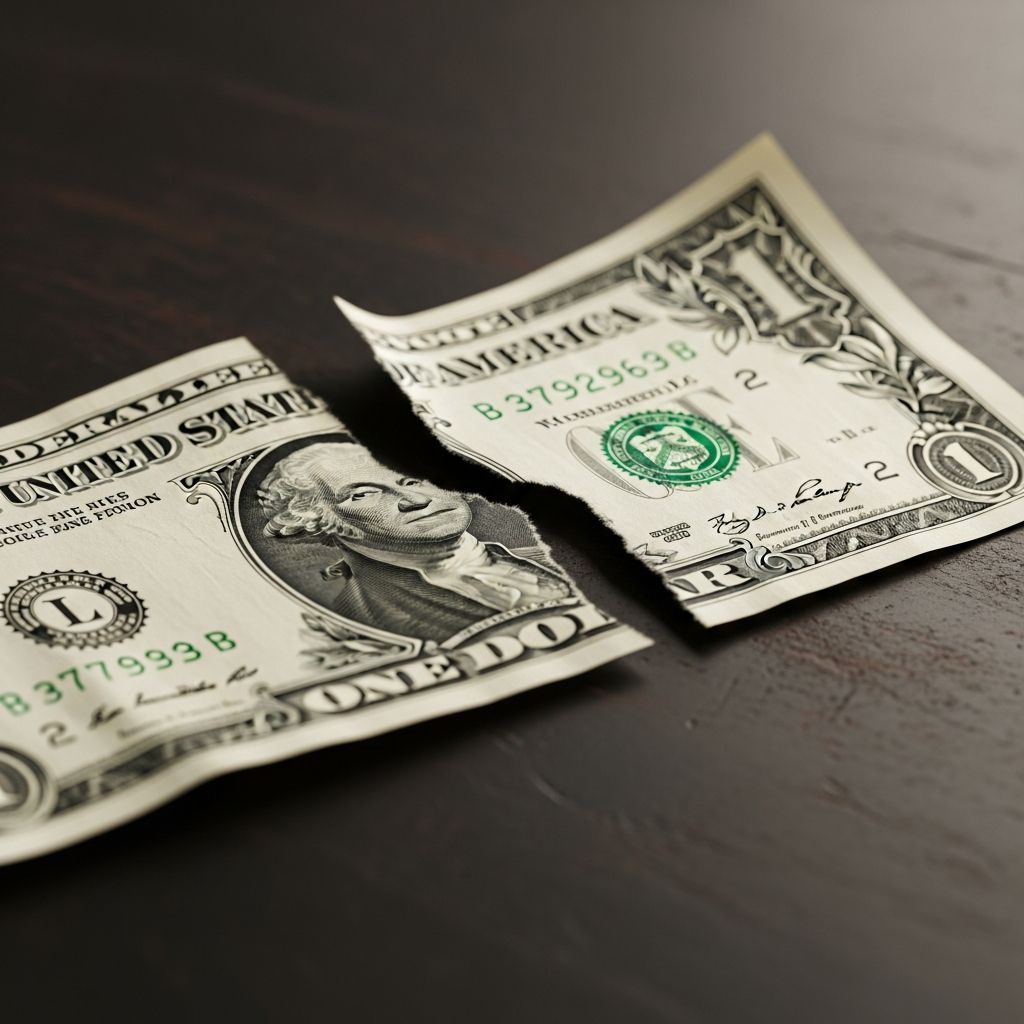
Can I Still Use Cash If It’s Torn?
Accidents happen. Maybe your dog got hold of your wallet, or your children decided to conduct a creative experiment with your bills. Whatever the cause, if your cash has suffered damage, don’t panic. The good news is that torn, bent, or otherwise damaged U.S. currency doesn’t necessarily mean your money is worthless. There are clear procedures in place to help you recover its value, whether the damage is minor or severe.
Using Cash With Minor Damage
If you have a bill with just a corner missing or minor damage, the news is straightforward: you can still use it. There’s no legal prohibition against spending slightly damaged cash at retail locations or other businesses. However, the practicality can be another matter—some merchants or automated systems might refuse it.
For bills that are ripped into two pieces, the solution is simple. Tape the pieces back together and take the bill to your bank. Bank employees will verify that the serial numbers on both sides match, confirming it’s a legitimate bill, and they’ll exchange it for a new one at full face value. This is one of the quickest and easiest remedies for damaged currency.
As a general rule, if three-quarters or more of a bill remains intact and identifiable as U.S. currency, you can typically exchange it for a whole bill at most banks without needing to involve federal authorities.
Understanding Mutilated Currency
The term “mutilated currency” has a specific definition in the world of U.S. money. According to the Department of the Treasury, mutilated currency is a note that has been damaged to the extent that one-half or less of the note remains, or its value is questionable such that special examination by trained experts is required before any exchange can be made.
This technical definition is important because it determines whether your damaged bill can be exchanged through standard banking channels or whether it requires processing through specialized federal services. The distinction between “unfit” currency (damaged but usable) and “mutilated” currency (severely damaged) determines your path forward.
Exchange Requirements for Damaged Currency
Under regulations issued by the Department of the Treasury, mutilated United States currency may be exchanged at face value if one of two conditions is met:
– More than 50% of a note identifiable as United States currency is present- 50% or less of a note identifiable as United States currency is present and the method of mutilation and supporting evidence demonstrates to the satisfaction of the Treasury that the missing portions have been totally destroyed
The second condition is particularly important. It means that even if you only have a small fragment of a bill, you might still recover its value if you can prove that the missing portions were destroyed. This could involve providing evidence of fire damage, for example, or documentation of the circumstances that led to the bill’s deterioration.
Additionally, security features play a crucial role in redemption eligibility. You can redeem a bill for its full value if more than 50% of the note is identifiable as U.S. currency with adequate security features intact. These security features include various embedded threads that glow under UV light, watermarks, and color-shifting numerals. If critical security features are missing or destroyed, the redemption process becomes more complicated.
The Bureau of Engraving and Printing’s Mutilated Currency Division
For severely damaged bills that cannot be redeemed through standard banking channels, the Bureau of Engraving and Printing (BEP) operates a specialized Mutilated Currency Division. This division exists to help U.S. currency holders recover value from bills that have suffered catastrophic damage.
The volume of work handled by this division is substantial. On average, the BEP’s Mutilated Currency Division receives more than 22,000 requests for examination of mutilated currency for possible redemption each year, with an estimated value exceeding $35 million. The service is completely free and operates as a routine government function.
To understand what qualifies for BEP examination, it’s helpful to know how the agency classifies U.S. currency. Currency can be classified as:
–
Fit:
Normal notes suitable for everyday commerce with no significant blemishes or deterioration-Unfit:
Notes that are torn, worn, have graffiti, missing pieces, or otherwise won’t work well in vending machines or ATMs-Contaminated:
Currency exposed to harmful substances-Counterfeit:
Fraudulent bills-Mutilated:
Severely damaged notes requiring expert examinationThe BEP only processes genuinely mutilated U.S. paper currency. They do not accept coins or foreign currency. Coins that are bent or damaged are redeemable only at their bullion (metal) value as established by the Director of the U.S. Mint, not at face value.
Common Causes of Currency Mutilation
Mutilated currency results from various circumstances, some more common than others. The most frequent causes include:
– Fire or burning- Water damage- Chemical exposure- Explosive damage- Animal, insect, or rodent damage- Petrification or deterioration from being buried
Each type of damage presents unique challenges for examination. Burned currency, for instance, requires special handling because it can be fragile and compromised. Currency that is clearly less than one-half of a complete note and cannot be handled without compromising its integrity is still considered mutilated currency and may be eligible for examination.
The Durability of U.S. Currency
Despite its vulnerability to damage, the U.S. dollar is surprisingly hardy. This durability stems from its composition and construction. A paper currency note isn’t actually made of paper; instead, it’s composed of 75% cotton and 25% linen. This unique blend of fibers makes the material far more durable than regular paper.
This composition allows currency to withstand approximately 4,000 double folds before it tears. That’s a remarkable level of durability that explains why currency remains in circulation for extended periods despite heavy handling.
The average lifetime of paper currency varies by denomination. According to the Federal Reserve, $10 bills typically remain in circulation for about 4.5 years, while $100 bills last approximately 15 years. This variation reflects different usage patterns, with higher denominations often being used as stores of value and passing between users less frequently than lower denominations.
The Cost of Currency Replacement
Replacing damaged bills represents a significant expense for the U.S. government. In 2015, the Federal Reserve spent $689 million to print and transport new currency and destroy mutilated bills. This substantial investment reflects the scale of the problem.
Remarkably, more than 90% of the new bills the BEP delivers to the Federal Reserve—millions of notes each day—are used to replace money that is already in, or has been taken out of, circulation. This means that currency replacement is one of the largest ongoing expenses in the nation’s monetary system.
How to Submit Damaged Currency to the BEP
If you have severely damaged currency, submitting it to the Bureau of Engraving and Printing is a straightforward process. First, you’ll need to fill out BEP Form 5283 through the BEP’s website. This form collects information about your damaged currency and the circumstances of its damage.
Proper packaging is essential for the examination process. The mutilated currency examiners are best able to determine the value of the currency when it has been carefully packed and boxed according to specific BEP guidelines. Instructions for proper packing are provided on the BEP website and should be followed carefully to ensure your damaged bills are not further compromised during shipping.
Once your package arrives at the BEP, trained examiners will receive the mutilated currency to determine its value and authenticity. If it is determined that what you have is indeed mutilated currency and meets the redemption criteria, you will receive compensation at face value.
Federal Reserve Processing of Damaged Currency
The Federal Reserve also plays an important role in managing damaged currency. As the institution responsible for both placing cash into circulation and removing unfit currency from circulation, the Federal Reserve has developed sophisticated systems for identifying damaged bills.
Unfit currency, defined as a note not suitable for further circulation because of its physical condition, is removed from circulation regularly. Federal Reserve banks use two methods to detect unfit cash:
– Complex, high-speed equipment that can identify various defects- Examination by highly trained employees who inspect notes firsthand
According to Federal Reserve representatives, approximately 85% of currency deposited with them is fit for continued circulation. The machines can determine whether torn money can remain in circulation based on the degree of damage, and if machines cannot make a clear determination, the note is evaluated by a trained employee.
Frequently Asked Questions
Q: What if only a small piece of my bill remains?
A: If you have 50% or less of a note but can provide evidence that the missing portions have been totally destroyed, you may still be able to redeem it at the BEP. You’ll need to submit supporting evidence of the damage.
Q: Can I exchange damaged currency at any bank?
A: Banks can exchange currency that is damaged but still identifiable, particularly if more than 50% of the bill is present. However, for severely mutilated currency, you’ll need to contact the Bureau of Engraving and Printing.
Q: How long does it take to get compensation from the BEP?
A: The BEP processes approximately 22,000 to 30,000 cases annually. While they don’t publicize specific timeframes, the process is considered routine and free, though it may take several weeks.
Q: What security features must be present for redemption?
A: Security features include embedded threads that glow under UV light, watermarks, and color-shifting numerals. If these are missing or destroyed, redemption becomes more difficult and requires additional evidence.
Q: Are coins subject to the same rules as paper currency?
A: No. Bent or damaged coins are redeemable only at their bullion value, not at face value. The BEP does not accept coins for mutilated currency redemption.
Q: Can I submit foreign currency or damaged bills from other countries?
A: No. The BEP only accepts genuine U.S. paper currency. Foreign currency must be handled through other channels.
References
- Mutilated Currency and Bent or Partial Coin — Federal Reserve Banks. https://www.frbservices.org/resources/financial-services/cash/exception-processing/mutilated-currency-coin.html
- Can I Still Use Cash If It’s Torn? — Money Magazine. 2024. https://money.com/torn-money-currency/
- The U.S. Treasury Department’s BEP Explains What is Mutilated Currency — Bureau of Engraving and Printing. September 13, 2023. https://www.youtube.com/watch?v=y9JH1_DBPJo
- What to Do with Ripped, Torn or Damaged Money — Federal Reserve Bank of St. Louis. October 2019. https://www.stlouisfed.org/open-vault/2019/october/what-to-do-with-ripped-damaged-money
- When Bills Go Bad: What Happens When Cash Is No Longer Fit for Circulation — Federal Reserve Bank of Boston. July 2019. https://www.bostonfed.org/news-and-events/news/2019/07/when-bills-go-bad.aspx
- What Should I Do If I Have Damaged or Mutilated Currency? — Board of Governors of the Federal Reserve System. https://www.federalreserve.gov/faqs/what-should-i-do-if-i-have-damaged-or-mutilated-currency.htm
- Mutilated Currency Packing Directions — Bureau of Engraving and Printing. https://www.bep.gov/services/mutilated-currency-redemption/packing-directions
Similar Articles








Read full bio of Sneha Tete