How To Calculate Principal And Interest: Simple Formulas
Master the fundamentals of calculating principal and interest for loans and investments.

How to Calculate Principal and Interest
Understanding how to calculate principal and interest is fundamental to managing personal finances, whether you’re taking out a loan, investing money, or saving for the future. Principal represents the original amount of money borrowed or invested, while interest is the cost of borrowing or the return on investment. Mastering these calculations empowers you to make informed financial decisions and evaluate the true cost or benefit of financial products.
Understanding Principal and Interest Basics
Before diving into calculations, it’s essential to grasp what principal and interest mean in the context of financial transactions. Principal is the initial sum of money that serves as the foundation for interest calculations. When you borrow $10,000 from a lender, that $10,000 is your principal. Similarly, if you invest $5,000 in a savings account, that $5,000 is your principal.
Interest, on the other hand, is the additional money charged by a lender or earned through an investment. It represents the cost of using borrowed money or the compensation you receive for lending your money to a financial institution. Interest rates are typically expressed as a percentage of the principal and can be calculated using different methodologies.
Simple Interest: Definition and Formula
Simple interest is the most straightforward method of calculating interest. It’s calculated only on the principal amount and doesn’t account for previously accumulated interest. This makes simple interest easier to understand and calculate, though it’s less common in modern banking.
The simple interest formula is:
Interest = Principal × Rate × Time
Where:
- Principal (P) = The initial amount of money
- Rate (R) = The annual interest rate (expressed as a decimal)
- Time (T) = The time period in years
To calculate the total amount owed or accumulated, you would use:
Total Amount = Principal + Interest
Or combined: Total Amount = P(1 + RT)
Simple Interest Examples
Let’s work through practical examples to illustrate how simple interest calculations work in real-world scenarios.
Example 1: Calculating Interest on a Loan
Suppose you borrow $5,000 from a lender at a simple interest rate of 6% per year for 3 years. Using the simple interest formula:
- Principal (P) = $5,000
- Rate (R) = 6% or 0.06
- Time (T) = 3 years
Interest = $5,000 × 0.06 × 3 = $900
Total Amount Due = $5,000 + $900 = $5,900
This means you would owe $5,900 at the end of the three-year period, with $900 representing the interest charge.
Example 2: Investment Returns
If you invest $10,000 in a certificate of deposit (CD) earning 4% simple interest annually for 2 years:
- Principal (P) = $10,000
- Rate (R) = 4% or 0.04
- Time (T) = 2 years
Interest = $10,000 × 0.04 × 2 = $800
Total Amount = $10,000 + $800 = $10,800
Your investment would grow to $10,800, earning you $800 in interest income.
Compound Interest: Definition and Formula
Compound interest is more complex than simple interest because it calculates interest not only on the principal but also on the accumulated interest from previous periods. This creates exponential growth, making it more favorable for investors and less favorable for borrowers.
The compound interest formula is:
A = P(1 + r/n)^(nt)
Where:
- A = Final amount
- P = Principal (initial investment)
- r = Annual interest rate (as a decimal)
- n = Number of times interest is compounded per year
- t = Time in years
The compounding frequency (n) can vary significantly. Common compounding periods include:
- Annually: n = 1
- Semi-annually: n = 2
- Quarterly: n = 4
- Monthly: n = 12
- Daily: n = 365
Compound Interest Examples
Example 1: Monthly Compounding
You invest $5,000 at an annual interest rate of 5%, compounded monthly, for 3 years.
- P = $5,000
- r = 0.05
- n = 12 (monthly)
- t = 3
A = $5,000(1 + 0.05/12)^(12×3)
A = $5,000(1 + 0.004167)^36
A = $5,000(1.004167)^36
A ≈ $5,809.11
The interest earned would be $5,809.11 – $5,000 = $809.11
Example 2: Daily Compounding
You deposit $10,000 into a savings account with a 3% annual interest rate, compounded daily, for 5 years.
- P = $10,000
- r = 0.03
- n = 365 (daily)
- t = 5
A = $10,000(1 + 0.03/365)^(365×5)
A = $10,000(1.0000822)^1825
A ≈ $11,618.22
The interest earned would be $11,618.22 – $10,000 = $1,618.22
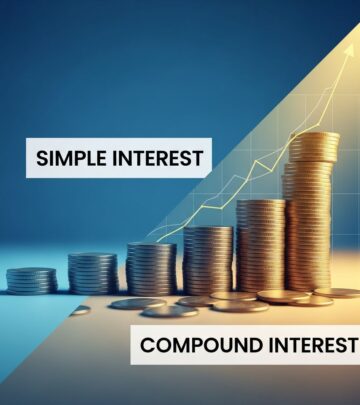
Simple Interest vs. Compound Interest: Key Differences
Understanding the differences between simple and compound interest is crucial for financial decision-making:
| Aspect | Simple Interest | Compound Interest |
|---|---|---|
| Calculation | Only on principal | On principal and accumulated interest |
| Growth Pattern | Linear | Exponential |
| Formula | I = PRT | A = P(1 + r/n)^(nt) |
| Returns | Consistent annually | Increases over time |
| Common Usage | Short-term loans, certain bonds | Savings accounts, investments, mortgages |
Factors Affecting Interest Calculations
Several factors can influence how interest is calculated and what you ultimately pay or earn:
- Interest Rate: Higher rates result in more interest paid or earned. Even small differences compound significantly over time.
- Principal Amount: Larger principals generate greater interest amounts. Doubling your principal doubles your interest earnings (in simple interest scenarios).
- Time Period: Longer time periods allow more interest accumulation, especially with compound interest where time amplifies the exponential effect.
- Compounding Frequency: More frequent compounding results in higher returns. Daily compounding yields more than monthly compounding, which yields more than annual compounding.
- Payment Schedule: For loans, making extra payments reduces the principal faster, thereby reducing total interest paid.
Practical Applications of Interest Calculations
Mortgage Calculations
When calculating mortgage interest, lenders typically use compound interest formulas with monthly compounding. Understanding this helps borrowers comprehend why the majority of early payments go toward interest rather than principal reduction.
Student Loans
Student loan interest calculations depend on whether you have federal or private loans. Federal loans often use simple interest, while private loans may use compound interest with various compounding periods.
Savings Accounts and CDs
Banks typically use daily compound interest for savings accounts, meaning your interest earns interest every single day, maximizing your returns.
Credit Cards
Credit card companies usually calculate interest daily using compound interest. This is why high-interest credit card debt can escalate quickly if only minimum payments are made.
Using Online Calculators and Tools
While manual calculations help you understand the concepts, numerous online tools can streamline the process:
- Online Interest Calculators: Many financial websites offer free calculators for simple and compound interest calculations.
- Spreadsheet Software: Microsoft Excel or Google Sheets can perform complex calculations using built-in formulas.
- Financial Planning Apps: Dedicated applications help track loans, investments, and calculate potential returns.
- Bank Websites: Most banks provide calculators specific to their products and rates.
Tips for Maximizing Interest Earnings and Minimizing Interest Payments
To maximize interest earnings on investments:
- Choose accounts with higher interest rates when comparable
- Opt for accounts with daily compounding for maximum growth
- Consider longer-term investments when rates are favorable
- Make regular additional deposits to increase your principal
To minimize interest payments on loans:
- Make extra principal payments when possible
- Choose shorter loan terms to reduce total interest paid
- Negotiate for lower interest rates
- Avoid making only minimum payments on revolving credit
Frequently Asked Questions
Q: What is the difference between APR and interest rate?
A: The interest rate is the percentage of principal charged as interest, while APR (Annual Percentage Rate) includes the interest rate plus other costs or fees associated with the loan, providing a more complete picture of borrowing costs.
Q: How often should interest be compounded?
A: The more frequently interest is compounded (daily vs. monthly), the more interest you’ll earn on investments. For borrowing, frequent compounding means you’ll pay more interest, so less frequent compounding is preferable.
Q: Can I calculate interest manually without a calculator?
A: Yes, you can use the simple interest formula (I = PRT) manually. Compound interest calculations are more complex but can be done with a scientific calculator or spreadsheet software.
Q: Why does my loan balance decrease slowly at first?
A: With amortized loans like mortgages, early payments are heavily weighted toward interest. As you pay down the principal, a larger portion of each payment goes toward principal reduction.
Q: What is the “Rule of 72”?
A: The Rule of 72 is a quick estimation tool: divide 72 by your interest rate to approximate how many years it takes for your money to double. For example, at 6% interest, your money doubles in approximately 12 years (72÷6=12).
References
- Understanding Interest Rates and Yield — U.S. Securities and Exchange Commission. 2024. https://www.sec.gov/investor/alerts-bulletins/investorpubs.html
- Consumer Handbook to Mortgages — Federal Reserve Board. 2024. https://www.federalreserve.gov/pubs/mortgage/
- Truth in Lending Act (Regulation Z) — Consumer Financial Protection Bureau. 2024. https://www.consumerfinance.gov/rules-policy/regulations/1026/
- Student Loan Interest Rates and Terms — Federal Student Aid, U.S. Department of Education. 2024. https://studentaid.gov/understand-aid/types/loans
- Compound Interest and Investment Returns — OECD Financial Education Resources. 2023. https://www.oecd.org/financial-literacy/
Similar Articles








Read full bio of medha deb