How to Calculate Marginal Propensity to Consume
Master MPC calculations and understand consumer spending behavior in modern economies.

Understanding Marginal Propensity to Consume
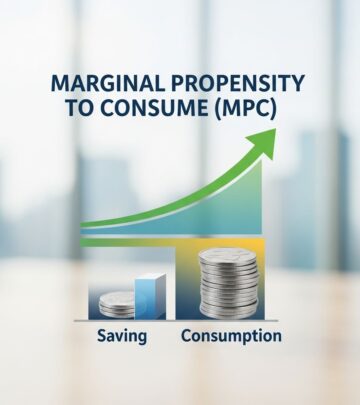
The marginal propensity to consume (MPC) is a fundamental concept in economics that measures the proportion of additional income that consumers spend on goods and services rather than save. In essence, it represents consumer behavior in response to income changes and serves as a critical indicator for understanding economic dynamics and predicting the effectiveness of fiscal policies. When individuals or households receive additional income, they face a decision: spend it or save it. The MPC quantifies this spending behavior by calculating the percentage of extra income that goes toward consumption.
Understanding MPC is essential for economists, policymakers, and business analysts because it directly influences economic growth, investment decisions, and the effectiveness of government stimulus programs. A higher MPC indicates that consumers are more likely to spend additional income, which stimulates economic activity and potentially triggers a multiplier effect throughout the economy. Conversely, a lower MPC suggests that consumers prefer to save additional income, which may indicate economic uncertainty or higher income levels where basic needs are already satisfied.
The Basic MPC Formula and Calculation
The marginal propensity to consume is calculated using a straightforward mathematical formula that compares the change in consumption to the change in disposable income. The standard formula is:
MPC = Change in Consumption ÷ Change in Disposable Income
Or in mathematical notation:
MPC = ΔC ÷ ΔYd
Where ΔC represents the change in consumption and ΔYd represents the change in disposable income. This formula produces a value between 0 and 1, representing the proportion of additional income spent on consumption.
Practical Example of MPC Calculation
To illustrate how MPC works in practice, consider a concrete example. Suppose an individual receives a bonus of $100 at work. If this person spends $80 of the bonus and saves $20, the calculation would be:
MPC = $80 ÷ $100 = 0.80 (or 80%)
This result means that for every additional dollar earned, the individual spends 80 cents and saves 20 cents. In another scenario, if someone receives an extra £10 and spends £7.50, the MPC would be £7.50 ÷ £10 = 0.75, indicating that 75% of the additional income is spent on consumption.
MPC in the Consumption Function
The marginal propensity to consume appears as the slope of the consumption function, a relationship that shows how consumption changes as income increases. The consumption function can be expressed as:
C = a + MPC × Yd
In this equation, C represents total consumption, ‘a’ represents autonomous consumption (spending that occurs regardless of income level), MPC is the marginal propensity to consume, and Yd represents disposable income. This formula demonstrates that consumption consists of two components: a fixed amount (autonomous consumption) and a variable amount that depends on income and the MPC.
The graphical representation of this function shows a straight line that slopes upward, with the steepness of the slope determined by the MPC value. A higher MPC results in a steeper slope, indicating that consumption increases more significantly with income increases. This relationship is crucial for understanding consumer behavior patterns and predicting how economic changes will affect spending throughout the economy.
Key Factors That Influence Marginal Propensity to Consume
Multiple variables affect an individual’s or household’s marginal propensity to consume. Understanding these factors helps economists and policymakers predict consumer behavior and design effective economic policies.
Income Levels
The relationship between income levels and MPC is inverse. Individuals with low incomes typically have high marginal propensities to consume because they have many essential goods and services they need to purchase—food, housing, utilities, and transportation. When low-income earners receive additional income, they are more likely to spend it on necessities.
In contrast, high-income earners often have an MPC closer to zero because they have already satisfied their basic needs and accumulated savings. When wealthy individuals receive additional income, they are more inclined to save it rather than spend it. This relationship explains why tax cuts targeting lower and middle-income groups are often more effective at stimulating economic growth than tax cuts for high earners.
Temporary Versus Permanent Income Changes
How consumers perceive income changes significantly affects their spending behavior. If individuals view an income increase as temporary—such as a one-time bonus or irregular freelance payment—they are more likely to save this additional income rather than spend it. This conservative approach reflects uncertainty about future income stability.
Conversely, when consumers receive what they perceive as a permanent income increase, such as a promotion or salary raise, they feel more confident increasing their consumption spending. This distinction is crucial for policymakers to understand, as permanent tax cuts are likely to have a greater stimulative effect than temporary tax rebates.
Interest Rates
Interest rate changes influence the decision between consuming and saving. Higher interest rates make saving more attractive because individuals can earn greater returns on their saved funds. However, the effect of interest rates on MPC is generally modest because higher rates also increase income from savings, reducing the urgency to save more.
Additionally, higher interest rates typically increase borrowing costs, which can discourage consumption financed through credit. This creates a complex relationship where interest rate changes affect both the incentive to save and the ability to finance consumption through debt.
Consumer Confidence and Economic Expectations
Consumer sentiment and expectations about future economic conditions strongly influence MPC. When consumer confidence is high, individuals feel optimistic about their financial future and are more willing to spend additional income. This confidence translates into higher MPC values.
Conversely, when consumers are pessimistic—fearing unemployment, recession, or financial instability—they reduce spending and increase savings as a precaution. In such periods, MPC falls significantly, limiting the effectiveness of fiscal stimulus programs that rely on consumer spending to generate economic growth.
MPC Greater Than One: Understanding the Exception
While MPC typically ranges between 0 and 1, it is theoretically possible for MPC to exceed 1. This occurs when consumers increase spending by more than the amount of additional income received, financing the excess spending through borrowing or reducing savings.
For example, if an individual receives $100 in additional income but increases consumption by $110, the MPC would be 1.1. This behavior might occur during economic booms when consumers are highly optimistic and willing to take on debt, or when falling income doesn’t immediately reduce spending because individuals maintain certain autonomous consumption levels through borrowed funds.
MPC and Domestic Consumption
When calculating the marginal propensity to consume on domestic goods specifically, economists must account for withdrawals that reduce the proportion of additional income spent on home-produced goods. These withdrawals include:
Savings (Marginal Propensity to Save): The portion of additional income that consumers choose to save rather than spend.
Imports (Marginal Propensity to Import): The portion of additional consumption spending directed toward foreign-produced goods and services.
Taxes (Marginal Propensity to Tax): The portion of additional income paid in taxes, reducing disposable income available for consumption.
For instance, if a worker receives an extra $100 in income, not all of this will be spent on domestic consumption. Taxes might claim $20, savings might account for $15, and imports might represent $10, leaving only $55 for domestic consumption. This distinction is crucial for policymakers assessing the domestic economic impact of fiscal policies.
The Multiplier Effect and MPC
One of the most important applications of MPC in economics is determining the multiplier effect—the phenomenon where an initial injection of spending into the economy creates a larger total increase in economic output. The relationship between MPC and the multiplier is direct: a higher MPC produces a larger multiplier effect.
The multiplier can be calculated using the formula:
Multiplier (k) = 1 ÷ (1 – MPC)
For example, if the MPC is 0.75, the multiplier would be 1 ÷ (1 – 0.75) = 1 ÷ 0.25 = 4. This means that a $1 billion government spending increase could generate $4 billion in total economic growth through the multiplier effect.
However, if consumer confidence is very low and MPC is only 0.25, the multiplier would be just 1.33, meaning the same $1 billion injection would generate only $1.33 billion in total growth. This explains why fiscal stimulus is more effective during periods of high consumer confidence and why low MPC during recessions limits the impact of government spending programs.
MPC and Tax Policy Effectiveness
Understanding MPC is essential for designing effective tax policies. Policymakers often use tax cuts as a tool for fiscal stimulus, but the effectiveness of these cuts depends significantly on the MPC of the income groups affected.
If the government cuts the highest marginal tax rate for top earners—those already spending a small proportion of additional income—the stimulative effect will be limited. A tax cut providing an extra $1,000 to someone with an MPC of 0.1 will generate only $100 in additional spending.
Conversely, increasing the income tax threshold so that middle and lower-income earners keep more of their income is likely to be more effective. These groups have higher MPCs, meaning a $1,000 tax savings might generate $700–$800 in additional spending, creating more economic stimulus and job creation.
Relationship Between MPC and MPS
The marginal propensity to save (MPS) represents the proportion of additional income that consumers save rather than spend. In a closed economy without taxes, MPC and MPS have a direct relationship:
MPC + MPS = 1
This relationship reflects the fundamental choice consumers face with additional income: spend it or save it. If the MPC is 0.80, then the MPS must be 0.20. Understanding this relationship helps economists predict consumer behavior and the economy’s capacity for growth.
Average Propensity to Consume Versus MPC
It is important to distinguish between the marginal propensity to consume and the average propensity to consume (APC). While MPC measures the proportion of additional income spent on consumption, APC measures the proportion of total income spent on consumption.
The formula for APC is:
APC = Total Consumption ÷ Total Income
For example, if someone earns $50,000 annually and spends $45,000 on consumption, the APC is 0.90. However, if an additional $5,000 in income results in only $3,000 additional spending, the MPC would be 0.60. The APC typically decreases as income increases because higher earners spend a smaller percentage of their total income on consumption.
Frequently Asked Questions
Q: What does an MPC of 0.75 mean?
A: An MPC of 0.75 means that for every additional dollar earned, consumers spend 75 cents on consumption and save 25 cents. This represents a relatively high propensity to consume, typically associated with lower to middle-income earners who have significant consumption needs.
Q: How is MPC different from APC?
A: MPC measures the proportion of additional income spent on consumption, while APC measures the proportion of total income spent on consumption. MPC is more useful for predicting how consumers will respond to income changes, while APC provides a snapshot of overall spending patterns.
Q: Why is MPC important for government policy?
A: MPC determines the effectiveness of fiscal stimulus policies. A higher MPC means government spending or tax cuts will have a larger multiplier effect, creating more economic growth and job creation. Policymakers use MPC data to design more targeted and effective economic interventions.
Q: Can MPC be negative?
A: While theoretically possible, negative MPC is extremely rare. It would mean consumers reduce spending when income increases, which contradicts normal economic behavior. In practice, MPC values range from near 0 to slightly above 1.
Q: How do economists measure MPC?
A: Economists measure MPC by comparing changes in consumption to changes in disposable income using historical data, consumer surveys, and statistical analysis. Government statistical agencies like the Bureau of Labor Statistics collect consumption and income data used to calculate MPC estimates.
References
- Marginal Propensity to Consume (MPC) — Economics Help. 2024. https://www.economicshelp.org/university/marginal-propensity-to-consume/
- Marginal Propensity to Consume – MPC Formula — Corporate Finance Institute. 2024. https://corporatefinanceinstitute.com/resources/economics/mpc/
- Marginal Propensity to Consume – Keynesian Theory — Professor Ryan Economics Education. YouTube. https://www.youtube.com/watch?v=QS70Nx_BQ2s
- MPC Calculator — Omni Calculator. 2024. https://www.omnicalculator.com/finance/mpc
- Marginal Propensity to Consume: Definition and Formula — Study.com Academy. 2024. https://study.com/academy/lesson/video/marginal-propensity-to-consume-definition-and-formula-of-the-mpc.html
- Estimating the Marginal Propensity to Consume Using the Household Expenditure Survey — Federal Reserve Bank of Boston. 2019. https://www.bostonfed.org/-/media/Documents/Workingpapers/PDF/2019/wp1904.pdf
- Marginal Propensity to Consume — U.S. Bureau of Labor Statistics. 2018. https://www.bls.gov/cex/ws2018-marginal-propensity-to-consume.pdf
Similar Articles








Read full bio of Sneha Tete