CAGR Formula: How to Calculate Compound Annual Growth Rate in Excel
Master CAGR calculations in Excel with step-by-step formulas and real-world examples.
Understanding Compound Annual Growth Rate (CAGR)
Compound Annual Growth Rate, commonly abbreviated as CAGR, is a financial metric that represents the mean annual growth rate of an investment over a specified period longer than one year. Unlike simple growth rate calculations that may show volatile year-to-year changes, CAGR provides a smoothed representation of how an investment performs when compounded annually. This metric is particularly valuable for investors and financial analysts who need to compare the performance of different investments across varying time periods and understand the consistent rate at which their portfolios have grown.
The importance of CAGR extends beyond simple curiosity about investment performance. It allows investors to make informed decisions by presenting a clear picture of historical growth trajectories, which can then be used to project future values. Whether you’re evaluating mutual funds, bonds, stock portfolios, or business revenues, CAGR offers a standardized way to assess performance that eliminates the noise created by periodic fluctuations.
What is the CAGR Formula?
The CAGR formula is the foundation of all compound annual growth rate calculations. The mathematical expression is straightforward yet powerful:
CAGR = (Ending Value ÷ Beginning Value) ^ (1 ÷ Number of Years) – 1
In this formula, each component plays a critical role:
- Ending Value: The value of your investment at the conclusion of your measurement period
- Beginning Value: The initial amount you invested or the starting value of the metric you’re measuring
- Number of Years: The total number of years encompassed in your investment period
The formula can also be expressed using alternative financial terminology:
CAGR = (Future Value ÷ Present Value) ^ (1 ÷ Number of Periods) – 1
Both expressions are mathematically identical; the latter simply uses common financial jargon where future value represents the ending value and present value represents the beginning value. This flexibility in notation allows financial professionals across different sectors to communicate using terminology most familiar to them.
Step-by-Step Process for Calculating CAGR
Understanding the mechanics of CAGR calculation involves breaking down the formula into manageable steps. This methodical approach ensures accuracy and helps demystify what might initially seem like a complex calculation:
Step 1: Divide Ending Value by Beginning Value
Start by taking your ending value and dividing it by your beginning value. This ratio shows how many times your initial investment has multiplied. For example, if you invested $10,000 and it grew to $15,000, your ratio would be 1.5, indicating your investment increased by 50% in total.
Step 2: Raise to the Power of (1 ÷ Number of Years)
Next, take the ratio from Step 1 and raise it to the power of 1 divided by the number of years in your investment period. This step annualizes your growth rate. If your investment period was 5 years, you would raise the ratio to the power of 0.2 (1 ÷ 5). This mathematical operation converts your total return into an annual equivalent.
Step 3: Subtract One
Finally, subtract 1 from the result obtained in Step 2. This converts your result into a decimal form that represents your growth rate. To express this as a percentage, multiply by 100.
Practical CAGR Calculation Example
Let’s work through a concrete example to illustrate how these steps function in practice. Suppose you invested $20,000 in a stock portfolio at the beginning of 2020, and by the end of 2024 (5 years later), your portfolio had grown to $32,500.
Step 1: Divide ending value by beginning value: $32,500 ÷ $20,000 = 1.625
Step 2: Raise to the power of (1 ÷ 5): 1.625 ^ 0.2 = 1.1099
Step 3: Subtract 1 and convert to percentage: (1.1099 – 1) × 100 = 10.99%
Your CAGR is therefore 10.99%, meaning your investment grew at an average annual rate of approximately 11% over the 5-year period.
How to Calculate CAGR in Excel
Excel provides multiple methods for calculating CAGR, making it accessible whether you prefer entering formulas or using built-in functions. The spreadsheet application’s flexibility allows you to choose the approach that best suits your workflow.
Using the Standard Formula in Excel
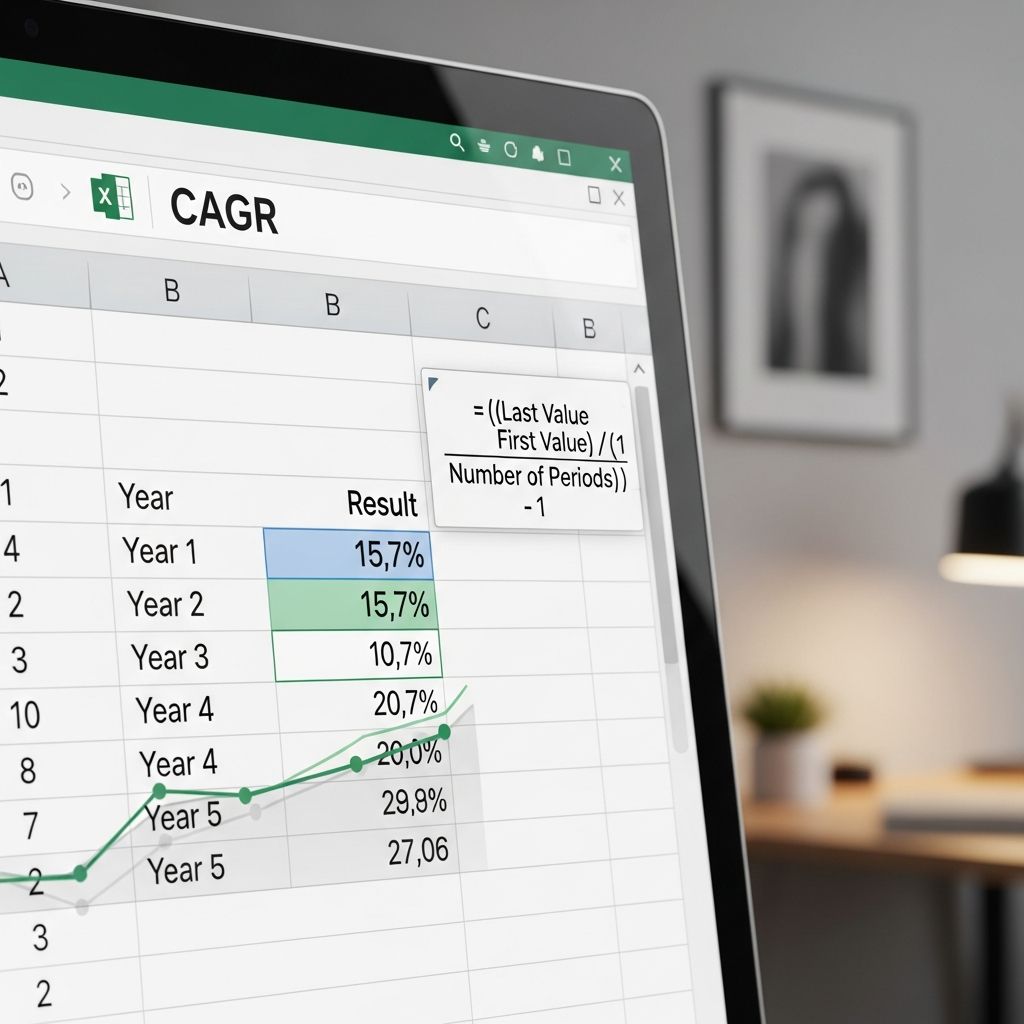
The most direct method involves entering the CAGR formula directly into an Excel cell. If your beginning value is in cell A1, your ending value is in cell B1, and the number of years is in cell C1, you would enter:
=((B1/A1)^(1/C1))-1
Excel will then calculate your CAGR instantly. You can format this cell as a percentage to display your result in familiar percentage terms.
Using the XIRR Function
For more complex scenarios involving irregular cash flows, Excel’s XIRR function provides an alternative approach. This function calculates the internal rate of return for a series of cash flows that may not be periodic:
=XIRR(values, dates)
Where “values” includes all cash flows and “dates” includes the corresponding dates. This method is particularly useful when your investment involves multiple deposits or withdrawals at different times.
CAGR Applications and Use Cases
CAGR serves numerous practical applications across the financial world. Understanding these use cases helps illustrate why this metric has become so integral to financial analysis.
Investment Performance Comparison
One of the most common applications is comparing different investments over identical time periods. If you’re deciding between two mutual funds, both of which have 10-year track records, comparing their CAGRs provides an apples-to-apples comparison that eliminates the confusion created by different market conditions during various parts of each decade.
Business Growth Analysis
Companies use CAGR to analyze revenue growth, customer acquisition rates, and market expansion. A technology startup might calculate its revenue CAGR over five years to demonstrate to investors that it has achieved consistent growth despite volatile quarterly results.
Portfolio Evaluation
Individual investors use CAGR to assess their overall portfolio performance. By calculating the CAGR of their total net worth over several years, investors can determine whether their wealth accumulation strategy is succeeding in meeting their long-term financial goals.
Historical Trend Analysis
Financial analysts employ CAGR to identify long-term trends in economic data, housing prices, commodity costs, and other financial metrics. This application helps distinguish genuine trends from temporary market fluctuations.
CAGR vs. Simple Growth Rate
Understanding the difference between CAGR and simple growth rate is essential for accurate financial analysis. The simple growth rate is calculated using the formula:
SGR = (Ending Value – Beginning Value) ÷ Beginning Value × 100
The simple growth rate provides the total percentage change over your entire investment period without accounting for the effect of compounding. For a 5-year investment, the simple growth rate does not reveal what happened during individual years or account for the fact that your money earned returns on returns.
CAGR, by contrast, reveals the annual compounded rate, providing insight into consistent annual performance. For most long-term financial analysis, CAGR is the superior metric because it accounts for the mathematical reality of compounding and provides a more accurate picture of investment performance.
Factors Affecting CAGR Calculations
Several critical considerations can affect how CAGR calculations are performed and interpreted:
Investment Time Horizon
The length of your investment period significantly impacts your CAGR. Longer periods tend to smooth out volatility, while shorter periods may be more heavily influenced by market timing. A one-year investment period may show an inflated CAGR if that single year happened to be particularly profitable.
Frequency of Compounding
While traditional CAGR assumes annual compounding, some investments compound more frequently. Understanding your investment’s specific compounding frequency ensures your calculations accurately reflect its performance.
Cash Flows and Deposits
CAGR calculations become more complex when you add money to or withdraw money from your investment during the period. In these scenarios, using the XIRR function provides more accurate results than the standard CAGR formula.
Starting and Ending Points
The specific dates you choose as your starting and ending points can significantly influence your CAGR. Market cycles mean that choosing different endpoints can dramatically alter your calculated growth rate.
Common Pitfalls and Considerations
When calculating and interpreting CAGR, investors should be aware of several common mistakes:
- Ignoring time periods: Always ensure you’re comparing CAGRs calculated over identical time periods. A 10-year CAGR is not directly comparable to a 3-year CAGR without additional analysis.
- Confusing CAGR with average returns: CAGR is not the same as the average annual return. CAGR accounts for compounding, while average return calculations do not.
- Overlooking fees and taxes: Published CAGR figures often don’t account for investment fees or taxes. When calculating personal returns, ensure you’re working with after-fee, after-tax figures for accurate personal performance assessment.
- Misinterpreting negative CAGRs: A negative CAGR indicates that your investment declined in value over time. This is mathematically valid and important to recognize.
CAGR Limitations
While CAGR is a valuable metric, it has important limitations that users should understand. CAGR assumes steady, consistent growth throughout the investment period, which rarely occurs in real markets. Investments typically experience periods of growth followed by periods of decline. Additionally, CAGR doesn’t account for investment risk or volatility. Two investments with identical CAGRs might have experienced dramatically different levels of fluctuation along the way. CAGR also assumes that dividends and distributions are reinvested, which may not reflect your actual investment strategy. Finally, CAGR becomes less meaningful for very short investment periods and can be misleading when comparing investments with vastly different risk profiles.
Frequently Asked Questions
Q: What is considered a good CAGR?
A: What constitutes a “good” CAGR depends on the investment type, market conditions, and time period. Historical stock market CAGRs average around 10% annually, while bond returns typically range from 4-6%. Real estate and other alternative investments have their own benchmarks. Compare your CAGR to appropriate benchmarks for your investment type rather than using absolute figures.
Q: Can CAGR be negative?
A: Yes, CAGR can be negative, indicating that an investment declined in value over the measurement period. A negative CAGR is mathematically valid and simply represents a loss rather than a gain. For example, if an investment declined from $100,000 to $80,000 over 5 years, the CAGR would be negative approximately -4.56%.
Q: How often should I recalculate CAGR for my investments?
A: You can recalculate CAGR as frequently as you wish, but most investors calculate it annually or quarterly. Recalculating too frequently may result in meaningless statistics, while annual or quarterly calculations provide useful insights into ongoing performance trends.
Q: Is CAGR better than other return metrics?
A: CAGR is not inherently better than other metrics; rather, it serves different purposes. Use CAGR for long-term growth comparisons, but consider metrics like Sharpe ratio, standard deviation, and maximum drawdown when evaluating risk-adjusted returns. The best approach uses multiple metrics together for comprehensive analysis.
Q: How do I calculate CAGR for irregular cash flows?
A: For investments with irregular deposits or withdrawals, use Excel’s XIRR function instead of the standard CAGR formula. XIRR calculates the internal rate of return and automatically accounts for the timing and magnitude of each cash flow.
References
- Calculate a compound annual growth rate (CAGR) in Excel — Microsoft Support. 2024. https://support.microsoft.com/en-us/office/calculate-a-compound-annual-growth-rate-cagr-in-excel-3ccb7cd3-39b3-49ee-8b38-c19972607dfa
- CAGR Calculator (Compound Annual Growth Rate) — Omni Calculator. 2024. https://www.omnicalculator.com/finance/cagr
- CAGR (Compound Annual Growth Rate) – Calculator — Corporate Finance Institute. 2024. https://corporatefinanceinstitute.com/resources/valuation/what-is-cagr/
- CAGR Formula and Calculations — Wall Street Prep. 2024. https://www.wallstreetprep.com/knowledge/cagr-compound-annual-growth-rate/
- Definition, Formula, Calculate in Excel – CAGR — Financial Education. 2024. https://www.fe.training/free-resources/valuation/how-to-calculate-cagr-in-excel/
Similar Articles








Read full bio of medha deb