C-Note: Understanding $100 Bills in Currency
Learn what a C-Note is, its history, features, and significance in modern currency.
What is a C-Note?
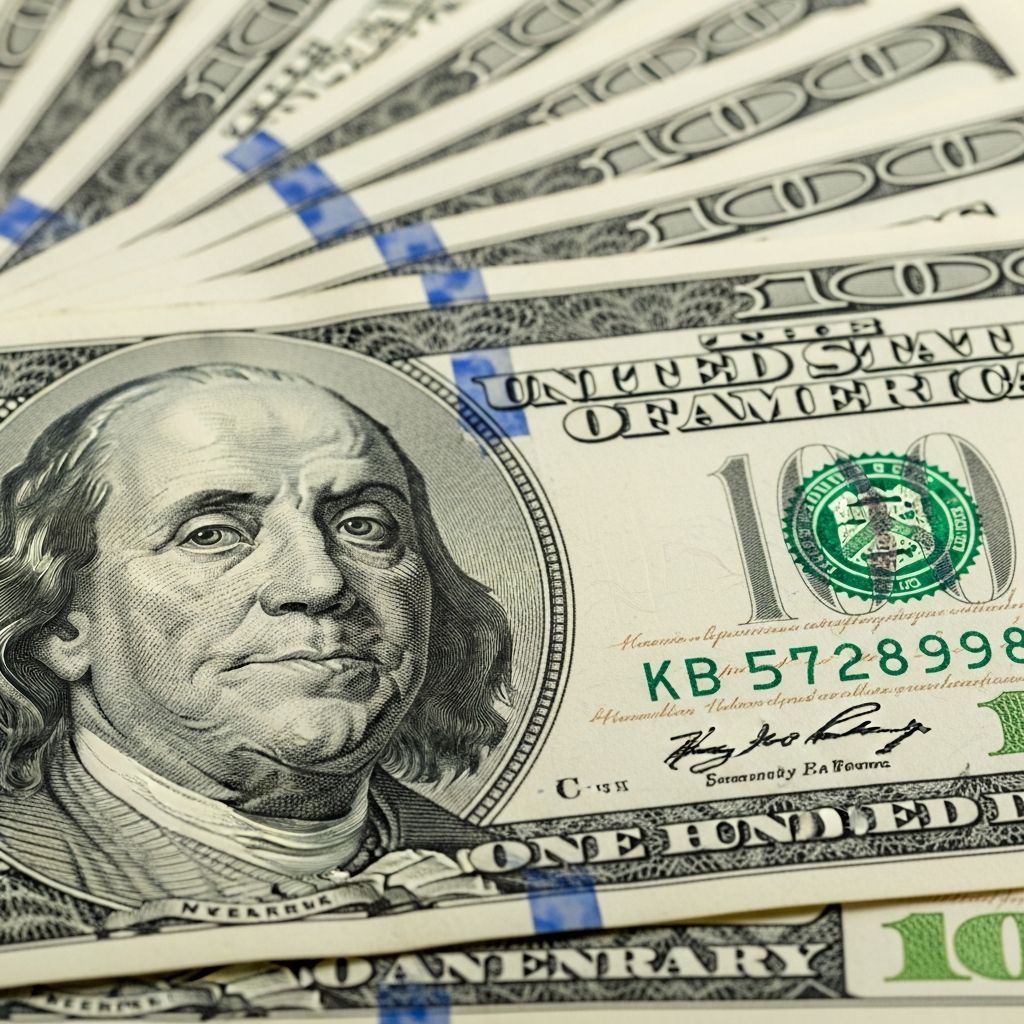
A C-Note is a colloquial term for a $100 bill in U.S. currency. The “C” in the term derives from the Roman numeral for 100, making it an intuitive shorthand for referring to this particular denomination. Understanding the terminology and significance of the C-Note is essential for anyone engaged in financial transactions, investments, or general currency knowledge. The C-Note represents one of the highest denomination bills currently in circulation in the United States, and it plays a crucial role in both everyday commerce and larger financial operations.
The term “C-Note” is commonly used in colloquial speech, particularly in financial circles, casual transactions, and popular culture. However, the formal name for this currency remains the “100-dollar bill” or simply “$100 bill.” Despite the informal nature of the term, it is widely recognized and understood across the United States and in many international financial contexts.
Historical Background of the C-Note
The $100 bill has a rich and fascinating history that dates back to the early days of U.S. currency. The first $100 notes were issued during the Civil War as “Demand Notes” by the U.S. government to finance military operations. These early bills bore little resemblance to modern currency and were primarily used for government transactions rather than public circulation.
Throughout the 19th and 20th centuries, the design and production of $100 bills underwent numerous transformations. The federal government has continuously updated the appearance and security features of high-denomination notes to combat counterfeiting and adapt to modern economic needs. Each redesign brought new visual elements, improved printing techniques, and enhanced security measures to protect the integrity of U.S. currency.
The most significant redesign of the modern C-Note occurred in 1996, with additional security enhancements introduced in subsequent years. These updates reflected advancing technology and the evolving threat of counterfeiting. The most recent major redesign of the $100 bill was released in 2013, introducing state-of-the-art security features that made it significantly more difficult to counterfeit.
Key Features and Characteristics
Physical Dimensions and Composition
All U.S. currency, including the $100 bill, measures 6.14 inches in length and 2.61 inches in width. The bills are printed on a specialized paper composed of 75 percent cotton and 25 percent linen, which gives currency its distinctive feel and durability. This composition allows bills to withstand regular handling, folding, and circulation without deteriorating as quickly as regular paper would.
Primary Design Elements
- Portrait: The obverse side of the C-Note features a portrait of Benjamin Franklin, one of the Founding Fathers of the United States and a renowned polymath, scientist, and diplomat.
- Reverse Design: The reverse side displays Independence Hall in Philadelphia, a site of great historical significance in American history.
- Serial Numbers: Each bill contains unique serial numbers that identify its specific printing batch and run.
- Treasury Seal: The official seal of the U.S. Department of the Treasury appears on the bill, confirming its legitimacy.
- Color: The predominant color of modern $100 bills is green, though newer versions incorporate subtle blue and orange accents as security features.
Security Features and Anti-Counterfeiting Measures
The U.S. government has implemented numerous security features in modern $100 bills to prevent counterfeiting and protect the integrity of the currency system. These features are designed to be easily recognized by ordinary citizens while being extremely difficult to replicate using standard printing technology.
Advanced Security Elements
- Security Thread: An embedded thread runs vertically through the bill and contains microprinting that reads “USA 100” and is visible only when held up to light.
- Watermark: A watermark matching the portrait on the bill appears when the note is held to light, corresponding to the image on the obverse side.
- Color-Shifting Ink: The numeral “100” in the lower right corner of the bill is printed in color-shifting ink that changes color when viewed from different angles, appearing to shift between green and blue.
- Intaglio Printing: The use of intaglio printing creates a distinctive raised texture that can be felt by running a finger across the bill’s surface.
- Microprinting: Tiny text appears throughout the bill, visible only under magnification, making reproduction difficult for counterfeiters.
- Ultraviolet Features: Security elements that are only visible under ultraviolet light have been incorporated into newer designs.
- Security Fibers: Colored security fibers are embedded throughout the paper, which cannot be replicated by photocopying or scanning.
The Role of C-Notes in the Economy
C-Notes play a significant role in the U.S. and global economy, serving multiple functions beyond everyday transactions. As the highest denomination bill in regular circulation (the $500, $1,000, $5,000, and $10,000 bills are no longer produced and are rarely seen), the $100 bill represents a substantial store of value in relatively compact form.
Uses and Applications
- International Transactions: The $100 bill is recognized and accepted worldwide, making it a preferred currency for international business and travel.
- Large Purchases: C-Notes are commonly used in significant transactions where cash is the preferred method of payment.
- Currency Reserves: Central banks and governments maintain reserves of $100 bills as part of their foreign currency holdings.
- Personal Finance: Individuals use $100 bills for savings, large purchases, and emergency funds.
- Business Operations: Retail establishments, banks, and financial institutions maintain supplies of $100 bills for customer transactions and daily operations.
Benjamin Franklin: The Face of the C-Note
Benjamin Franklin, whose portrait adorns the $100 bill, is one of the most influential figures in American history. Born in 1706, Franklin was a printer, author, inventor, diplomat, and statesman who played a crucial role in American independence and the formation of the United States government. His contributions to science, including his famous kite experiment demonstrating the nature of lightning, and his diplomatic efforts in securing French support during the Revolutionary War were instrumental to the success of the American cause.
Franklin was selected for the honor of appearing on the $100 bill due to his multifaceted contributions to American society and his status as an intellectual pioneer. His image has graced the bill since 1914, when the current $100 bill design was first introduced. Franklin’s presence on the bill reflects the American value of intellectual achievement, innovation, and service to the nation.
Circulation and Distribution
The Federal Reserve manages the circulation of $100 bills throughout the United States, ensuring an adequate supply to meet economic demands. C-Notes are distributed through banks, credit unions, and other financial institutions to businesses and individuals as needed. The demand for $100 bills fluctuates based on economic conditions, inflation, and consumer preferences for cash versus digital payments.
Interestingly, a significant portion of $100 bills in circulation are held outside the United States, particularly in regions where the U.S. dollar is preferred as a store of value or due to currency instability in local economies. This international demand for C-Notes reflects the global trust in American currency and the strength of the U.S. dollar.
Modern Challenges and Future Developments
The rise of digital payments and cashless transactions presents ongoing challenges to the relevance of physical currency, including C-Notes. Credit cards, debit cards, mobile payment systems, and cryptocurrency are increasingly replacing cash in many transactions. However, the $100 bill continues to maintain significant demand, particularly for large transactions and in regions where digital payment infrastructure is not yet fully developed.
The U.S. government continues to invest in currency research and development to stay ahead of counterfeiting threats. Future iterations of the $100 bill will likely incorporate even more advanced security features utilizing cutting-edge technology. Additionally, discussions regarding the potential demonetization of large-denomination bills or the introduction of digital currency alternatives continue to evolve as financial systems modernize.
Frequently Asked Questions
Q: Why is a $100 bill called a “C-Note”?
A: The term “C-Note” derives from the Roman numeral “C,” which represents 100. This colloquial term is commonly used to refer to a $100 bill in informal speech and financial contexts.
Q: Is the $100 bill the highest denomination in circulation?
A: Yes, the $100 bill is the highest denomination currently in regular circulation. Higher denominations ($500, $1,000, $5,000, and $10,000) are no longer printed and are considered rare collectibles.
Q: How can I verify that a $100 bill is authentic?
A: You can verify authenticity by checking for security features such as the security thread, watermark, color-shifting ink, microprinting, and the distinctive texture of intaglio printing. Holding the bill up to light will reveal several security elements.
Q: Why was Benjamin Franklin chosen for the $100 bill?
A: Benjamin Franklin was selected due to his significant contributions to American independence, science, and governance. His intellectual achievements and diplomatic efforts made him an appropriate choice for this high-value denomination.
Q: How long does a $100 bill typically remain in circulation?
A: The average lifespan of a $100 bill is approximately 15 years. After this period, damaged or worn bills are removed from circulation and destroyed, while new notes are printed to replace them.
Q: Are C-Notes still widely used despite the rise of digital payments?
A: Yes, C-Notes remain in significant demand, particularly for large transactions, international commerce, and as a store of value. However, their relative usage has declined as digital payment methods become more prevalent.
Q: What is the composition of the paper used in $100 bills?
A: U.S. currency, including $100 bills, is printed on a specialized paper composed of 75 percent cotton and 25 percent linen, making it durable and distinctive in texture.
References
- The New $100 Note — Federal Reserve Board. 2024. https://www.federalreserve.gov
- United States Currency Security Features — Bureau of Engraving and Printing, U.S. Department of the Treasury. 2024. https://www.bep.gov/services/security-features-100-note
- Benjamin Franklin Biography — Library of Congress. 2024. https://www.loc.gov/exhibits/franklin/
- Currency in Circulation — Federal Reserve System. 2024. https://www.federalreserve.gov/paymentsystems/coin_currency_circ.htm
- History of U.S. Currency Design — Smithsonian National Museum of American History. 2024. https://americanhistory.si.edu/collections
Similar Articles








Read full bio of Sneha Tete