C Corporation: Structure, Taxation, and Key Advantages
Complete guide to C corporations: taxation, liability protection, and business structure fundamentals.
What Is a C Corporation?
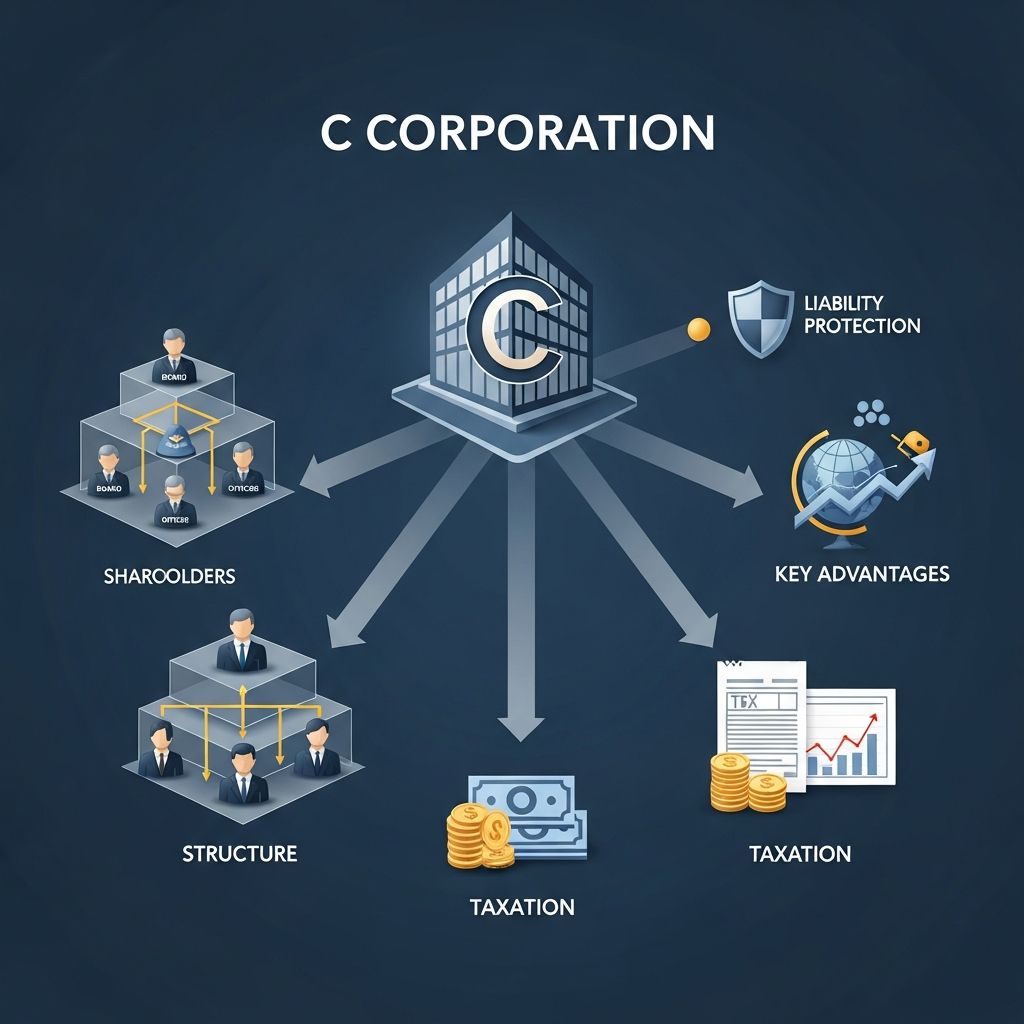
A C corporation is a business entity designed to serve as a separate legal structure that operates independently from its owners. The corporation acts as an abstraction layer between the operators of the business and the owners, known as shareholders, who may or may not be directly involved in day-to-day operations. For federal income tax purposes, a C corporation is recognized as a separate taxpaying entity that conducts business, realizes net income or loss, pays taxes, and distributes profits to shareholders.
The defining characteristic of a C corporation is that it represents ownership through shares of stock. Each share corresponds to a defined portion of control over the business and entitlement to the economic benefits generated by it. Shareholders hold these shares and have voting rights in corporate decisions, typically exercised through annual meetings and board elections.
Key Characteristics of C Corporations
C corporations possess several fundamental characteristics that distinguish them from other business structures:
Limited Liability Protection
One of the most significant advantages of a C corporation is the limited liability protection it provides. Shareholders are generally not individually liable for the debts and obligations of the company. This separation of personal and corporate liability means that creditors can pursue claims against the corporation’s assets, but personal assets of shareholders remain protected in most circumstances.
Corporate Taxation
C corporations are assessed corporate taxes on their own profits and have extensive filing obligations. Unlike pass-through entities, a C corporation files its own tax returns and pays taxes at the corporate level. Shareholders are taxed separately if the company distributes dividends to them or if it pays them a salary as employee owners.
Standardized Structure
C corporations are more standardized compared to other business entities. They share commonalities such as stock representing ownership, governance by a board of directors, and day-to-day operations handled by officers. This standardization makes C corporations easier to understand and operate compared to more flexible entities like LLCs.
Centralized Management
C corporations feature a clear management hierarchy. The shareholders elect a board of directors, who oversee and direct corporation affairs and decision-making but are not responsible for day-to-day operations. The board, in turn, elects officers to manage daily business affairs.
Taxation of C Corporations
Understanding how C corporations are taxed is crucial for business owners considering this structure. C corporations operate as separately taxable entities under Subchapter C of the Internal Revenue Code.
Double Taxation Concept
C corporations face the possibility of double taxation if corporate income is distributed to business owners as dividends. Corporate income tax is paid first at the corporate level, and then again at the individual level on dividends, which are considered personal taxable income. This double taxation is one of the primary disadvantages of the C corporation structure.
Tax Filings and Obligations
C corporations file a corporate tax return using Form 1120 and pay taxes at the corporate level. A corporation generally takes the same deductions as a sole proprietorship to figure its taxable income and can also take special deductions. The filing requirements and obligations are more extensive for C corporations compared to other business structures.
When C Corporation Taxation Makes Sense
Taxation under Subchapter C may result in lower taxes than taxation under Subchapter S in certain situations. Additionally, if distributions will not be made to shareholders, or if the company plans to reinvest profits back into the business, the double taxation issue becomes less problematic. Some corporations retain earnings within the entity rather than distributing them as dividends to shareholders.
Differences Between C Corporations and S Corporations
While both C corporations and S corporations offer limited liability protection and share similar structural characteristics, they differ significantly in taxation and ownership restrictions.
Taxation Structure
The C corporation is the standard or default corporation under IRS rules. The S corporation is a corporation that has elected a special tax status with the IRS and thereby gains some tax advantages. Both business structures get their names from the parts of the Internal Revenue Code that they are taxed under. C corporations are taxed under Subchapter C while S corporations are taxed under Subchapter S.
Ownership Restrictions
C corporations have no restrictions on ownership, while S corporations are restricted to no more than 100 shareholders, and shareholders must be U.S. citizens or residents. S corporations cannot be owned by C corporations, other S corporations (with some exceptions), LLCs, partnerships, or many trusts. This makes C corporations far more flexible for attracting diverse investors.
Stock Classes
S corporations can have only one class of stock (disregarding voting rights), while C corporations can have multiple classes of stock. This flexibility allows C corporations to issue preferred stock and provide different dividend preferences to different classes of investors.
C Corporations vs. LLCs
Both LLCs and C corporations are primary corporate entities in the United States, yet they differ substantially in structure, taxation, and operational flexibility.
Operating Agreements vs. Standardized Structure
An LLC is organized under an operating agreement, which is a contract between the owners (called “members”) specifying how it will be run and how economic burdens and returns will be split. The possibilities for how to structure an LLC are almost endless, which can be a blessing and a curse. By contrast, C corporations are more standardized and share commonalities like stock to represent ownership, governance by a board of directors, and day-to-day operations handled by officers.
Taxation Approach
LLCs are considered pass-through entities for U.S. taxation purposes; they don’t file taxes in their own right, but have their income reported on the personal income tax returns of their owners. C corporations file their own tax returns. Though confusingly, C corporations can sometimes elect pass-through status, and LLCs can elect to be taxed like a corporation, but these are not their default treatments.
Investor Considerations
The extreme flexibility available in the LLC form means that investors attempting to invest in one will have to do substantial legal due diligence to ensure that they are buying what they expect to be buying. Many investors do not want to undertake substantial expensive legal work as a condition of making an investment; they prefer to make investments in standardized companies under standardized terms. C corporations are much better suited to this preference.
Advantages of C Corporations
C corporations offer several compelling advantages that make them attractive for certain business owners and situations.
Unlimited Number of Shareholders
There is no limit on the number of shareholders a corporation taxed under Subchapter C can have. This unlimited expansion potential is crucial for businesses planning growth or seeking capital from multiple investors.
No Ownership Restrictions
Anyone can own shares in a C corporation, including business entities and non-U.S. citizens. This unrestricted ownership structure makes C corporations ideal for attracting foreign investment and corporate investors.
Multiple Classes of Stock
A C corporation can issue more than one class of stock, including stock with preferences to dividends and distributions. This flexibility allows companies to create customized investment packages for different types of investors.
Capital Raising Capabilities
Because Subchapter C of the tax code does not impose the same restrictions on ownership as Subchapter S, it is easier for a C corporation to obtain equity financing. This is particularly important for venture capital and private equity investments.
Transferability of Shares
C corporation shares are typically more freely transferable than S corporation shares, providing shareholders with greater liquidity and exit opportunities.
When to Choose a C Corporation Structure
Several situations indicate that a C corporation may be the optimal choice for a business:
– Taxation under Subchapter C will result in lower taxes than taxation under Subchapter S
– Distributions will not be made to shareholders, and profits will be reinvested in the business
– You plan on an initial public offering (IPO) or seeking investors not allowed for an S corporation
– You want shares to be freely transferable without restrictions
– You want to issue preferred stock with special rights and privileges
– You need to attract venture capital or private equity investment
– Your business requires unlimited growth potential with multiple investor classes
Forming a C Corporation
The process of forming a C corporation involves several key steps and filings.
Initial Steps
In forming a corporation, prospective shareholders exchange money, property, or both for the corporation’s capital stock. You will need to choose a name for your corporation (after first determining that it is available to you) and choose your corporation’s registered agent. Both the name of the corporation and the registered agent must be included in the Articles of Incorporation.
Post-Incorporation Requirements
After the incorporation process is completed, you will need to fulfill other requirements. These include adopting bylaws, holding an initial meeting of directors and shareholders, and issuing shares of stock to owners. Your corporation will be taxed under Subchapter C unless you qualify for and elect to be taxed under Subchapter S.
Ongoing Compliance
C corporations require ongoing compliance with corporate formalities, such as maintaining corporate records, holding regular board and shareholder meetings, and maintaining proper documentation of major corporate actions and decisions.
Comparison: C Corporations vs. Other Business Structures
| Feature | C Corporation | S Corporation | LLC |
|---|---|---|---|
| Liability Protection | Yes | Yes | Yes |
| Taxation | Double taxation (corporate + individual) | Pass-through | Pass-through |
| Shareholder Limit | Unlimited | 100 maximum | Unlimited |
| Ownership Restrictions | None | U.S. citizens/residents only | None |
| Stock Classes | Multiple allowed | One class only | Flexible membership structure |
| Formality Requirements | High | High | Low |
| Capital Raising | Excellent | Limited | Moderate |
Frequently Asked Questions
What is the primary advantage of a C corporation?
The primary advantage of a C corporation is limited liability protection, which shields shareholders’ personal assets from corporate debts and liabilities. Additionally, the ability to raise unlimited capital and attract diverse investors makes it ideal for growing businesses.
What is double taxation in a C corporation?
Double taxation occurs when a C corporation pays taxes at the corporate level on its profits, and then shareholders pay personal income taxes again on dividends distributed to them. This results in the same income being taxed twice.
Can a C corporation have foreign shareholders?
Yes, a C corporation can have foreign shareholders and non-U.S. citizen owners. This is a significant advantage over S corporations, which restrict ownership to U.S. citizens and residents.
What is the difference between a C corporation and an S corporation?
The main differences are taxation (C corporations face double taxation while S corporations use pass-through taxation), shareholder limits (C corporations have no limit while S corporations are capped at 100), and ownership restrictions (C corporations have none while S corporations restrict to U.S. citizens/residents).
Is a C corporation suitable for startups seeking venture capital?
Yes, C corporations are ideal for startups seeking venture capital because they allow unlimited shareholders, multiple classes of stock, and have no restrictions on investor types, which makes them preferred by venture capital and private equity firms.
What are the ongoing compliance requirements for a C corporation?
C corporations must maintain corporate records, hold regular board and shareholder meetings, file annual tax returns, adopt bylaws, and document major corporate decisions through formal resolutions and stockholder votes.
References
- LLC vs. C Corporation: What’s the difference? — Stripe. 2025. https://stripe.com/guides/atlas/llc-vs-c-corp
- S Corp vs C Corp: Key Differences and Benefits — Wolters Kluwer. 2025. https://www.wolterskluwer.com/en/expert-insights/s-corp-vs-c-corp-differences-benefits
- Forming a corporation — Internal Revenue Service (IRS). 2025. https://www.irs.gov/businesses/small-businesses-self-employed/forming-a-corporation
Similar Articles








Read full bio of Sneha Tete