Buying on Margin: Definition, How It Works, Risks
Understanding margin trading: leverage your investments with borrowed funds and manage associated risks.

What Is Buying on Margin?
Buying on margin refers to the practice of purchasing securities by borrowing funds from a brokerage firm. This investment strategy allows traders and investors to amplify their purchasing power beyond what their available cash would normally permit. When you buy on margin, you deposit a percentage of the investment’s value with your broker and borrow the remaining balance. This borrowed capital essentially leverages your investment, allowing you to control larger positions with a smaller initial investment.
The concept of margin trading has been an integral part of financial markets for decades, enabling investors to increase their potential returns. However, this amplified leverage comes with proportionally amplified risks. Understanding the mechanics and implications of margin trading is crucial for any investor considering this strategy.
How Buying on Margin Works
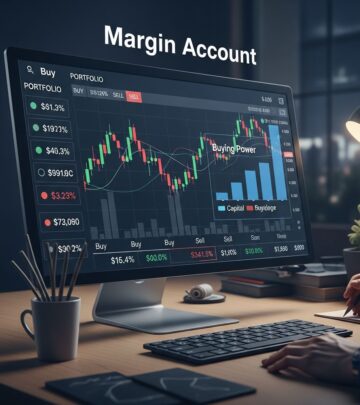
When you decide to buy securities on margin, the process begins with opening a margin account with your brokerage firm. Unlike a standard cash account, a margin account permits you to borrow funds to purchase securities. Here’s how the process unfolds:
The Margin Account Setup
- You establish a margin account rather than a traditional cash account
- The broker requires an initial deposit known as the initial margin requirement
- You sign an agreement acknowledging the terms and conditions of margin borrowing
- Interest accrues on borrowed funds until repayment
The Purchase Process
Once your margin account is established, you can purchase securities with borrowed money. For example, if you have $5,000 in cash and wish to buy $10,000 worth of stock, you would deposit your $5,000 and borrow $5,000 from your broker. The securities you purchase serve as collateral for the borrowed amount. Your broker holds these securities in the account as protection against potential losses.
Interest and Fees
The borrowed funds are not free. Brokers charge interest on the borrowed amount, typically calculated daily and added to your account monthly. The interest rate, often called the margin interest rate or loan rate, varies by broker and market conditions. Additionally, some brokers may charge account fees or commissions for margin trading.
Understanding Margin Requirements
Regulatory bodies and individual brokers establish margin requirements to protect both investors and the financial system. These requirements specify the minimum percentage of a purchase price that an investor must pay with their own cash.
Initial Margin Requirement
The initial margin requirement represents the percentage of the purchase price you must deposit when opening a margin position. Established by the Federal Reserve under Regulation T, the standard initial margin requirement is currently 50% for stocks. This means you must deposit at least half of the purchase price in cash, allowing you to borrow the remaining 50% from your broker.
Maintenance Margin Requirement
The maintenance margin requirement is the minimum account equity percentage you must maintain after the initial purchase. The standard maintenance margin requirement set by the Financial Industry Regulatory Authority (FINRA) is 25% of the total market value of securities in the account. Individual brokers may impose higher maintenance margins, typically ranging from 25% to 40%, depending on the specific securities held and their volatility.
Margin Calls Explained
A margin call occurs when your account equity falls below the maintenance margin requirement. This typically happens when the value of your securities declines. When a margin call is issued, you must take action to restore your account to the required maintenance level. Your options include:
- Depositing additional cash into your account
- Selling securities in the account to generate cash
- Allowing the broker to forcibly liquidate securities to meet the requirement
If you fail to respond to a margin call within a specified timeframe, typically two to five business days, your broker has the right to sell your securities without your permission to bring the account into compliance. This forced liquidation can result in significant losses and may lock in losses at unfavorable prices.
Advantages of Buying on Margin
Despite the inherent risks, margin trading offers several potential benefits for experienced investors:
Increased Purchasing Power
The primary advantage of margin trading is amplified purchasing power. With initial margin requirements at 50%, you can potentially control twice as much in securities with your available capital. This leverage allows you to take larger positions and theoretically increase potential profits when your investments appreciate.
Opportunity for Greater Returns
If your investments perform well, the returns on your initial capital can be substantially higher. For instance, a 10% gain on a $10,000 position funded with $5,000 of your own money represents a 20% return on your invested capital.
Flexibility and Liquidity
Margin accounts provide flexibility in managing your portfolio. You can quickly adjust positions without waiting for cash to settle, enabling more dynamic portfolio management and tactical trading opportunities.
Risks and Disadvantages of Margin Trading
While margin trading can amplify gains, it equally amplifies losses. Understanding these risks is essential before engaging in margin trading:
Magnified Losses
The most significant risk is that losses are magnified proportionally to your leverage. A 20% decline in a stock position funded 50% with borrowed money results in a 40% loss on your initial investment. In severe cases, your losses can exceed your initial investment.
Margin Calls and Forced Liquidation
When market values decline, margin calls can force you to liquidate positions at the worst possible time—when prices are falling. This forced selling can lock in losses and prevent you from waiting for a market recovery.
Interest Costs
The interest charged on borrowed funds reduces overall returns and becomes increasingly burdensome during extended periods of portfolio underperformance. If your investments fail to outpace the margin interest rate, you’re essentially losing money even if your positions are stable.
Market Volatility and Risk
In highly volatile markets, margin calls can be triggered more easily and frequently. During market crashes or significant corrections, margin investors often face simultaneous margin calls, creating a cascade effect that can devastate portfolios.
Psychological Pressure
The pressure of maintaining margin requirements and the threat of forced liquidation can lead to poor decision-making, panic selling, or holding losing positions longer than prudent.
Key Considerations Before Buying on Margin
Before engaging in margin trading, consider the following factors:
- Experience Level: Margin trading is generally suitable for experienced investors with strong market knowledge and risk tolerance
- Risk Tolerance: Honestly assess your ability to handle significant short-term losses without affecting your financial stability
- Investment Strategy: Determine whether margin aligns with your long-term investment strategy or if it’s merely speculative trading
- Market Conditions: Consider whether current market conditions favor your positions and if margin is necessary
- Broker Selection: Choose a reputable broker with transparent fee structures and reliable customer service
- Diversification: Avoid concentrating borrowed funds in a few positions; diversify to mitigate risk
Margin Trading vs. Options Trading
While both strategies use leverage, margin trading and options trading operate differently. Margin trading involves borrowing cash to purchase full securities, with unlimited loss potential. Options trading involves purchasing contracts that give you the right to buy or sell securities at specific prices, with losses limited to the premium paid. Options are typically considered riskier for beginners due to their complexity, while margin trading is more straightforward but carries significant liquidation risk.
Historical Context and Margin Regulations
The role of margin trading in market history is significant. Excessive margin use contributed to the 1929 stock market crash and the Great Depression, as widespread forced liquidations created a cascade effect. In response, the Securities and Exchange Commission (SEC) and the Federal Reserve implemented regulations to control margin usage, including establishing initial and maintenance margin requirements. These regulatory safeguards aim to prevent similar market collapses while still allowing investors access to leverage.
Best Practices for Margin Trading
If you decide to engage in margin trading, adopt these best practices:
- Never use margin for 100% of your available borrowing capacity
- Establish clear stop-loss orders to limit potential losses
- Maintain margin cushion well above minimum maintenance requirements
- Avoid margin trading during volatile market periods if you’re inexperienced
- Regularly monitor your account equity and margin balance
- Understand the interest rates and fees charged by your broker
- Use margin only for calculated, well-researched investments
Frequently Asked Questions (FAQs)
Q: What is the difference between initial margin and maintenance margin?
A: Initial margin is the percentage of a purchase price you must deposit when opening a margin position, typically 50% for stocks. Maintenance margin is the minimum equity percentage you must maintain in your account afterward, typically 25%. If account equity falls below maintenance margin, a margin call is triggered.
Q: Can you lose more than your initial investment with margin trading?
A: Yes, theoretically you can lose more than your initial investment. If securities decline significantly and you’re unable to meet a margin call, your losses can exceed your initial deposit. However, brokers typically liquidate positions to prevent account balances from going deeply negative.
Q: How long can you hold a margin position?
A: There is no fixed time limit for holding a margin position. You can maintain it as long as your account equity remains above maintenance margin requirements and you continue paying interest on borrowed funds. The position can be held indefinitely if properly maintained.
Q: Can you use margin to buy all types of securities?
A: No, margin availability varies by security. Stocks and most exchange-traded funds (ETFs) are marginable, but penny stocks, mutual funds, and certain other securities may have restrictions or may not be marginable at all. Check with your broker for specific marginability rules.
Q: Is margin trading suitable for beginners?
A: Margin trading is generally not recommended for beginners. It requires significant market knowledge, strong risk management discipline, and the emotional fortitude to handle substantial losses. New investors should develop a solid foundation before considering margin trading.
Q: What happens if the stock market crashes and I have a margin position?
A: During market crashes, positions financed with margin are particularly vulnerable. Rapid declines trigger margin calls, forcing liquidation at unfavorable prices. This creates a cascade effect where many margin traders simultaneously sell, intensifying market declines and amplifying losses.
Conclusion
Buying on margin is a powerful tool that can amplify both gains and losses in investing. While it offers increased purchasing power and potential for higher returns, the risks—including magnified losses, forced liquidation, and margin calls—are substantial. Success with margin trading requires experience, discipline, strong risk management practices, and a thorough understanding of how margin accounts function. Most importantly, margin trading should only be pursued by investors with sufficient knowledge, risk tolerance, and financial resources to withstand significant losses. When used responsibly and conservatively, margin can be a valuable component of an investor’s toolkit; when used recklessly, it can devastate personal finances. Always consult with financial advisors and carefully consider whether margin trading aligns with your investment objectives and risk profile before opening a margin account.
References
- Regulation T — Credit by Brokers and Dealers — Board of Governors of the Federal Reserve System. https://www.federalreserve.gov/aboutthefed/boardmeetings/regulationt.htm
- FINRA Rule 4521 — Customers’ Securities (Free Credit Balances) — Financial Industry Regulatory Authority. https://www.finra.org/rules-guidance/rulebooks/finra-rules/4521
- Margin Requirements and Maintenance Margins — U.S. Securities and Exchange Commission. https://www.sec.gov/investor/pubs/margins.pdf
- Understanding Margin Accounts and Buying on Margin — Consumer Financial Protection Bureau. https://www.consumerfinance.gov/
- Stock Market Crash of 1929 — Historical Context — U.S. History Encyclopedia. 2024. https://www.ushistory.org/topics/great-depression
Similar Articles








Read full bio of Sneha Tete