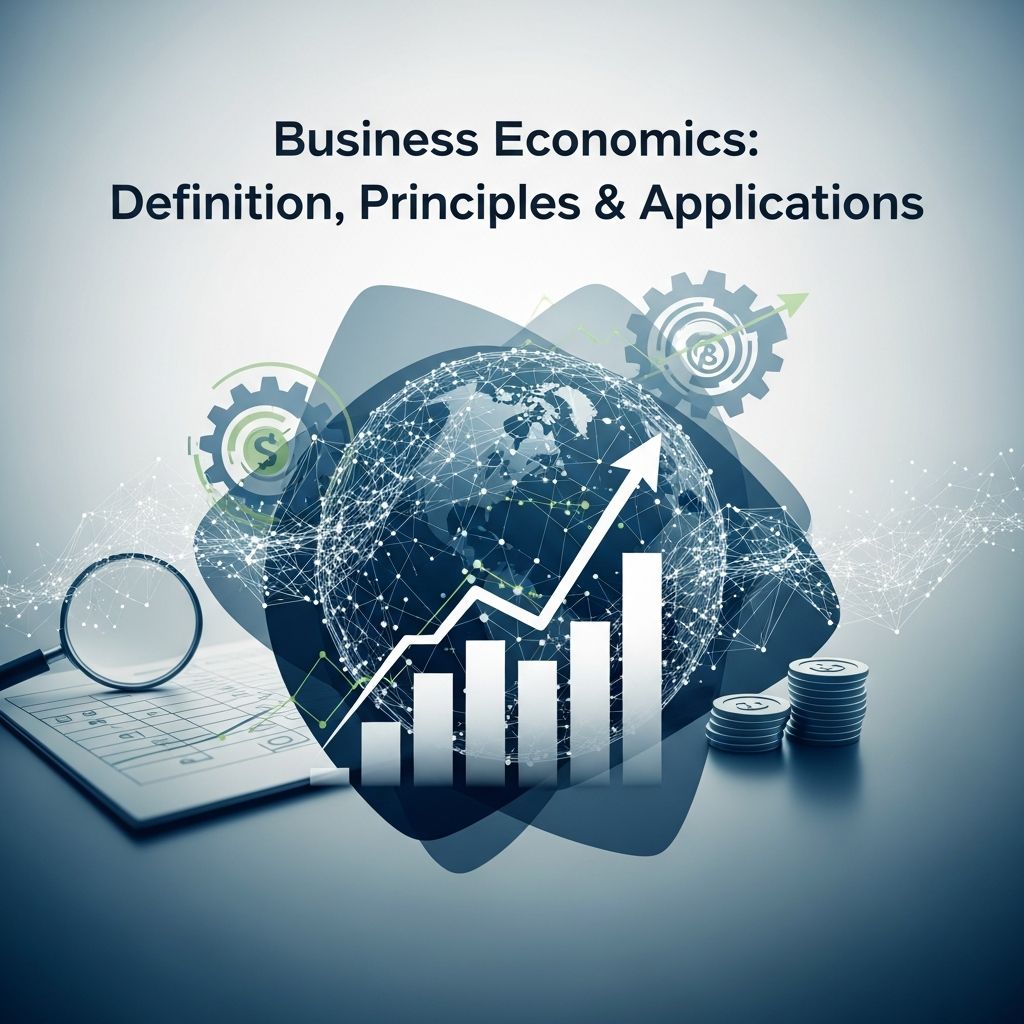
Business Economics: Definition, Principles & Applications
Master the fundamentals of business economics and its strategic application in modern enterprise decision-making.
What Is Business Economics?
Business economics is the application of economic theory and principles to the analysis of business decision-making and organizational strategy. It represents the intersection of economic science and practical business management, enabling companies to understand and respond to market dynamics, consumer behavior, and competitive forces. This discipline combines microeconomic analysis with real-world business challenges, helping managers and executives make informed decisions that maximize efficiency, profitability, and sustainable growth.
At its core, business economics examines how organizations allocate scarce resources—capital, labor, time, and materials—to achieve their objectives within competitive market environments. By applying economic reasoning to business problems, executives can better understand pricing strategies, production decisions, investment choices, and risk management approaches.
Core Principles of Business Economics
Business economics rests on several fundamental principles that guide organizational decision-making:
- Scarcity and Resource Allocation: Organizations face unlimited wants but limited resources. Business economics teaches managers how to allocate these scarce resources efficiently to maximize returns and minimize waste.
- Opportunity Cost: Every business decision involves choosing one alternative over another. Understanding opportunity cost helps leaders recognize what they give up when selecting one course of action, ensuring they choose the most valuable option.
- Supply and Demand: Market prices reflect the balance between what consumers want (demand) and what producers can provide (supply). Businesses must understand these dynamics to set competitive prices and forecast market conditions.
- Marginal Analysis: This principle examines how small changes in production, pricing, or marketing affect overall business performance. Managers use marginal analysis to determine optimal production levels and pricing strategies.
- Elasticity of Demand: Understanding how sensitive customers are to price changes helps businesses optimize pricing and predict revenue fluctuations in response to market conditions.
Microeconomic Foundations
Business economics primarily draws from microeconomic theory, which focuses on individual consumers, firms, and markets rather than the economy as a whole. Microeconomic concepts directly inform business strategy:
Consumer Behavior and Demand
Understanding consumer preferences, purchasing patterns, and price sensitivity enables businesses to develop effective marketing strategies and product positioning. Consumer surplus—the difference between what consumers are willing to pay and what they actually pay—influences pricing decisions and competitive advantage.
Production and Cost Analysis
Businesses must understand the relationship between inputs (labor, materials, equipment) and outputs (products or services). Cost analysis examines fixed costs (expenses that don’t change with production volume) and variable costs (expenses that fluctuate with production), helping determine the break-even point and optimal production levels.
Market Structures
Different market structures—perfect competition, monopolistic competition, oligopoly, and monopoly—create distinct business environments. Organizations must analyze their market structure to understand competitive intensity, pricing power, and barriers to entry. A technology company operating in an oligopoly faces different strategic challenges than a retailer in highly competitive markets.
Elasticity and Pricing Strategy
Price elasticity measures how demand changes with price adjustments. Products with inelastic demand (like essential medicines or utilities) allow higher profit margins through price increases, while elastic demand products (like luxury goods) require careful pricing to maintain sales volume.
Key Applications in Business Decision-Making
Strategic Pricing
Business economics provides frameworks for setting prices that balance profitability with market competitiveness. Managers analyze production costs, competitor pricing, customer willingness to pay, and demand elasticity to determine optimal price points. Dynamic pricing strategies—adjusting prices based on demand, inventory levels, and market conditions—exemplify economics-based business applications.
Production Planning and Optimization
Companies use economic analysis to determine optimal production volumes, factory capacity utilization, and supply chain efficiency. Marginal analysis helps identify the production level where marginal revenue equals marginal cost, maximizing profit margins. This principle guides decisions about whether to increase production or invest in new facilities.
Market Analysis and Forecasting
Business economists analyze market trends, consumer preferences, and competitive dynamics to forecast demand and identify growth opportunities. Understanding market structures helps predict competitor behavior and anticipate industry disruptions. This analysis informs product development, market entry strategies, and investment decisions.
Risk Management and Investment Evaluation
Economic principles guide capital investment decisions by comparing expected returns against risks. Present value analysis, cost-benefit analysis, and scenario planning help executives determine which projects deliver the best returns. Understanding economic cycles helps businesses prepare for recessions or expansionary periods.
Human Resources and Labor Economics
Business economics examines labor markets, wage determination, productivity, and compensation strategies. Understanding labor supply and demand helps organizations set competitive wages, retain talent, and optimize workforce productivity. Marginal revenue product of labor—the additional revenue generated by hiring one more worker—guides hiring decisions.
Competitive Strategy and Market Positioning
Business economics provides analytical tools for developing competitive advantage. Porter’s Five Forces framework, informed by microeconomic theory, examines competitive intensity, bargaining power of suppliers and customers, threats from substitutes, and barriers to entry. Companies use this analysis to identify strategic opportunities and develop defensible competitive positions.
Understanding value creation—the difference between what customers pay and the cost of production—helps businesses identify where to focus resources. Some companies compete on cost leadership by minimizing production expenses, while others pursue differentiation by creating unique products commanding premium prices. Business economics reveals which strategy best suits specific market conditions and competitive environments.
Organizational Economics and Efficiency
Beyond market analysis, business economics examines internal organizational efficiency. Transaction cost economics explores how organizational structures affect efficiency—determining whether to perform functions internally or outsource to external providers. This analysis influences decisions about vertical integration, supply chain design, and strategic partnerships.
Agency theory examines how to align incentives between managers (agents) and shareholders (principals). Compensation structures, performance metrics, and governance mechanisms reflect economic principles aimed at minimizing agency costs and promoting organizational objectives.
Digital Economy and Emerging Considerations
Modern business economics must address digital disruption and platform economies. Network effects—where a product becomes more valuable as more people use it—dramatically change traditional competitive dynamics. Data economics introduces new considerations about information as a scarce resource requiring strategic management. Understanding these contemporary applications keeps business economics relevant in rapidly evolving markets.
Quantitative Methods and Analysis
Business economists employ sophisticated analytical tools including regression analysis, econometrics, and forecasting models. Statistical analysis of historical data reveals relationships between variables—how advertising spending affects sales, how price changes influence demand, or how economic conditions impact business performance. These quantitative methods enable evidence-based decision-making rather than relying on intuition or tradition.
Common Analytical Approaches:
- Break-Even Analysis: Determines the production volume or sales level where total revenue equals total costs, identifying minimum performance thresholds.
- Regression Analysis: Identifies relationships between variables, such as how various factors influence demand or profitability.
- Scenario Planning: Analyzes potential outcomes under different assumptions, helping organizations prepare for uncertainty.
- Forecasting Models: Predict future demand, market trends, and economic conditions using historical data and statistical techniques.
Challenges and Limitations
While powerful, business economics has limitations. Economic models often simplify complex realities through assumptions that may not fully reflect actual market conditions. Behavioral economics reveals that consumers don’t always make perfectly rational decisions as traditional models assume. Unpredictable events—pandemics, geopolitical crises, technological breakthroughs—can invalidate historical patterns that models rely upon.
Additionally, business economics focuses primarily on profit maximization, sometimes overlooking social and environmental considerations increasingly important to stakeholders. Modern managers must balance economic efficiency with sustainability, corporate social responsibility, and ethical considerations.
Business Economics vs. Traditional Economics
| Aspect | Business Economics | Macroeconomics |
|---|---|---|
| Focus Level | Individual firms and micromarkets | National and global economies |
| Decision Context | Pricing, production, investment | Growth, inflation, employment |
| Primary Users | Business managers, executives | Policymakers, governments |
| Time Horizon | Short to medium term | Long-term trends |
Frequently Asked Questions
Q: How does business economics differ from general economics?
A: Business economics applies economic theory specifically to organizational decision-making and strategy, focusing on individual firms and markets. General economics includes macroeconomics, which examines aggregate economic phenomena like national growth and inflation. Business economics is more narrowly focused and practically oriented toward business operations.
Q: Why is understanding opportunity cost important for businesses?
A: Opportunity cost represents what a company sacrifices when choosing one alternative over another. Understanding this helps managers make better decisions by recognizing the true cost of their choices. For example, investing capital in a new factory means forgoing the returns that capital could generate elsewhere, so managers must ensure the new factory generates higher returns than alternative investments.
Q: How do businesses use elasticity in pricing decisions?
A: Businesses calculate price elasticity of demand to understand how customers respond to price changes. For products with inelastic demand (demand doesn’t change much with price), companies can increase prices to boost revenue. For elastic demand products (demand is sensitive to price), companies may need to maintain lower prices to maximize sales volume and revenue.
Q: What role does market structure play in business strategy?
A: Market structure determines competitive intensity and pricing power. In perfectly competitive markets, businesses have little pricing power and compete primarily on cost. In monopolistic markets, companies can set higher prices. Understanding whether you operate in monopoly, oligopoly, or competitive markets shapes strategic decisions about pricing, product differentiation, and investment.
Q: Can business economics predict future market conditions?
A: Business economics provides forecasting tools based on historical patterns and statistical analysis, but predictions have limitations. Unexpected events like pandemics, technological disruptions, or geopolitical crises can invalidate forecasts based on past data. Successful businesses use economic analysis alongside scenario planning and risk management to prepare for uncertainty.
References
- Principles of Microeconomics — N. Gregory Mankiw. Cengage Learning. 2020. https://www.cengage.com/c/principles-of-microeconomics-9e-mankiw/
- Business Economics: Applying Economic Theory to Management Decisions — Bhattacharyya, Arindam. Journal of Economic Literature. 2019. https://www.aeaweb.org/
- Strategic Management and Business Economics Framework — Harvard Business Review. 2023. https://hbr.org/
- Market Structure and Competitive Strategy — Porter, Michael E. Competitive Strategy: Techniques for Analyzing Industries and Competitors. Free Press. 2004. https://www.iftf.org/
- Behavioral Economics and Decision Making — Kahneman, Daniel. Thinking, Fast and Slow. Farrar, Straus and Giroux. 2011. https://en.wikipedia.org/wiki/Daniel_Kahneman
- Agency Theory and Organizational Economics — Jensen, Michael C. & Meckling, William H. Journal of Financial Economics. 1976. https://doi.org/10.1016/0304-405X(76)90026-X
Similar Articles








Read full bio of medha deb