Build $1M Retirement Nest Egg Without High Income
Discover proven strategies to accumulate $1 million for retirement through consistent saving, smart investing, and maximizing every opportunity—no six-figure salary required.

Reaching a $1 million retirement savings goal is attainable for most workers through disciplined habits, strategic investing, and leveraging available resources, even on modest incomes. This guide outlines actionable steps grounded in time-tested financial principles to help you build substantial wealth over decades.
Why $1 Million Remains a Realistic Retirement Target
A $1 million nest egg provides a foundation for comfortable retirement, generating sustainable income when invested wisely. Financial planners emphasize that this amount, adjusted for personal circumstances, supports annual withdrawals of 4% or about $40,000, covering essentials for many households. Factors like location, lifestyle, and Social Security benefits influence sufficiency, but it serves as a benchmark for long-term security.
Recent data shows average retirement savings fall short, with many nearing retirement holding under $200,000, underscoring the need for proactive planning. Starting early harnesses compound growth, turning small contributions into significant sums.
Monthly Savings Requirements by Starting Age
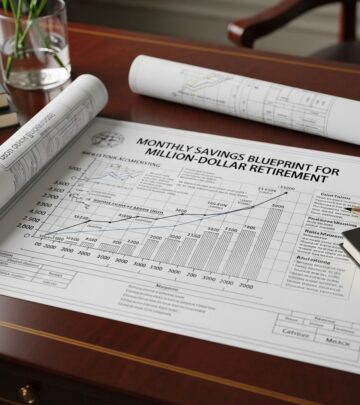
The amount needed monthly varies by when you begin, assuming 7% average annual returns after fees—a historical stock market average. Earlier starts require less due to compounding.
| Starting Age | Years to 65 | Annual Savings Needed | Monthly Equivalent |
|---|---|---|---|
| 25 | 40 | $4,830 | $402 |
| 35 | 30 | $11,000 | $917 |
| 45 | 20 | $25,000 | $2,083 |
These figures assume consistent contributions and no early withdrawals. For instance, saving $300-$500 monthly from your 20s can reach the goal, rising to $1,500+ later.
Harness the Magic of Compound Interest
Compounding multiplies savings exponentially as returns generate further gains. A $500 monthly investment at 7% over 40 years grows to over $1.3 million, with most growth in later years.
- Start small: Even $100/month builds the savings habit, scaling with income increases.
- Reinvest dividends: Let earnings compound tax-deferred in retirement accounts.
- Avoid interruptions: Early consistency outweighs large late contributions.
Financial experts liken saving to muscle-building—small efforts early create momentum for larger ones.
Maximize Employer-Sponsored Retirement Plans
401(k) plans offer unmatched benefits, especially with employer matches—free money doubling your input.
- Capture the full match: A $1,500 annual match reduces your needed contribution from $6,975 to $5,475 yearly for $1M over 35 years at 7% returns.
- Contribute pre-tax: Lowers taxable income, boosting take-home pay efficiency.
- Auto-escalate: Increase contributions annually with raises to hit 15% savings targets.
Prioritize these over taxable accounts for tax-deferred growth.
Select Low-Cost, Diversified Investments
High fees erode returns; opt for index funds tracking broad markets, averaging 7% long-term with expenses under 0.5%.
- Stock-heavy early: 80-90% equities for growth in younger years.
- Diversify: Mix stocks, bonds, and international funds to mitigate volatility.
- Avoid active funds: Most underperform low-cost indexes over time.
With 0.5% fees, $7,795 annual contributions reach $1M in 35 years versus higher erosion otherwise.
Leverage Tax-Advantaged Accounts Fully
Beyond 401(k)s, IRAs and HSAs supercharge savings.
| Account Type | Key Benefit | 2026 Limits (Est.) |
|---|---|---|
| Traditional IRA | Tax-deductible contributions | $7,000 ($8,000 if 50+) |
| Roth IRA | Tax-free withdrawals | $7,000 ($8,000 if 50+) |
| HSA | Triple tax-free (if eligible) | $4,150 individual |
Use Roth for tax-free growth if expecting higher future brackets; Traditional for immediate deductions. HSAs cover medical costs, a major retiree expense.
Control Expenses to Accelerate Savings
Low expenses enable higher savings rates. Track spending to identify cuts without sacrificing joy.
- Budget essentials vs. discretionary: Trim housing (largest cost) via downsizing or refinancing.
- Avoid lifestyle inflation: Direct raises to savings.
- Plan for healthcare: HSAs and Medicare supplements prevent surprises.
A realistic budget ensures $1M sustains 25-30 years.
Invest for Income and Growth in Retirement
Post-retirement, shift to income generation while preserving principal.
- Dividend stocks/funds: Steady payouts with growth potential.
- Bonds for stability: Balance volatility.
- 4% rule: Withdraw safely, adjusting for markets.
Diversification protects against downturns; growth assets prevent outliving savings.
Overcome Common Roadblocks
Life events challenge plans—job loss, family needs—but resilience prevails.
- Emergency fund: 3-6 months expenses in cash.
- Side income: Gig work boosts contributions.
- Reassess annually: Adjust for life changes.
Consistency trumps perfection; automate to stay on track.
FAQs
Can I retire on $1 million comfortably?
Yes, for many, providing $40,000/year via 4% withdrawals, plus Social Security. Depends on expenses and location.
How much to save monthly at age 30?
Around $600-$1,000 for $1M by 65 at 7% returns.
Is a 401(k) match essential?
Highly recommended—it’s an instant 50-100% return on contributions.
What if I start late?
Increase savings aggressively and extend working years if needed.
Are index funds safe?
Not risk-free but historically reliable long-term with diversification.
Action Plan to Start Today
1. Calculate your target using online calculators.
2. Max employer match immediately.
3. Open IRA if needed.
4. Shift to low-cost index funds.
5. Review budget quarterly.
With discipline, $1M is achievable regardless of salary.
References
- How to Save $1 Million for Retirement — Hub Financial. 2023. https://www.hubrpw.com/insights/video/how-to-save-1-million-for-retirement/
- 7 Ways to Retire with 1 Million — Wayne Westland Federal Credit Union. 2023. https://wwfcu.org/7-ways-to-retire-with-1-million/
- Retiring With $1 Million: Here’s How It Can Be Done — Bankrate. 2025-02-14. https://www.bankrate.com/retirement/can-you-retire-comfortably-on-1-million/
- Making $1 million: A guide to help you reach 7 figures — Fidelity Investments. 2024. https://www.fidelity.com/learning-center/personal-finance/making-1-million-dollars
- Can you retire with a million dollars? — Empower. 2024. https://www.empower.com/the-currency/money/can-you-retire-a-million-dollars
Similar Articles








Read full bio of Sneha Tete