Broad Money: Understanding Money Supply Aggregates
Explore broad money's role in monetary policy, economic stability, and financial systems.
What Is Broad Money?
Broad money represents the sum of all liquid financial instruments held by money-holding sectors that are widely accepted in an economy as a medium of exchange, plus those that can be converted into a medium of exchange at short notice at, or close to, their full nominal value. This comprehensive measure of the money supply plays a fundamental role in how central banks and policymakers understand and manage their economies. Unlike narrow money, which includes only the most liquid assets such as physical currency and demand deposits, broad money encompasses a wider spectrum of financial assets that can relatively quickly be converted into cash.
The concept of broad money is essential for understanding how modern economies function and how monetary policy affects different economic variables. Central banks monitor broad money closely because changes in its supply can influence inflation, interest rates, employment, and overall economic growth. Economists and policymakers use broad money as a key indicator to assess the health of the financial system and make informed decisions about monetary policy adjustments.
Understanding the Components of Broad Money
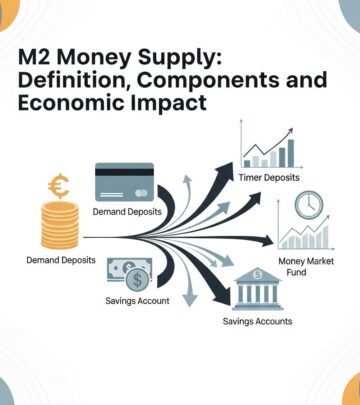
Broad money consists of several layers of financial assets, each with varying degrees of liquidity. The primary components include physical currency in circulation, demand deposits held in checking and savings accounts, time deposits, certificates of deposit (CDs), money market accounts, and various other liquid financial instruments. These components are organized hierarchically, with the most liquid assets forming the core and progressively less liquid assets added as the definition expands.
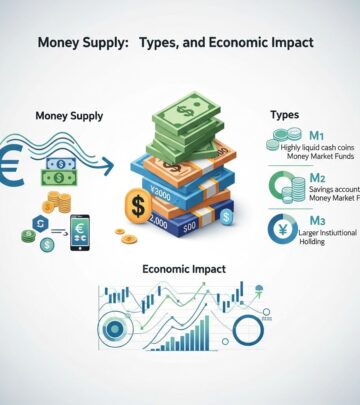
The specific composition of broad money can vary significantly across different countries and monetary systems. In the United States, broad money typically includes M1 (currency plus demand deposits) and M2 (M1 plus savings deposits and money market accounts). In the Eurozone, the European Central Bank defines M3 as broad money, which includes M1, M2, and additional components such as large time deposits, repurchase agreements, and money market fund shares. Understanding these variations is crucial for international investors and economists analyzing different economies.
Broad Money Versus Narrow Money
The distinction between broad and narrow money is fundamental to monetary economics. Narrow money, also called M0 or M1 depending on the country, includes only the most liquid assets: physical currency and demand deposits that can be accessed immediately. These are the assets most directly controlled by central bank policy and most readily used for everyday transactions.
Broad money, conversely, includes all components of narrow money plus additional less-liquid assets that can be converted to cash relatively quickly. This broader definition recognizes that modern economies function with a complex array of financial instruments beyond simple currency and checking accounts. While narrow money is the immediate medium of exchange, broad money encompasses assets that serve as stores of value and can fulfill monetary functions over slightly longer timeframes.
The relationship between narrow and broad money is critical for understanding monetary transmission mechanisms. When the Federal Reserve or other central banks adjust their policy rates or engage in open market operations, these actions initially affect narrow money most directly. However, changes in narrow money eventually influence broad money supplies, which in turn affect overall credit conditions, interest rates, and economic activity. Different economic theories and policymakers may emphasize one measure over another depending on their analytical framework and policy objectives.
How Broad Money Is Measured and Expressed
Central banks and international organizations like the International Monetary Fund (IMF) measure broad money through standardized statistical methodologies. Broad money is typically expressed as a percentage of Gross Domestic Product (GDP), which represents the total income earned through production of goods and services in an economic territory during an accounting period. This percentage allows for meaningful comparisons across countries of different sizes and at different points in time.
The measurement of broad money follows the Monetary and Financial Statistics Manual established by the IMF, ensuring international consistency and comparability. National central banks compile detailed data on all components of broad money, including currency in circulation, various types of deposits, money market instruments, and other financial assets meeting the liquidity criteria. This data is collected with annual periodicity and tracked continuously to monitor changes in the money supply.
The derivation and calculation of broad money indicators has been standardized to ensure accuracy and consistency. Modern calculations typically divide current-year broad money by current-year GDP and multiply by 100 to express the result as a percentage. This standardization makes it easier for policymakers, investors, and analysts to understand monetary conditions and make appropriate economic decisions. Different time periods and reference ranges allow economists to track long-term trends in money supply relative to economic output.
The Role of Broad Money in Monetary Policy
Central banks use broad money as a critical tool and indicator in formulating and executing monetary policy. By monitoring changes in broad money growth, central bankers can assess whether they are providing appropriate liquidity to the economy or whether conditions are becoming too tight or too loose. When broad money grows too rapidly, it may signal inflationary pressures ahead, prompting central banks to raise interest rates or reduce the monetary base. Conversely, when broad money growth slows significantly, it may indicate economic weakness, potentially leading central banks to ease policy.
The transmission of monetary policy operates through various channels, and broad money serves as a crucial link between central bank actions and real economic outcomes. When central banks inject liquidity into the system through open market operations or other mechanisms, broad money typically increases. This increase in liquidity can lower interest rates, encourage borrowing and spending, and stimulate economic activity. However, if broad money expands too rapidly relative to the productive capacity of the economy, it can generate inflation without corresponding real economic growth.
Different central banks and monetary economists may weight the importance of broad money differently in their policy frameworks. Some institutions focus primarily on narrow money or the monetary base, viewing these as more directly controllable through policy instruments. Others emphasize broad money as it more accurately captures the total liquidity available in the economy for spending and investment decisions. The choice of monetary aggregate to target reflects different theoretical perspectives and practical considerations about monetary transmission mechanisms.
Significance for Economic Stability and Financial System Health
Broad money serves as a vital indicator of financial system stability and economic health. For central banks and policymakers, monitoring broad money provides crucial information about the functioning of the monetary system and the availability of credit in the economy. Sudden changes in broad money growth can signal emerging problems in the financial system, such as a credit crunch or excessive speculative activity. Regulators use broad money data to assess systemic risks and take preventive measures when necessary.
For investors and market analysts, broad money figures provide a window into financial sector stability and overall economic performance, guiding investment decisions and risk evaluations. A healthy financial system typically shows steady, moderate growth in broad money aligned with real economic growth and inflation targets. Periods of unusually rapid broad money expansion may indicate asset bubbles or excessive leverage building in the system, while sharp contractions in broad money often signal financial stress or economic recession.
The relationship between broad money and economic variables such as inflation, employment, and growth is well-established in economic theory and empirical research. The quantity theory of money suggests that changes in the money supply have proportional effects on the price level in the long run. More sophisticated modern theories recognize complex lags and nonlinearities in these relationships, but the fundamental importance of monitoring broad money remains clear. Central banks that ignore broad money dynamics risk creating either insufficient liquidity for healthy economic growth or excessive liquidity that generates inflation.
International Variations in Broad Money Definitions
Different countries define and measure broad money according to their specific institutional frameworks and monetary systems. In the United Kingdom, M4 is the official measure of broad money and includes currency in circulation plus all deposits and other claims on the banking system. The European Central Bank defines M3 as broad money for the Eurozone, which encompasses M1, M2, and additional components including large deposits and money market instruments. The Australian Reserve Bank defines broad money as M3 plus borrowings from the private sector by nonbank financial institutions, reflecting Australia’s particular financial structure.
These variations reflect different economic structures, financial market development levels, and policy traditions across countries. The New Zealand Reserve Bank’s definition of M3 as the broadest monetary aggregate includes all New Zealand dollar funding of M3 institutions and central bank repurchase agreements. Understanding these different definitions is essential for anyone conducting international economic analysis or managing global investment portfolios. What qualifies as broad money in one country may not precisely correspond to broad money in another, making direct international comparisons challenging without careful adjustment.
Frequently Asked Questions
Q: How does broad money differ from M1 money supply?
A: M1 represents narrow money and includes only currency in circulation and demand deposits. Broad money (typically M2, M3, or M4 depending on the country) includes M1 plus less liquid assets like time deposits, money market accounts, and certificates of deposit. Broad money provides a more comprehensive picture of liquid financial assets available in an economy.
Q: Why do central banks monitor broad money?
A: Central banks monitor broad money to assess monetary conditions, gauge inflationary pressures, and evaluate financial system health. Changes in broad money growth can signal whether the economy has sufficient liquidity or faces constraints, helping policymakers make informed decisions about interest rates and monetary policy adjustments.
Q: Can broad money be too large relative to GDP?
A: Yes, when broad money expands significantly faster than GDP growth, it may indicate excessive liquidity in the economy that could fuel inflation or asset bubbles. Conversely, broad money growing slower than GDP may signal insufficient liquidity and economic constraints. The ideal rate of broad money growth generally tracks real economic growth plus the central bank’s inflation target.
Q: How does broad money relate to inflation?
A: According to monetary theory, sustained rapid growth in broad money relative to economic output tends to increase inflationary pressures over time. Central banks use broad money growth as one indicator among many to assess inflation risks and make policy adjustments to maintain price stability and economic balance.
Q: What causes changes in broad money supply?
A: Changes in broad money result from central bank actions (open market operations, discount rate changes, reserve requirements), commercial bank lending decisions, and changes in economic activity and confidence. Central banks can influence broad money growth, but they do not control it completely, as private sector decisions about borrowing and saving also affect the money supply.
References
- Broad money (% of GDP) – Glossary — World Bank DataBank. 2025. https://databank.worldbank.org/metadataglossary/world-development-indicators/series/FM.LBL.BMNY.GD.ZS
- Money supply — International Monetary Fund & Central Banks. 2024. https://www.imf.org/
Similar Articles








Read full bio of medha deb