BOT Contract: Build-Operate-Transfer Model Explained
Understand BOT contracts: A comprehensive guide to build-operate-transfer project financing.
What Is a BOT Contract?
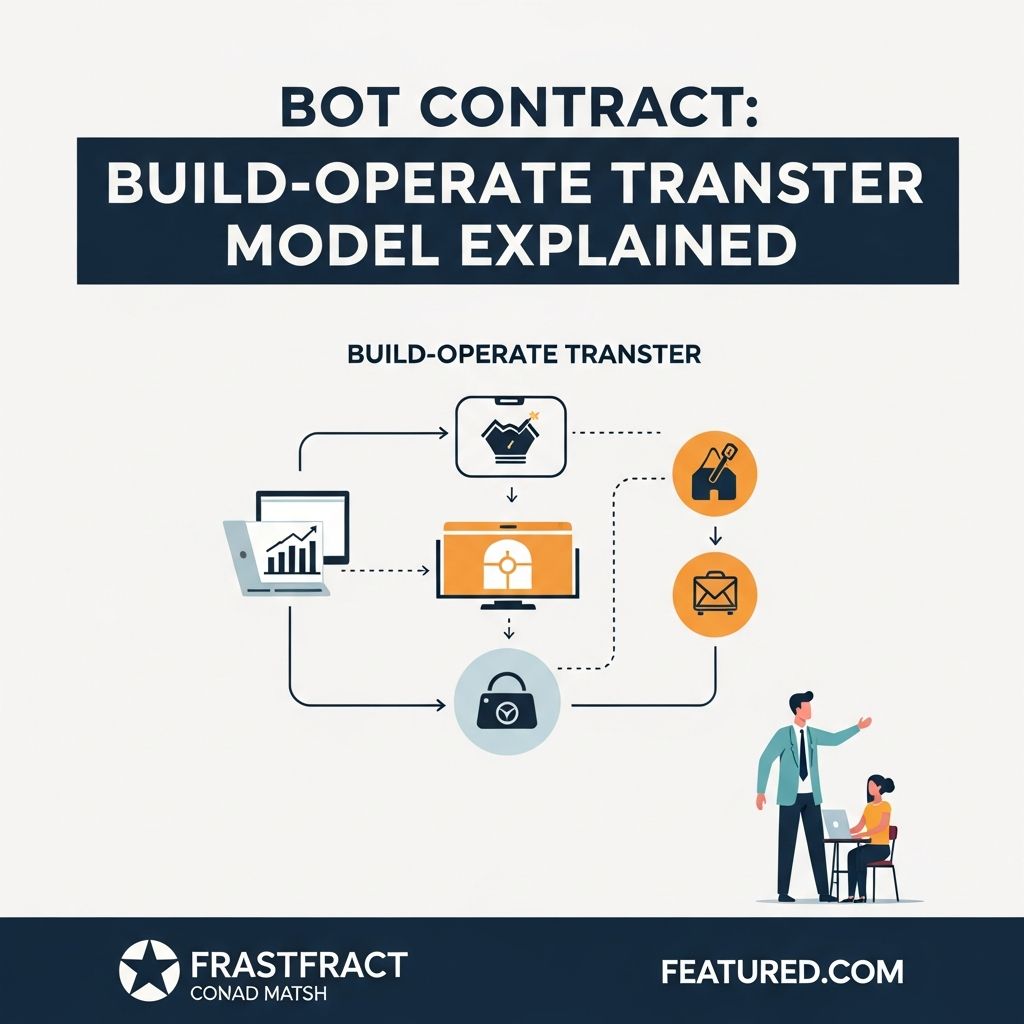
A Build-Operate-Transfer (BOT) contract is a project delivery and financing mechanism primarily used for large-scale infrastructure projects. Under this model, a government entity grants a concession to a private sector party—typically a consortium of financiers, architects, developers, and engineers—to design, build, finance, and operate a facility for a specified period. The private entity assumes responsibility for raising capital, constructing the project, and operating it during the concession period, while the government retains ownership of the asset. Upon expiration of the contract period, typically spanning 20 to 40 years, control and ownership transfer completely to the government entity.
BOT contracts represent an alternative financing approach to traditional government-funded infrastructure development. Rather than bearing the entire financial burden and operational risk, governments can leverage private sector expertise, capital, and efficiency while maintaining long-term control over critical infrastructure assets. This model has become increasingly popular in developing nations and emerging markets seeking to expand infrastructure without straining public budgets.
How BOT Contracts Work
The operational mechanics of a BOT contract involve several distinct phases and stakeholder responsibilities. The process begins when a government authority issues a concession—a formal license granting the private entity rights to execute, implement, and construct a public utility infrastructure or service.
The private consortium then assumes full responsibility for project financing, design, and construction. Unlike traditional procurement methods where governments fund projects directly, private entities must secure their own financing through banks, development finance institutions, and other capital sources. This risk transfer incentivizes private operators to manage costs efficiently and meet quality standards.
During the operational phase, the private entity operates and maintains the facility, collecting revenues through user fees, tolls, or government payments. The concessionaire retains these revenues to recover its initial investment, cover operating expenses, and generate returns. The government typically pays a fixed fee, milestone-based payments, or a combination thereof to the private operator.
Upon contract completion, the facility transfers to government control at no additional cost. The infrastructure then becomes a public asset, potentially operated by government agencies or continued under new private management arrangements.
Key Characteristics of BOT Contracts
BOT contracts possess several defining features that distinguish them from other project delivery mechanisms:
Risk Allocation
Risk distribution represents a fundamental advantage of BOT arrangements. The private sector assumes construction, operational, and financial risks, while the government shares market and regulatory risks. This balanced risk allocation protects public finances from project overruns and operational failures.
Long-Term Concession Periods
BOT contracts typically extend for 25 to 40 years, providing private operators sufficient time to recoup investments and generate acceptable returns. The extended timeframe reflects the capital-intensive nature of infrastructure projects and the lengthy payback periods required for profitability.
Revenue Generation Mechanisms
Private operators generate revenues through various channels. In some cases, they collect user fees or tolls directly from facility users. Alternatively, governments may pay fees to operators, particularly when infrastructure serves public purposes where direct user charges prove impractical or politically unfeasible.
Technology and Expertise Transfer
Private sector involvement brings advanced technology, management expertise, and operational best practices to infrastructure projects. This knowledge transfer enhances project efficiency and service quality beyond what government agencies might achieve independently.
BOT Contract Structure and Essential Clauses
Comprehensive BOT contracts contain numerous provisions addressing project scope, timelines, performance standards, and dispute resolution mechanisms.
Scope of Work
The scope clause delineates all work required from the contractor, encompassing design, construction, financing, operation, and maintenance obligations. Sample contractual language typically states: “The concessionaire shall have the right and obligation at its cost, with due care and diligence and in accordance with good engineering and operating practices, to design, build, own, operate, finance, and maintain the project subject to and in accordance with the provisions of this agreement.”
Completion Timelines
Contracts specify precise completion deadlines, establishing the timeframe within which contractors must finish construction and satisfy performance tests. This clause protects government interests by ensuring timely project delivery and reduces the risk of indefinite project extensions.
Performance Standards
Detailed performance specifications establish quality benchmarks and operational requirements. These standards ensure facilities meet government expectations and serve public needs effectively throughout the concession period.
Financial Terms
Contracts precisely define payment mechanisms, including fee structures, payment schedules, and provisions for price adjustments. Many contracts tie fee increases to inflation indices and economic variables, allowing operators to maintain satisfactory returns despite changing economic conditions.
Dispute Resolution Mechanisms
Comprehensive dispute resolution provisions establish procedures for addressing disagreements between government and private operators, typically including negotiation, mediation, and arbitration processes.
Types of BOT and Related Models
Several variations of the BOT model exist, each tailored to specific project characteristics and financing requirements.
Build-Own-Operate-Transfer (BOOT)
Under BOOT arrangements, private entities construct and own facilities for specified periods before transferring ownership to governments. This model proves particularly suitable for schools, hospitals, and ports, where private ownership during the operational phase provides additional security for investment recovery. BOOT contracts typically involve massive financial requirements but offer operators greater control and revenue security.
Design-Build (DB)
Design-Build contracts assign performance specification responsibilities to individual private entities rather than consortiums, potentially reducing costs and timelines while providing performance guarantees. This streamlined approach suits projects where design and construction integration enhances efficiency.
Design-Build-Finance (DBF)
Under DBF arrangements, private entities design, construct, and finance capital costs exclusively during the construction phase. The government assumes financing responsibilities for operational expenses, creating a shared financing structure suited to certain project types.
Advantages of BOT Contracts
BOT arrangements offer substantial benefits to government entities and public sectors:
Reduced Government Financial Burden
Private sector financing eliminates massive upfront public expenditures, preserving government resources for other priorities. Governments avoid the debt accumulation that traditional infrastructure financing requires.
Risk Transfer and Mitigation
Private entities assume construction, operational, and financial risks, protecting public budgets from cost overruns and performance failures. This risk allocation incentivizes efficient project management and quality control.
Access to Expertise and Technology
Private consortiums bring specialized knowledge, advanced technologies, and international best practices to infrastructure development. This expertise typically exceeds capabilities within many government agencies.
Operational Efficiency
Private sector management often achieves superior operational efficiency compared to government agencies, resulting in better service quality and lower lifecycle costs. Competition and profit incentives drive performance improvements.
Faster Project Delivery
Streamlined private sector processes often accelerate project timelines compared to traditional government procurement and construction methodologies.
Disadvantages and Risks of BOT Contracts
Despite significant advantages, BOT arrangements present notable challenges and risks requiring careful management:
Higher Financing Costs
Private sector financing typically carries higher interest rates than government borrowing, increasing overall project costs that ultimately transfer to users through higher fees or government payments.
Public Accountability Concerns
Private operation of essential infrastructure may reduce public sector oversight and accountability. Profit-driven operators may prioritize financial returns over universal service provision.
Complex Negotiations
Extensive contract negotiations between governments and private entities consume significant time and resources. Disagreements over contract terms can delay project initiation.
Performance and Quality Risks
Private operators may reduce maintenance investments or service quality to enhance profits, potentially compromising infrastructure integrity over extended concession periods.
Regulatory and Political Risks
Changes in government policies, regulatory environments, or political administrations can jeopardize project viability and investor returns, potentially leading to disputes or contract termination.
BOT Contracts in Different Sectors
BOT arrangements have proven particularly effective in specific infrastructure categories:
Transportation Infrastructure
Toll roads, bridges, airports, and ports represent primary BOT applications. User fees provide clear revenue mechanisms supporting private sector investment recovery.
Energy Projects
Power generation facilities, particularly renewable energy projects, frequently employ BOT structures. Long-term power purchase agreements with governments ensure revenue predictability.
Water and Sanitation
Water treatment facilities and sanitation systems utilize BOT models, though government payments often supplement user revenues given social considerations around water access.
Information Technology
Increasingly, BOT models apply to technology infrastructure and IT service centers. Private entities build and operate development centers or research facilities before transferring control to client organizations. This approach proves particularly popular in countries including Ukraine, Poland, Romania, India, Vietnam, and the Philippines.
Best Practices for BOT Contract Implementation
Successful BOT projects require adherence to several critical practices:
Comprehensive Due Diligence
Governments must conduct thorough feasibility studies, market analyses, and financial projections before issuing concessions. Inadequate due diligence leads to unrealistic assumptions and subsequent project failures.
Clear Contractual Agreements
Detailed contracts must clearly outline project terms, deliverables, timelines, and costs, with provisions for dispute resolution, termination, and confidentiality protecting all parties’ interests.
Transparent Financial Arrangements
Governments should request comprehensive transparency regarding project costs, payment terms, and additional fees, ensuring fair and budget-aligned financial structures.
Effective Risk Management
Collaborative risk identification and mitigation planning address potential challenges including market volatility, political instability, and operational disruptions. Contingency plans should address foreseeable risks.
Robust Communication Channels
Established communication protocols and transparent dialogue mechanisms facilitate effective collaboration and timely problem-solving throughout project lifecycles.
Performance Monitoring
Implementation of performance monitoring and evaluation processes with defined key performance indicators ensures alignment with project goals and service quality standards.
Scalability Assessment
Governments should evaluate private operators’ capacity to accommodate future growth and changing requirements, discussing scalability options and resource allocation strategies.
Exit Strategy Development
Comprehensive exit strategies defining knowledge transfer and asset handover processes minimize disruption during transitions to government control.
BOT Contracts and Public-Private Partnerships
BOT arrangements represent one of several public-private partnership (PPP) models. PPPs constitute alternative financing methods for capital-intensive infrastructure projects funded by private sectors, enabling infrastructure upgrades, renewals, or entirely new construction. Different PPP contract types vary based on project characteristics, risk factors, financing requirements, and desired outcomes.
BOT contracts prove particularly common among PPP structures because they effectively balance risk allocation, leverage private sector capabilities, and preserve government control over long-term asset management. The framework has facilitated hundreds of infrastructure projects worldwide, particularly in developing nations lacking sufficient public capital for large-scale development initiatives.
Global BOT Applications and Case Studies
BOT models have gained prominence in numerous countries and regions. The Belt and Road Initiative, for example, extensively utilizes BOT mechanisms for financing large-scale infrastructure projects across Asia, Africa, and beyond. Chinese developers and other private entities construct projects according to design specifications and operate them for specified periods before transferring control to host countries.
This global application demonstrates BOT contracts’ versatility across diverse economic, political, and regulatory contexts. Successful implementations require careful adaptation to local conditions while maintaining core structural principles.
Frequently Asked Questions
Q: What is the primary advantage of BOT contracts for governments?
A: The primary advantage is reduced government financial burden. BOT contracts transfer infrastructure financing and construction risk to private entities, preserving public resources for other priorities while providing access to private sector expertise and technology.
Q: How long do BOT concession periods typically last?
A: BOT concession periods typically range from 20 to 40 years, with many contracts specifying 25 to 30 years. Extended periods allow private operators sufficient time to recover investments and generate acceptable returns on their capital.
Q: What happens to the infrastructure when the BOT contract expires?
A: Upon contract expiration, the facility transfers to government ownership and control at no additional cost. The infrastructure then becomes a public asset that governments may operate directly or through alternative management arrangements.
Q: How do private operators recover their investments under BOT contracts?
A: Private operators recover investments through multiple mechanisms: collecting user fees or tolls directly from facility users, receiving government payments, or generating operational revenues. Fee structures often include provisions for price adjustments tied to inflation and economic variables.
Q: What sectors most commonly utilize BOT contracts?
A: BOT contracts primarily apply to transportation (toll roads, bridges, airports), energy projects (power generation), water and sanitation infrastructure, and increasingly to technology and IT service centers.
Q: How do BOT contracts differ from BOOT contracts?
A: Under BOOT (Build-Own-Operate-Transfer) arrangements, private entities retain ownership during the operational phase before transferring assets to governments. BOT contracts transfer ownership immediately upon facility completion, with private operators receiving usage rights rather than ownership.
Q: What risks do private operators face in BOT arrangements?
A: Private operators face construction risks, operational risks, financial risks, regulatory risks, and political risks. Changes in government policies or political administrations can jeopardize project viability and investor returns.
Conclusion
Build-Operate-Transfer contracts represent sophisticated project delivery mechanisms that balance government fiscal constraints with infrastructure development imperatives. By leveraging private sector capital, expertise, and operational efficiency while maintaining long-term public control, BOT arrangements have become increasingly prevalent in infrastructure financing globally. Successful implementation requires comprehensive due diligence, transparent financial arrangements, effective risk management, and robust contractual frameworks. As governments worldwide grapple with aging infrastructure and limited public budgets, BOT contracts will likely continue expanding as viable alternatives to traditional procurement methods, particularly in developing economies seeking accelerated infrastructure development.
References
- Overview of BOT (Build-Operate-Transfer) Contracts — iPleaders. 2024. https://blog.ipleaders.in/overview-of-bot-contracts/
- BOT Meaning: The Build-Operate-Transfer Model — Bluecoding. 2024. https://www.bluecoding.com/post/bot-meaning-the-build-operate-transfer-model
- Build-Operate-Transfer (BOT) — Asia Society Policy Institute. 2024. https://asiasociety.org/policy-institute/navigating-belt-road-initiative-toolkit/glossary/infrastructure-development/build-operate-transfer-bot
- Build–operate–transfer — Wikipedia. 2024. https://en.wikipedia.org/wiki/Build–operate–transfer
Similar Articles








Read full bio of medha deb