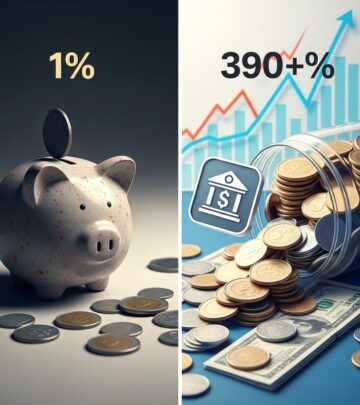
Boost Your Savings: Earn $380 More on $10K Yearly
Discover how switching from low-rate bank savings to high-yield options can add hundreds to your annual earnings without added risk.

Keeping substantial sums in low-interest savings accounts means missing out on significant earnings potential. For instance, with $10,000 in a typical big-bank savings account yielding just 0.04% APY, your annual interest might total around $4. High-yield alternatives, however, can deliver up to 5% APY, generating approximately $500 yearly— a difference of $380 that compounds over time. This guide explores why traditional banks lag, highlights superior options, and provides actionable steps to maximize your savings growth.
Understanding the Savings Rate Landscape in 2026
Savings account rates have fluctuated with Federal Reserve policies, but as of March 2026, a clear divide exists between legacy banks and modern online institutions. National averages hover around 0.39% APY according to FDIC data, yet top performers exceed 4%—often 10-100 times higher. This disparity stems from operational efficiencies: online banks avoid physical branches, passing savings to customers via better rates.
Bank of America’s Advantage Savings exemplifies traditional offerings. Tiered based on relationship balances, its top rate reaches only 0.04% APY for Platinum Honors or Diamond Honors tiers, requiring $100 minimum deposits. Even at peak, this barely outpaces inflation, eroding purchasing power.
| Bank of America Tier | APY | Min. Deposit | Est. Yearly on $10K |
|---|---|---|---|
| Standard Advantage | 0.01% | $100 | $1 |
| Gold | 0.02% | $100 | $2 |
| Platinum | 0.03% | $100 | $3 |
| Platinum/Diamond Honors | 0.04% | $100 | $4 |
Contrast this with high-yield leaders. Varo Money offers up to 5.00% APY, Axos Bank 4.21%, and Newtek Bank 4.20% as of mid-March 2026. These rates apply broadly, often with no balance tiers or minimums beyond opening deposits.
Why Big Banks Like Bank of America Pay So Little
Brick-and-mortar giants prioritize convenience—thousands of ATMs, in-person service—but this costs dearly. Branch networks, staff, and marketing inflate expenses, squeezing margins for interest payouts. Bank of America, with its Preferred Rewards program, incentivizes loyalty through tiers, but even elite levels yield paltry returns compared to competitors.
Regulatory caps don’t bind rates directly; market competition does. Online-only banks like Marcus by Goldman Sachs (3.65% APY) or SoFi (up to 4.00%) leverage digital models for agility. They adjust rates swiftly to Fed moves, maintaining competitive edges while big banks lag.
- Operational Costs: Physical infrastructure vs. app-based services.
- Scale: Online banks pool deposits efficiently for higher yields.
- Customer Base: Tech-savvy savers flock to better rates, pressuring innovation.
Top High-Yield Savings Accounts to Consider
Selecting the best account balances rate, accessibility, and features. All listed are FDIC-insured up to $250,000, matching Bank of America’s protection.
| Institution | APY (as of Mar 2026) | Min. Deposit | Key Features | Est. Yearly on $10K |
|---|---|---|---|---|
| Varo Money | Up to 5.00% | $0 | No fees, mobile-first | $500 |
| Axos Bank | 4.21% | $0 | Unlimited transfers | $421 |
| Newtek Bank | 4.20% (best no-min) | $0 | Award-winning | $420 |
| SoFi | Up to 4.00% | $0 | Checking hybrid, bonuses | $400 |
| Marcus by Goldman Sachs | 3.65% | $0 | Savings goals tool | $365 |
| Openbank by Santander | 4.20% | $500 | Competitive entry | $420 |
These outperform Bank of America’s max by 100x. For $10K, the gap is stark: $4 vs. $400+. Rates fluctuate; check current figures before switching.
Calculating Your Potential Gains
Use this formula for annual interest: Principal × APY. For $10,000:
- Bank of America (0.04%): $10,000 × 0.0004 = $4
- Varo (5%): $10,000 × 0.05 = $500
- Difference: $496
Over 5 years, assuming steady rates and no withdrawals, compound growth amplifies this. At 5% APY, $10K grows to $12,762; at 0.04%, just $10,020. Tools like online calculators from FDIC or bank sites aid precise projections.
Steps to Switch and Maximize Earnings
- Assess Current Account: Log into Bank of America to view exact APY and fees.
- Compare Options: Use aggregators like Bankrate or NerdWallet for latest rates.
- Open New Account: Online process takes minutes; fund via ACH transfer.
- Transfer Funds: Move money in batches to stay under FDIC limits if needed.
- Close Old Account: Avoid monthly fees (Bank of America charges $8 unless waived).
- Automate Deposits: Set recurring transfers for hands-off growth.
Watch for intro bonuses: SoFi offers up to $300 for direct deposits. Ensure no early withdrawal penalties—standard savings allow six outbound transfers monthly.
Risks and Considerations for Savers
High-yield accounts mirror traditional ones in safety but differ in access. No branches mean app reliance, though most offer ATM reimbursements. Variable rates can dip with Fed cuts, but historical trends show online banks lead adjustments upward too.
Diversify across institutions for FDIC coverage beyond $250K. Taxes apply to interest earned; report on Form 1099-INT. Inflation at 2-3% still favors 4-5% APYs over 0.04%.
FAQs
Is my money safe in online high-yield savings accounts?
Yes, FDIC insurance covers up to $250,000 per depositor per bank, same as Bank of America.
How often do savings rates change?
Rates are variable and can shift weekly based on Fed policy. Top accounts like Varo adjust competitively.
Are there fees with high-yield accounts?
Most listed have none, unlike big banks’ maintenance charges.
What’s the national average savings rate?
0.39% APY per FDIC, far below high-yield options.
Can I access my money anytime?
Yes, with standard federal limits on transfers; ATMs/debit often available.
Conclusion: Act Now for Compounding Benefits
Stagnant savings in low-rate accounts forfeit real wealth. By migrating to high-yield providers, everyday savers reclaim hundreds annually. Review your balances today—small shifts yield big rewards over time.
References
- Bank of America Savings Account Interest Rates — Bankrate. 2026. https://www.bankrate.com/banking/savings/bank-of-america-savings-rates/
- The top high-yield savings rates: Up to 5.00% on March 16, 2026 — Fortune. 2026-03-16. https://fortune.com/article/best-savings-account-rates-3-16-2026/
- Best High-Yield Savings Accounts for March 2026 — NerdWallet. 2026. https://www.nerdwallet.com/banking/best/high-yield-online-savings-accounts
- Bank Account Interest Rates for Savings, Checking & CDs — Bank of America. 2026. https://www.bankofamerica.com/deposits/bank-account-interest-rates-modal.go
- Account Rates for Savings, Checking, CDs & IRAs — Bank of America. 2026. https://www.bankofamerica.com/deposits/bank-account-interest-rates/
Similar Articles








Read full bio of Sneha Tete