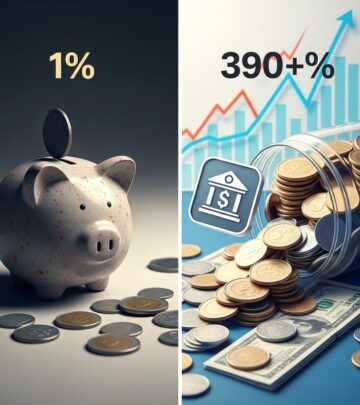
Boost Your $10K Savings: Earn 300+ More Yearly
Discover why traditional bank savings rates are costing you money and how high-yield accounts can generate over $300 extra annually on $10,000.

Your $10,000 in a traditional savings account at a major bank is barely keeping pace with everyday expenses, let alone growing meaningfully. With rates as low as 0.01% APY, you’re leaving hundreds of dollars on the table each year. High-yield savings accounts from online banks offer rates up to 5% APY, potentially adding over $300 annually to your balance while maintaining FDIC insurance.
The Hidden Cost of Sticking with Big Bank Savings
Large national banks prioritize convenience and branch access, but their savings rates reflect this with minimal returns. For instance, Bank of America’s Advantage Savings account tiers start at 0.01% APY for basic balances, climbing slightly to 0.04% for premium tiers requiring substantial combined deposits or investments. On $10,000, this generates just $1 to $4 per year—far below inflation, which erodes your purchasing power.
These low yields stem from big banks’ business models, funding extensive branch networks and services rather than maximizing depositor returns. The national average savings rate hovers around 0.39% APY, but even that pales against top high-yield options reaching 5.00% as of early 2026. Sticking with familiar names means your money works harder for the bank than for you.
High-Yield Savings: A Simple Path to Better Returns
High-yield savings accounts (HYSAs) are FDIC-insured deposit accounts from mostly online institutions offering competitive APYs with no monthly fees or minimums in many cases. They compound interest daily or monthly, accelerating growth without risk to principal up to $250,000 per depositor.
Switching $10,000 from a 0.04% APY account to one at 4.50% APY could net approximately $446 yearly versus $4— a $442 gain. At 5.00% APY, that’s $500 annually. These rates fluctuate with Federal Reserve policies, but as of March 2026, multiple banks sustain 4%+ yields.
Interest Earnings Breakdown: $10K Comparison
To illustrate the difference, consider this table comparing annual interest on $10,000 (assuming daily compounding):
| Account Type | APY | Annual Earnings | vs. Big Bank Gain |
|---|---|---|---|
| Bank of America Basic | 0.01% | $1 | $0 |
| Bank of America Top Tier | 0.04% | $4 | $0 |
| National Average | 0.39% | $39 | $35 |
| Varo Money | 5.00% | $500 | $496 |
| Axos Bank | 4.21% | $421 | $417 |
| SoFi | 4.00% | $400 | $396 |
Calculations based on formula: Earnings = Principal × (1 + APY/365)^365 – Principal. High-yield options deliver 100x the return of big bank rates.
Top High-Yield Savings Accounts for 2026
- Varo Money: Up to 5.00% APY with no minimum balance. Ideal for direct deposit users boosting rates further.
- Axos Bank: 4.21% APY, no fees, unlimited transfers. Strong for larger balances.
- Newtek Bank: 4.20% APY, user-friendly app with goal-tracking tools.
- SoFi Checking & Savings: Up to 4.00% APY on savings with direct deposit; combines checking perks.
- Forbright Bank: 3.85% APY, zero minimums, eco-focused banking.
These accounts often include mobile apps for easy transfers, ATM access via networks, and budgeting tools absent in traditional savings.
Why Online Banks Outpace Traditional Ones
Online banks lack physical branches, slashing overhead costs passed to customers as higher APYs. They leverage digital infrastructure for efficiency, often partnering with larger FDIC-insured entities. Bank of America confirms minimum $100 to open savings, with rates viewable online but rarely exceeding 0.04%.
FDIC data underscores the gap: while big banks average under 0.10%, online competitors average 4%+. This disparity rewards savvy savers who prioritize yield over branches.
Step-by-Step Guide to Switching Your Savings
- Assess Current Earnings: Check your statement for APY and calculate yearly interest.
- Research Rates: Use FDIC’s rate database or comparison sites for latest APYs.
- Open New Account: Choose FDIC-insured HYSA; provide ID and link external funding.
- Transfer Funds: Initiate ACH transfer (1-3 days); avoid overdrafts.
- Close Old Account: Once verified, request closure to eliminate fees.
- Automate Deposits: Set recurring transfers to maximize compounding.
Most switches complete in a week with no downtime. Watch for introductory bonuses adding $200-300 upfront.
Common Myths About High-Yield Savings Debunked
- Myth: Online banks aren’t safe. All listed are FDIC-insured up to $250,000, same as big banks.
- Myth: Rates change too often. True, but monitor quarterly; many sustain high yields.
- Myth: Need high balances for top rates. Most offer full APY from $0.
- Myth: Can’t access funds easily. Federal Regulation D limits withdrawn to 6/month, but many lifted this post-2020.
Tax Implications and Long-Term Growth
Interest from savings is taxable as ordinary income, reported on Form 1099-INT if over $10. High-yield earnings mean higher taxes, but the net gain far exceeds low-yield alternatives. Over 5 years, $10K at 4.5% compounds to $12,550 vs. $10,020 at 0.04%—a $2,530 difference.
For retirement or goals, pair HYSAs with CDs for locked rates or money market funds for liquidity.
Is a HYSA Right for Your Financial Plan?
Perfect for emergency funds (3-6 months expenses), short-term goals, or parking cash. For growth, consider stocks post-emergency buildup. Factors like liquidity needs and risk tolerance guide choices—HYSAs excel in safety and yield.
Frequently Asked Questions
What is APY and why does it matter?
Annual Percentage Yield accounts for compounding; higher APY means faster growth on savings.
Are high-yield accounts FDIC insured?
Yes, up to $250,000 per depositor per bank, protecting against bank failure.
How often do savings rates change?
Weekly or monthly, tied to Fed rates; check bank sites regularly.
Can I lose money in a savings account?
No principal loss from interest fluctuations, but inflation can reduce real value.
What’s the minimum to open a HYSA?
Often $0-$100; many waive fees.
Take Control of Your Savings Today
Moving $10K to a 4-5% HYSA adds $300-500 yearly effortlessly. With digital tools simplifying the process, there’s no excuse for subpar returns. Start comparing and transferring to build wealth faster.
References
- Bank of America Savings Account Interest Rates — Bankrate. 2026. https://www.bankrate.com/banking/savings/bank-of-america-savings-rates/
- The top high-yield savings rates: Up to 5.00% on March 16, 2026 — Fortune. 2026-03-16. https://fortune.com/article/best-savings-account-rates-3-16-2026/
- Best High-Yield Savings Accounts for March 2026 — NerdWallet. 2026. https://www.nerdwallet.com/banking/best/high-yield-online-savings-accounts
- Savings Account FAQs: Rates, Fees, Minimums, and More — Bank of America. 2026. https://www.bankofamerica.com/deposits/savings-accounts-faqs/
- Account Rates for Savings, Checking, CDs & IRAs — Bank of America. 2026. https://www.bankofamerica.com/deposits/bank-account-interest-rates/
Similar Articles








Read full bio of Sneha Tete