Bonus Taxation Explained
Discover how bonuses are taxed in the US, including federal rates, state variations, and strategies to maximize your take-home pay in 2026.
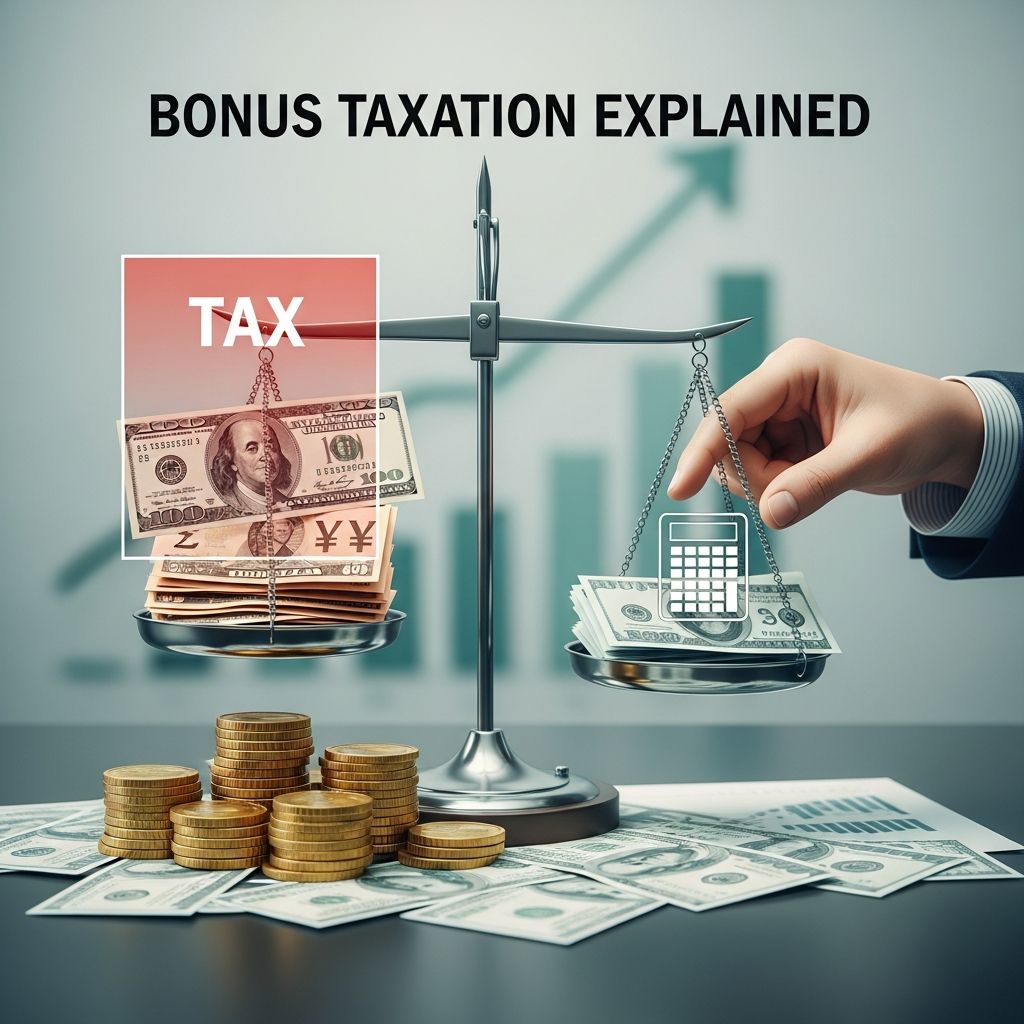
Receiving a bonus represents a significant achievement in one’s career, yet the joy can quickly diminish upon discovering the substantial tax withholdings applied. In the United States, the Internal Revenue Service (IRS) categorizes bonuses as supplemental wages, subjecting them to specific withholding rules distinct from regular salary payments. This guide delves into the mechanics of bonus taxation for 2026, covering federal mandates, additional payroll levies, state-specific considerations, and practical strategies for both employees and employers.
Understanding Supplemental Wages
Bonuses, commissions, overtime pay, and other non-regular earnings fall under the IRS definition of supplemental wages. Unlike standard wages, which use progressive tax brackets for withholding, supplemental income triggers flat-rate federal withholding to simplify employer compliance. This approach ensures the government receives immediate tax revenue while allowing final adjustments during annual tax filing.
Key characteristics include:
- Treated separately from base salary unless combined via the aggregate method.
- Subject to federal income tax, Social Security, Medicare, and potentially state/local taxes.
- No inherent ‘higher tax rate’—withholding differs, but ultimate liability aligns with total income brackets.
Federal Withholding Methods for Bonuses
Employers have two primary options for handling bonus taxes: the percentage method and the aggregate method. Each influences the immediate net amount received by the employee.
Percentage Method: The Flat Rate Approach
The most straightforward technique applies a fixed federal income tax rate directly to the bonus amount. For 2026, this stands at 22% for supplemental wages under $1 million. Amounts exceeding $1 million face 22% on the first million and 37% on the excess—a rule designed for high earners.
This method proves ideal for standalone bonus payments, minimizing administrative complexity. However, the flat rate may exceed or fall short of an individual’s marginal tax bracket, leading to refunds or additional payments at tax time.
Aggregate Method: Combining with Regular Pay
Alternatively, employers may add the bonus to the employee’s most recent regular paycheck, treating the total as a single payment. Withholding then follows standard wage tables, potentially pushing the combined amount into a higher bracket temporarily.
This option suits bonuses issued with regular payroll but can result in higher immediate withholdings, especially for moderate earners whose total spikes into elevated brackets.
Payroll Taxes on Bonuses
Beyond federal income tax, bonuses incur FICA taxes: 6.2% Social Security (up to the 2026 wage base limit of approximately $176,100) and 1.45% Medicare (unlimited). Employers match these contributions, doubling the cost.
Additional Medicare tax of 0.9% applies to high earners (over $200,000 single/$250,000 married), though this affects final liability rather than withholding.
| Tax Type | Employee Rate | 2026 Wage Base | Employer Match |
|---|---|---|---|
| Social Security | 6.2% | $176,100 | 6.2% |
| Medicare | 1.45% | Unlimited | 1.45% |
Total federal withholding often reaches 30-35% when combining income tax, Social Security, and Medicare.
State and Local Tax Variations
While federal rules apply nationwide, states impose their own income taxes on bonuses, ranging from 0% in states like Texas and Florida to over 10% in high-tax areas.
- California: Flat 10.23% on bonuses, escalating to 13.3% over $1 million.
- New York: Progressive rates up to 10.9%, plus NYC surcharge.
- Oregon: Up to 9.9% on higher amounts.
- No-income-tax states: Florida, Texas, Nevada—0% state tax.
Employers must also consider local taxes in cities like New York City (up to 3.876%). Always verify state-specific guidelines via official revenue departments.
Real-World Examples of Bonus Taxation
To illustrate, consider these 2026 scenarios assuming percentage method, no state tax, and wages below Social Security cap:
| Bonus Amount | Federal Income (22%) | Social Security (6.2%) | Medicare (1.45%) | Total Withheld | Net Pay |
|---|---|---|---|---|---|
| $1,000 | $220 | $62 | $14.50 | $296.50 | $703.50 |
| $5,000 | $1,100 | $310 | $72.50 | $1,482.50 | $3,517.50 |
| $15,000 | $3,300 | $930 | $217.50 | $4,447.50 | $10,552.50 |
| $1,200,000 | $264,000 | $10,918 | $17,400 | $292,318 | $907,682 |
Note: For the $1.2M bonus, federal withholding is 22% on $1M ($220,000) + 37% on $200,000 ($74,000) = $294,000 adjusted for FICA. Actual net varies with state taxes and personal circumstances.
Strategies to Optimize Bonus Take-Home Pay
Employees can mitigate surprises through proactive planning:
- Adjust W-4 Form: Update withholdings to account for expected bonuses, avoiding under- or over-withholding.
- Request Aggregate Method: If in a lower bracket, combining may reduce immediate withholding.
- Gross-Up Bonuses: Employers calculate gross amount needed for a target net (e.g., for $5,000 net at 30% withholding, pay ~$7,143).
- Deferral Options: If eligible, contribute to 401(k) or deferred compensation plans pre-tax.
Employers benefit from clear communication and compliant payroll software to handle methods accurately.
Common Misconceptions About Bonus Taxes
Myths persist, such as ‘bonuses are taxed at 40%.’ In reality, the 22% federal + FICA creates ~30% total, reconciled at filing. Another error: assuming bonuses escape payroll taxes—they do not.
Frequently Asked Questions (FAQs)
Are bonuses taxed differently than regular pay?
Withholding differs (flat 22% vs. brackets), but final tax integrates into total income.
Can employers pay tax-free bonuses?
No—all supplemental wages are taxable.
What if my bonus exceeds $1 million?
22% on first $1M, 37% thereafter.
Do bonuses affect my tax bracket?
No—tax is progressive on total annual income, not per payment.
How do I plan for bonus taxes?
Set aside 30-35% or adjust W-4; use tax software for projections.
Reporting Bonuses on Tax Returns
Bonuses appear on Form W-2 (Box 1 wages). Include in adjusted gross income; deductions/credits apply as usual. If overwithheld, expect a refund; underwithheld requires payment.
For non-US contexts like India, bonuses integrate into salary slabs with TDS—consult local rules.
References
- How Are Bonuses Taxed? Rates, How It Works in 2025 and 2026 — NerdWallet. 2025. https://www.nerdwallet.com/taxes/learn/bonus-tax-rate-how-are-bonuses-taxed
- How to Calculate Bonus Pay: 2026 Tax Rates & Easy Formulas — Homebase. 2026. https://www.joinhomebase.com/blog/how-to-run-a-bonus-payroll
- Are Bonuses Taxed Higher? Bonus Tax Rules Explained (2026 Guide) — Asanify. 2026. https://asanify.com/blog/human-resources/are-bonuses-taxed-higher-bonus-tax-rules-explained/
- How Bonuses Are Taxed — TurboTax/Intuit. 2025. https://turbotax.intuit.com/tax-tips/jobs-and-career/how-bonuses-are-taxed/L7UjtAZbh
- How Are Bonuses Taxed in 2026? — SmartAsset. 2026. https://smartasset.com/taxes/how-are-bonuses-taxed
- Publication 15-A (2026), Employer’s Supplemental Tax Guide — IRS.gov. 2026. https://www.irs.gov/publications/p15a
Similar Articles








Read full bio of medha deb