Bond Yield: 6 Essential Yield Types And How To Use Them
Master bond yields: Unlock the key to smarter fixed-income investing and precise return calculations.

Bond yield represents the effective return an investor anticipates from holding a bond, factoring in interest payments, price fluctuations, and time to maturity. It serves as a critical metric for evaluating fixed-income securities in dynamic markets.
Foundational Concepts of Bond Investing
Bonds function as debt instruments where issuers borrow funds from investors, promising periodic interest and principal repayment at maturity. Key elements include the face value, or par amount repaid at term end; coupon payments, the fixed interest disbursed regularly; and market price, which varies based on supply, demand, and economic shifts.
These components directly influence yield calculations. For instance, when market prices drop below face value, yields rise, offering higher returns to attract buyers. Conversely, premiums above par reduce yields. Understanding this inverse price-yield relationship is fundamental for portfolio management.
Core Bond Yield Calculations
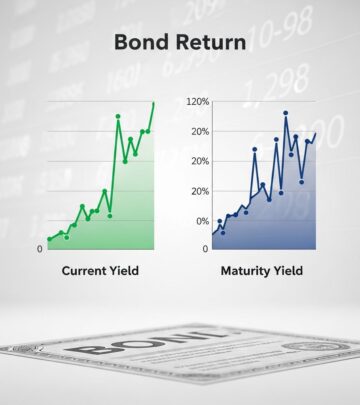
The simplest yield measure is the current yield, derived by dividing annual coupon payments by the bond’s prevailing market price and multiplying by 100 for percentage form. This provides a quick annual return estimate based on purchase price.
Formula: Current Yield = (Annual Coupon / Market Price) × 100
Consider a bond with a $1,000 face value and 5% coupon ($50 yearly), trading at $900. Current yield equals $50 / $900 × 100 = 5.56%, exceeding the coupon rate due to the discount purchase.
Advanced Yield Metrics
- Coupon Yield: Fixed annual interest as a percentage of face value, unchanging over the bond’s life. Coupon Yield = (Coupon Payment / Face Value) × 100.
- Yield to Maturity (YTM): Comprehensive total return assuming hold-to-maturity, incorporating coupons, principal, and time value of money via discounting future cash flows to present value.
YTM demands iterative solving or financial calculators, as it equates purchase price to the present value of inflows. It assumes reinvestment at the YTM rate, reflecting realistic long-term holding scenarios.
Specialized Yield Variants for Complex Bonds
Bonds with embedded options require tailored yield assessments. Yield to Call (YTC) mirrors YTM but assumes early redemption at the call date, crucial for callable securities where issuers might refinance amid falling rates.
Yield to Worst (YTW) identifies the lowest potential yield among YTM and all YTCs, promoting conservative analysis by highlighting downside scenarios. For semi-annual payers, Bond Equivalent Yield (BEY) annualizes returns for apples-to-apples comparisons: BEY = (1 + Periodic Yield)^2 – 1.
Comparative Yield Table
| Yield Type | Formula Basis | Use Case | Assumptions |
|---|---|---|---|
| Coupon Yield | Coupon / Face Value | Issuer’s fixed rate | No price changes |
| Current Yield | Coupon / Market Price | One-year return snapshot | Hold one year |
| YTM | Discounted cash flows to price | Full-term hold | Reinvestment at YTM |
| YTC | Like YTM to call date | Callable bonds | Early redemption |
| YTW | Min of YTM/YTCs | Risk-averse planning | Worst-case scenario |
Market Forces Shaping Bond Yields
Interest rate movements dominate yield dynamics; rising rates depress bond prices, elevating yields inversely. Credit quality plays a pivotal role: investment-grade bonds (e.g., AAA-rated) offer lower yields reflecting minimal default risk, while high-yield or junk bonds command premiums for elevated default probabilities.
Maturity duration amplifies sensitivity; longer-term bonds exhibit greater price volatility to rate changes, as extended cash flows heighten present value impacts. Economic indicators, inflation expectations, and central bank policies further modulate yields across the yield curve, which plots yields against maturities.
An upward-sloping curve signals normal conditions with higher long-term yields compensating for time risk. Flat or inverted curves may foreshadow recessions.
Practical Strategies for Yield Optimization
Investors leverage yields to balance risk-return profiles. Ladder strategies distribute maturities to mitigate rate risk while capturing varying yields. Barbell approaches blend short- and long-term bonds for flexibility.
Duration matching aligns portfolio sensitivity with liabilities. In rising yield environments, shorter maturities preserve capital; falling rates favor extending duration to lock in gains. Diversification across sectors and geographies tempers credit-specific risks.
Rising Yields: Investor Implications
Escalating yields pressure existing bond prices downward but enhance new purchase attractiveness. Long-term holders weather mark-to-market losses if retaining to maturity for par recovery. Active managers pivot to higher-yielding entrants.
Risks and Limitations in Yield Analysis
Yields assume no default, yet credit events erode returns. Liquidity risk hampers selling at fair prices in stressed markets. Reinvestment risk challenges YTM if rates decline post-purchase. Inflation erodes real yields, prompting TIPS consideration.
Callable features cap upside, as YTW underscores. Tax implications vary; municipal bonds offer tax-exempt yields, boosting after-tax appeal.
Yield Curve Insights for Forecasting
The yield curve visualizes rate expectations. Steep curves anticipate growth; flattening suggests caution. Inversion, where short-term yields exceed long-term, historically precedes downturns by signaling tight policy.
Central banks like the Federal Reserve influence via policy rates, rippling through Treasuries to corporates.
Tools and Resources for Yield Computation
Financial calculators, Excel’s RATE function, or online YTM solvers streamline computations. Bloomberg terminals provide real-time curves and analytics for professionals.
Investors track indices like Bloomberg U.S. Aggregate Bond for benchmarks.
Frequently Asked Questions
What factors most affect bond yields?
Interest rates, credit risk, maturity length, and inflation expectations primarily drive yields.
How does YTM differ from current yield?
Current yield ignores capital gains/losses and time value; YTM fully discounts all cash flows to maturity.
Are high-yield bonds always better?
No, higher yields compensate for default risk; they suit risk-tolerant investors.
What is an inverted yield curve?
Short-term yields exceed long-term, often predicting economic slowdowns.
Can yields be negative?
Yes, in low-rate environments, bonds trade at premiums where yield falls below zero.
Building a Yield-Focused Portfolio
Integrate yields with total return objectives. Stress-test against rate scenarios using duration and convexity metrics. Rebalance periodically to maintain yield targets amid market shifts.
For retirees, prioritize stable income via short-duration, high-quality bonds. Growth-oriented portfolios may tilt toward high-yield or emerging market debt judiciously.
References
- What Is Bond Yield? Meaning, Formula & Types Explained (2025) — BondBazaar. 2025. https://www.bondbazaar.com/blog-detail/what-is-bond-yield
- Bond Yield: Calculations, Examples, and Meaning — Breaking Into Wall Street. n.d. https://breakingintowallstreet.com/kb/debt-equity/bond-yield/
- Understanding Bond Yield and Return — FINRA.org. n.d. https://www.finra.org/investors/insights/bond-yield-return
- What Is a Bond? Understanding Bond Types and How They Work — Charles Schwab. n.d. https://www.schwab.com/learn/story/what-are-bonds-understanding-bond-types-and-how-they-work
- Bonds and the Yield Curve — Reserve Bank of Australia. n.d. https://www.rba.gov.au/education/resources/explainers/bonds-and-the-yield-curve.html
- What are rising bond yields mean to long-term investors? — RBC Global Asset Management. n.d. https://www.rbcgam.com/en/ca/learn-plan/investment-strategies/what-do-rising-bond-yields-mean-to-long-term-investors/detail
Similar Articles








Read full bio of medha deb