Bond Yield: Definition, Types, and Calculation
Understanding bond yield: A comprehensive guide to measuring bond returns and investment performance.
What Is Bond Yield?
Bond yield represents the income an investor receives from holding a bond, expressed as a percentage of the bond’s current market price. It measures the annual cash flows (coupon payments and principal repayment at maturity) relative to what an investor pays for the bond today. Bond yield is a fundamental metric for bond investors because it indicates the return they can expect from their investment over a specific period.
The term “yield” is often used interchangeably with “return,” though technically they have slightly different meanings. Yield typically refers to the income component of a return, while return encompasses both income and any capital appreciation or depreciation. For bonds, yield is the primary return driver for most investors, especially when held to maturity.
Key Characteristics of Bond Yield
- Inverse Relationship with Price: Bond yields move inversely to bond prices. When bond prices rise, yields fall, and vice versa. This fundamental relationship exists because the coupon payment remains fixed, so as the price changes, the percentage return changes accordingly.
- Interest Rate Sensitivity: Bond yields are highly sensitive to prevailing interest rates in the market. When the Federal Reserve raises rates, newly issued bonds offer higher yields, making existing bonds with lower yields less attractive and causing their prices to fall.
- Credit Risk Component: Higher-yielding bonds often carry greater credit risk. Investors demand higher yields to compensate for the increased risk of default or rating downgrades.
- Time Value of Money: Bond yield reflects the time value of money—the principle that money received today is worth more than the same amount received in the future.
Types of Bond Yield
Current Yield
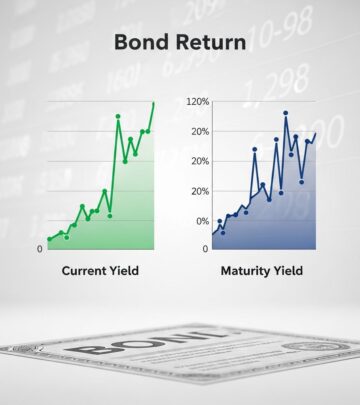
Current yield is the simplest form of bond yield calculation. It represents the annual coupon payment divided by the bond’s current market price. For example, if a bond pays $50 in annual coupons and is currently trading at $950, the current yield would be 5.26% ($50 ÷ $950).
Current yield is useful for comparing income streams across different bonds trading at different prices, but it does not account for capital gains or losses if the bond is held to maturity or sold before maturity.
Yield to Maturity (YTM)
Yield to maturity is the most comprehensive yield measure and represents the total annual return an investor will receive if they purchase the bond at its current market price and hold it until maturity. YTM accounts for:
- All future coupon payments
- The principal repayment at maturity
- Any capital gain or loss if purchased at a discount or premium to par value
- The timing of all cash flows
Calculating YTM requires solving a complex equation and is typically done using financial calculators or software. The YTM is expressed as an annual percentage rate and represents an internal rate of return (IRR) that equates the present value of all future cash flows to the current bond price.
Yield to Call (YTC)
For callable bonds (bonds that the issuer can redeem before maturity), yield to call measures the return an investor receives if the bond is called. This yield assumes the bond will be redeemed at the earliest call date rather than held to maturity. YTC is important for callable bond investors because it often results in a lower return than YTM if interest rates fall and the bond is called.
Coupon Yield
Coupon yield, also called the nominal yield, is the annual interest rate stated on the bond at issuance. It represents the fixed percentage of the par value that the bondholder receives each year. For a $1,000 bond with a 5% coupon, the investor receives $50 annually regardless of the market price.
How Bond Yield Is Calculated
Current Yield Formula
The current yield calculation is straightforward:
- Current Yield = Annual Coupon Payment ÷ Current Bond Price
Example: A bond with a $1,000 par value and 6% coupon rate generates $60 annual payments. If the bond is trading at $950, the current yield is $60 ÷ $950 = 6.32%.
Yield to Maturity Calculation
YTM calculation is more complex and requires solving the following equation:
Bond Price = (C ÷ (1 + YTM)¹) + (C ÷ (1 + YTM)²) + … + ((C + Par) ÷ (1 + YTM)ⁿ)
Where:
- C = Annual coupon payment
- Par = Par value of the bond
- n = Number of years to maturity
- YTM = Yield to maturity (the unknown variable being solved for)
Because this equation cannot be solved algebraically for YTM, investors use iterative methods or financial calculators to determine the yield.
Bond Prices and Yields Relationship
Why Bond Prices and Yields Move Inversely
The inverse relationship between bond prices and yields is fundamental to bond mathematics. Since the coupon payment is fixed when issued, the only variable that changes is the price. As market interest rates rise, existing bonds with lower coupon rates become less attractive, forcing their prices to decline to compensate investors with higher yields. Conversely, when interest rates fall, existing bonds with higher coupon rates become more desirable, causing prices to rise.
Duration and Yield Sensitivity
Duration measures how sensitive a bond’s price is to changes in yield. Bonds with longer maturities and lower coupon rates exhibit greater price volatility when yields change. Understanding duration helps investors assess interest rate risk—the risk that rising rates will cause bond prices to decline.
The Yield Curve
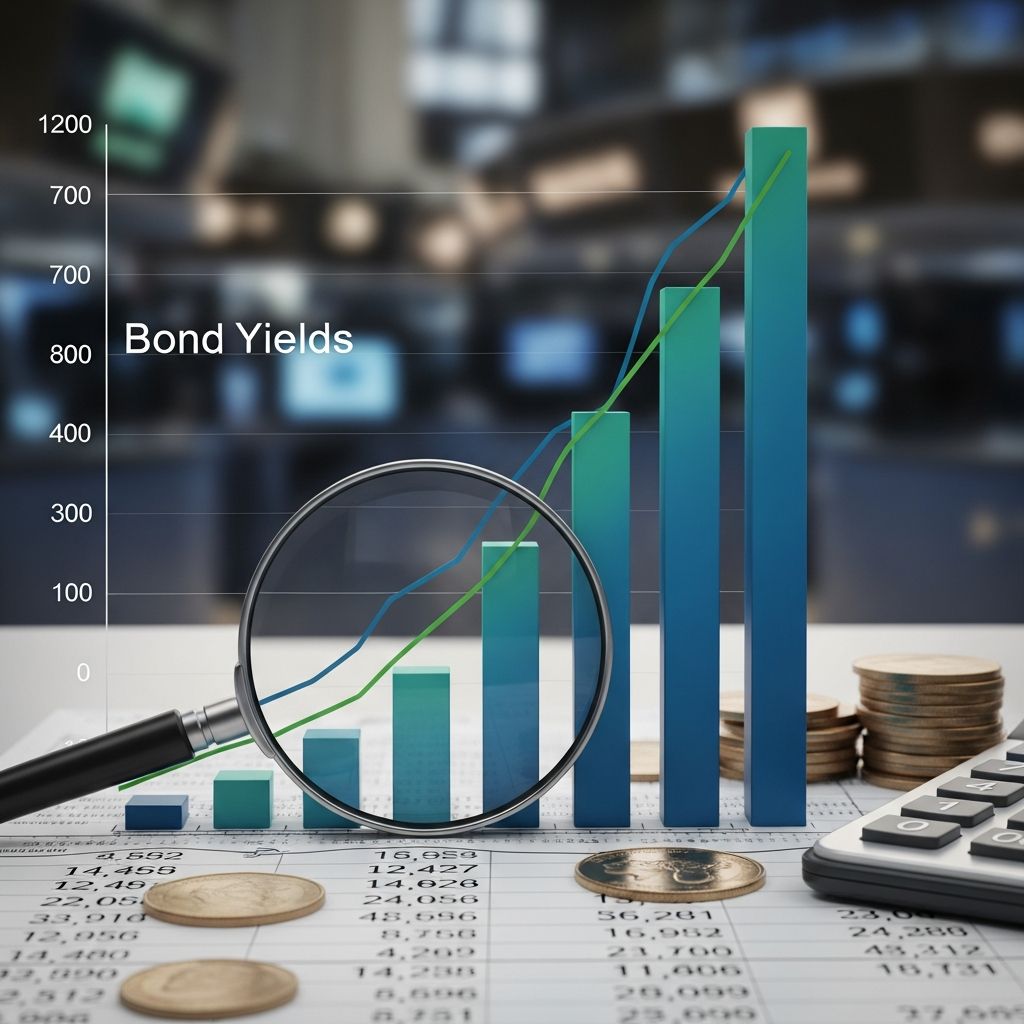
The yield curve is a graphical representation of bond yields across different maturities for bonds of similar credit quality. Typically, longer-maturity bonds offer higher yields to compensate investors for increased interest rate risk. A normal yield curve slopes upward, indicating higher yields for longer maturities.
When the yield curve inverts (shorter-term yields exceed longer-term yields), it often signals economic concerns and has historically preceded recessions. The shape and slope of the yield curve provide valuable information about market expectations for future economic growth and inflation.
Factors Affecting Bond Yield
Interest Rate Environment
The prevailing interest rate set by central banks, particularly the Federal Reserve in the United States, has the most significant impact on bond yields. Fed rate increases typically push yields higher across the bond market, while rate cuts generally lead to lower yields.
Credit Quality
Bonds issued by entities with poor credit ratings must offer higher yields to attract investors willing to accept greater default risk. Investment-grade bonds typically offer lower yields than speculative-grade (junk) bonds from the same issuer type.
Inflation Expectations
If investors expect higher inflation, they demand higher bond yields to maintain purchasing power. Central bank inflation targets and actual inflation data significantly influence yield movements.
Supply and Demand Dynamics
When bond supply exceeds demand, yields rise to attract buyers. Conversely, high demand for bonds relative to supply drives yields lower. Government actions, such as quantitative easing, can significantly influence bond supply and demand dynamics.
Time to Maturity
Bonds with longer maturities typically offer higher yields than shorter-maturity bonds of the same credit quality, reflecting the additional uncertainty and interest rate risk associated with longer holding periods.
Practical Applications for Bond Investors
Comparing Bond Investments
Bond yield provides a standardized metric for comparing returns across different bond issues, issuers, and maturity dates. By calculating YTM, investors can determine which bonds offer the best risk-adjusted returns for their portfolios.
Assessing Interest Rate Risk
Understanding yield and its relationship to bond prices helps investors gauge the potential impact of interest rate changes on their portfolios. A higher current yield might indicate a bond is undervalued, but investors must consider whether the issuer’s credit quality justifies the higher yield.
Portfolio Construction
Bond yields are essential inputs in constructing diversified bond portfolios. By mixing bonds with different yields, maturities, and credit qualities, investors can target specific return objectives while managing risk.
Frequently Asked Questions (FAQs)
Q: What is the difference between bond yield and interest rate?
A: Interest rate refers to the coupon rate paid on the bond when issued, while yield represents the actual return an investor receives based on the current market price. If a bond with a 5% coupon is purchased at a discount, its yield will be higher than 5%. If purchased at a premium, the yield will be lower than the coupon rate.
Q: Why do bond yields change after a bond is issued?
A: Bond yields change because market conditions evolve. When prevailing interest rates rise, existing bonds with lower yields become less attractive, and their prices must fall to increase their yields. When rates fall, existing bonds with higher yields become more valuable, and prices rise, reducing their yields.
Q: How does inflation affect bond yields?
A: Higher inflation expectations cause bond yields to rise as investors demand additional compensation to preserve purchasing power. If actual inflation increases, bond holders experience reduced real returns (return adjusted for inflation) unless yields rise sufficiently.
Q: What does it mean if a bond’s YTM is higher than its coupon rate?
A: This indicates the bond is trading at a discount to par value. The investor purchased the bond at a price below $1,000 (per $1,000 par), which increases the overall return through both coupon income and capital appreciation when the bond matures.
Q: Can bond yields be negative?
A: Yes, in unusual circumstances, particularly in certain foreign government bonds during periods of extreme monetary policy or economic uncertainty. Negative yields mean investors accept a guaranteed loss relative to par value, typically because they view the bond as a safe store of value or to meet regulatory requirements.
References
- Fixed Income Securities: Tools and Techniques for Relative Value Analysis — U.S. Securities and Exchange Commission (SEC). 2024. https://www.sec.gov/investor/education
- Understanding Bond Yields and Interest Rates — Board of Governors of the Federal Reserve System. 2023. https://www.federalreserve.gov
- Bond Valuation and Yield Calculations — CFA Institute. 2024. https://www.cfainstitute.org
- The Impact of Interest Rates on Bond Prices — Financial Industry Regulatory Authority (FINRA). 2023. https://www.finra.org/investors
- Yield Curve Dynamics and Economic Forecasting — Federal Reserve Bank of New York. 2024. https://www.newyorkfed.org
Similar Articles








Read full bio of medha deb