Bond Markets Essential Guide: Key Concepts, Risks, Strategies
Master the fundamentals of bond markets to build a resilient investment strategy with insights into pricing, yields, and market dynamics.
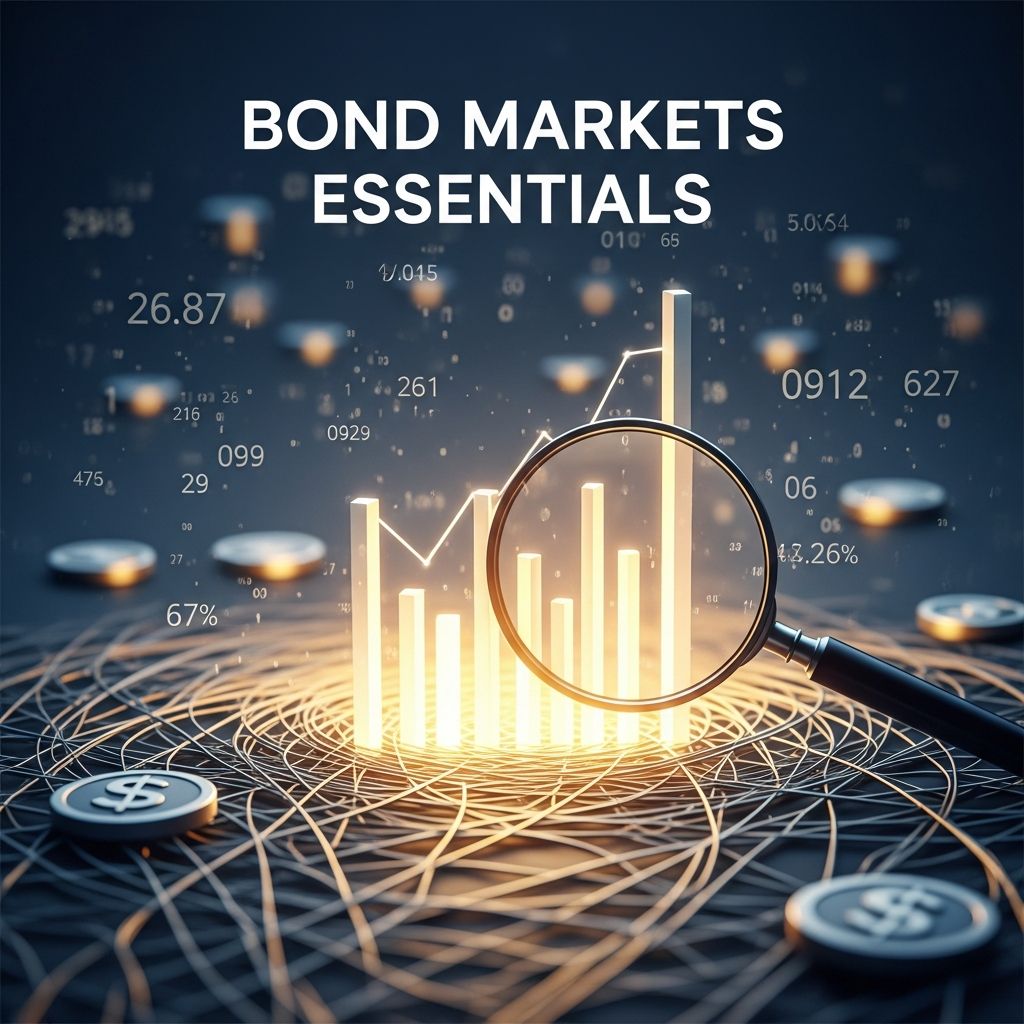
Bond markets form a cornerstone of global finance, offering investors predictable income through fixed-income securities. These instruments allow governments and corporations to borrow funds while providing lenders with regular interest payments and principal repayment at maturity.
Core Elements of Bonds
Every bond consists of fundamental features that define its value and appeal. The principal, often called face value, represents the amount repaid at maturity, typically $1,000 per bond. Maturity indicates the time until principal repayment, ranging from short-term notes to decades-long obligations. The coupon rate sets the periodic interest payment, calculated as a percentage of the face value and usually disbursed semiannually.
These components interact to determine a bond’s behavior in various market conditions. For instance, longer maturities expose investors to greater interest rate risk, as price fluctuations intensify over extended periods.
Dynamic Relationship Between Prices and Yields
Bond prices and yields move inversely, a principle central to market mechanics. When market interest rates rise, existing bonds with lower fixed coupons become less attractive, prompting price declines to elevate their effective yield. Conversely, falling rates boost prices of higher-coupon bonds, creating premiums.
This inverse dynamic stems from the fixed nature of coupon payments. Investors demand yields competitive with prevailing rates, adjusting prices accordingly. A bond purchased at a discount below par offers capital appreciation potential alongside coupon income, while premiums reduce yield to maturity.
| Scenario | Interest Rate Change | Bond Price Movement | Yield Impact |
|---|---|---|---|
| Rising Rates | Increase | Decrease | Increase to match market |
| Falling Rates | Decrease | Increase | Decrease relative to new issues |
| Stable Rates | No Change | Stable at par | Matches coupon |
Yield to Maturity Explained
Yield to maturity (YTM) encapsulates the total return if held until maturity, factoring in coupon payments, principal repayment, and price paid. It equals the discount rate making future cash flows’ present value match the current price.
For example, a bond bought below par yields more than its coupon due to amortized discount as gain. YTM assumes reinvestment at the same rate and no default, providing a standardized return metric.
Factors Influencing Bond Valuation
Interest Rate Environment
Central bank policies drive rate changes, profoundly affecting bonds. Lower rates from monetary easing elevate prices across durations, benefiting longer-term holdings most.
Credit Quality and Ratings
Issuer creditworthiness, assessed by agencies, impacts yields. Investment-grade bonds from stable entities command lower yields due to minimal default risk; high-yield or junk bonds offer higher returns compensating for elevated risk.
Ratings range from AAA (prime) to below investment grade, with downgrades eroding prices as yields rise to attract buyers.
Duration and Volatility
Duration measures price sensitivity to rate changes, expressed in years. Higher duration implies greater volatility; zero-coupon bonds exhibit highest sensitivity.
- Short duration: Lower risk, less price swing.
- Intermediate: Balanced income and moderate sensitivity.
- Long duration: Higher potential returns, amplified risk.
Callable Features and Liquidity
Callable bonds allow issuers to redeem early, typically in falling rate environments, capping investor upside. Liquidity varies; government bonds trade fluidly, while corporate issues may face wider spreads.
Types of Bonds in the Market
Diverse bond categories suit varied objectives:
- Treasury Securities: U.S. government-backed, virtually risk-free, spanning T-bills (short-term), notes, and bonds.
- Corporate Bonds: Issued by firms, yields reflect business risk; sectors like utilities offer stability.
- Municipal Bonds: State/local government debt, often tax-exempt, appealing to high earners.
- Agency Bonds: Government-sponsored entities like Fannie Mae, blending safety and yield.
Strategies for Bond Investors
Effective approaches mitigate risks while capturing opportunities.
Laddering Portfolios
Distribute maturities evenly, e.g., bonds maturing annually over 10 years. As segments mature, reinvest at current rates, smoothing reinvestment risk and providing liquidity.
Barbell Technique
Concentrate in short- and long-term bonds, avoiding intermediates. Shorts offer flexibility; longs yield higher coupons.
Buy-and-Hold Discipline
Hold to maturity for predictable income, ignoring interim price volatility, ideal for income-focused retirees.
| Strategy | Pros | Cons | Best For |
|---|---|---|---|
| Laddering | Diversified maturities, steady income | Requires management | Conservative investors |
| Barbell | Flexibility + high yield | Interest rate exposure | Active managers |
| Buy-and-Hold | Low turnover, full principal | Opportunity cost | Long-term holders |
Risks in Bond Investing
- Interest Rate Risk: Primary threat; mitigated by shorter durations.
- Credit Risk: Default potential; diversify and favor high ratings.
- Inflation Risk: Erodes real returns; consider TIPS.
- Call Risk: Premature redemption in low-rate scenarios.
Bond Markets’ Role in Diversification
Bonds counterbalance equities, rising during stock downturns amid economic uncertainty. Their income stream stabilizes portfolios, reducing overall volatility.
Institutional players like pension funds dominate, but retail access via funds and ETFs democratizes participation.
Frequently Asked Questions
What happens if I hold a bond to maturity?
You receive full face value plus all coupons, barring issuer default.
Why do bond prices fall when rates rise?
New bonds offer higher yields, devaluing existing lower-coupon bonds.
Are all bonds safe?
No; credit ratings gauge risk. Treasuries are safest.
How does inflation affect bonds?
It diminishes purchasing power of fixed payments.
Can I sell bonds before maturity?
Yes, on secondary markets, though prices fluctuate.
References
- Bond Market Basics — Britannica Money. 2023. https://www.britannica.com/money/bond-market-basics
- Fundamentals of the Bond Market — RBC Wealth Management. 2022-01-01. https://ca.rbcwealthmanagement.com/delegate/services/file/479106/content
- Bond Basics — RBC Global Asset Management. 2024. https://www.rbcgam.com/en/ca/learn-plan/investment-strategies/bond-basics/detail
- Understanding Bonds — Federal Reserve Education. 2023. https://www.federalreserveeducation.org/teaching-resources/personal-finance/saving/understanding-bonds
- Everything You Need to Know About Bonds — PIMCO. 2024-06-01. https://www.pimco.com/us/en/resources/education/everything-you-need-to-know-about-bonds
- Understanding the Bond Market — Stifel. 2023. https://www.stifel.com/newsletters/adgraphics/FlipBooks/_IND/Dobler-Steven/Investing/Understanding-The-Bond-Market.pdf
Similar Articles








Read full bio of medha deb