Bond Futures: Definition, How They Work, and Trading
Master bond futures trading: Learn definitions, mechanisms, strategies, and key considerations for investors.
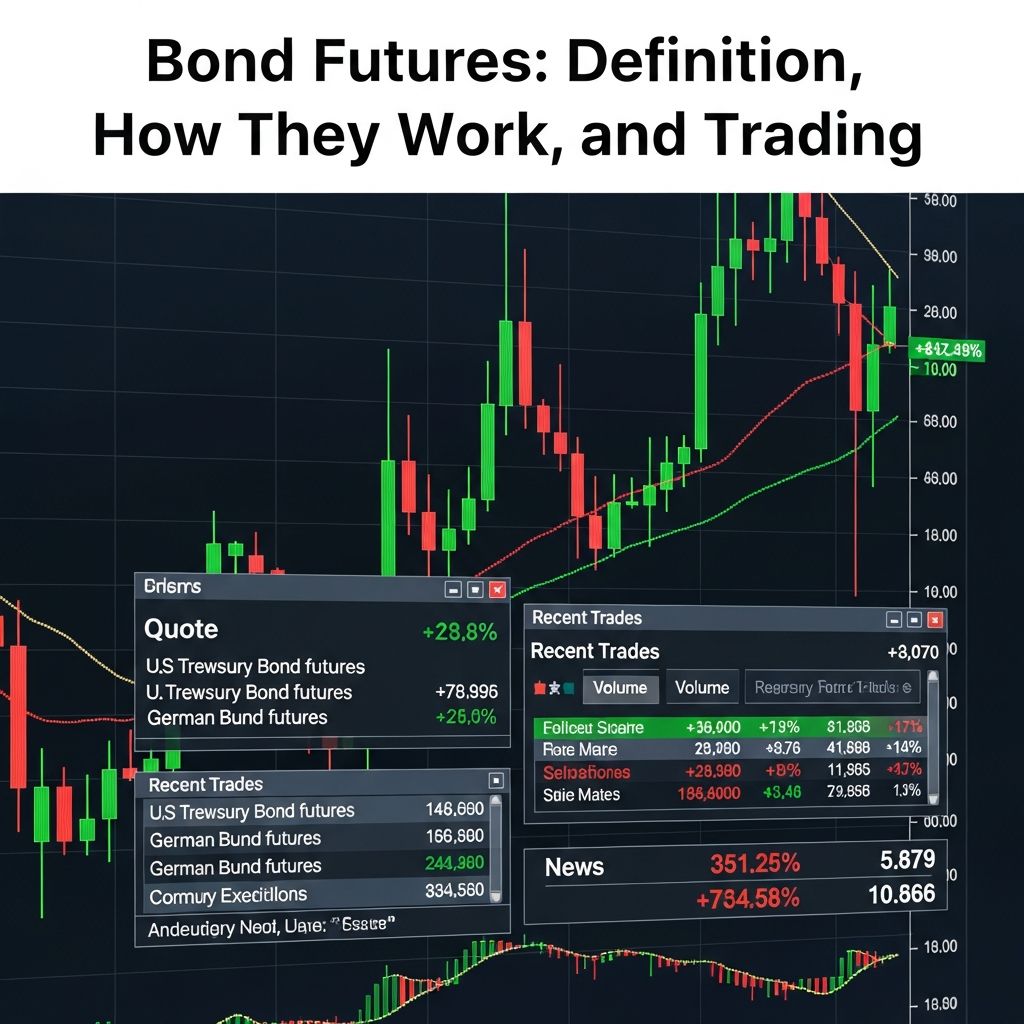
Bond futures represent standardized futures contracts based on fixed-income securities, primarily government bonds and Treasury instruments. These derivative products allow investors, traders, and institutions to speculate on future interest rate movements or hedge against potential bond price volatility. Bond futures are traded on organized exchanges and represent an agreement to buy or sell a specific quantity of bonds at a predetermined price on a future settlement date. Understanding bond futures is essential for portfolio managers, institutional investors, and active traders seeking to manage interest rate risk or capitalize on market opportunities.
What Are Bond Futures?
Bond futures are standardized contracts traded on major futures exchanges, such as the Chicago Board of Trade (CBOT) and the Intercontinental Exchange (ICE). These contracts obligate the buyer to purchase, or the seller to deliver, a specified quantity of bonds at a predetermined price on a specified future date. The underlying asset is typically long-term government bonds, such as U.S. Treasury bonds or Treasury notes, though bond futures also exist for corporate bonds and international government debt instruments.
The primary purpose of bond futures is to enable market participants to:
- Hedge Interest Rate Risk: Portfolio managers use bond futures to protect existing bond holdings from adverse price movements caused by rising interest rates.
- Speculate on Interest Rates: Traders can take leveraged positions to profit from anticipated changes in interest rates and bond prices.
- Manage Duration: Institutional investors adjust portfolio duration without buying or selling actual bonds.
- Arbitrage Opportunities: Market participants exploit price discrepancies between cash and futures markets.
Key Characteristics of Bond Futures Contracts
Bond futures contracts possess several standardized features established by the exchanges offering them:
| Characteristic | Description |
|---|---|
| Contract Size | Typically represents $100,000 face value of underlying bonds (standard contract) |
| Tick Size | Minimum price movement, usually 1/32 of a point or $31.25 per contract |
| Settlement Dates | Quarterly delivery months (March, June, September, December) |
| Delivery Options | Seller can choose which eligible bonds to deliver (“cheapest to deliver”) |
| Margin Requirements | Initial and maintenance margins required; varies with market conditions |
| Price Quotation | Quoted in points and 32nds (e.g., 135-16 represents 135 and 16/32) |
How Bond Futures Work
The mechanics of bond futures trading involve several interconnected components:
Price Determination
Bond futures prices reflect market expectations about future interest rates, inflation, credit risk, and macroeconomic conditions. The inverse relationship between bond prices and interest rates is fundamental: when interest rates rise, bond futures prices fall, and vice versa. This relationship means investors anticipating rising rates would short bond futures (sell), while those expecting falling rates would go long (buy).
Leverage and Margin
Bond futures provide substantial leverage through margin requirements. Traders must deposit initial margin (typically 2-5% of the contract’s notional value) to establish positions. This leverage amplifies both potential gains and losses, making bond futures inherently risky for undercapitalized or inexperienced traders. Brokers continuously monitor positions and issue margin calls if equity falls below maintenance levels.
Mark-to-Market Accounting
Futures contracts are marked-to-market daily, meaning profits and losses are settled each trading day based on closing prices. This daily settlement process ensures credit risk remains minimal and forces traders to maintain adequate capital reserves.
Settlement and Delivery
Most bond futures contracts are cash-settled or result in physical delivery of the underlying bonds. The seller has the right to deliver any bond meeting specified criteria (“deliverable grade”), typically including various Treasury issues within defined maturity ranges. This flexibility creates the “cheapest to deliver” option, where the seller chooses the least expensive eligible bond to deliver.
Types of Bond Futures Contracts
Various bond futures contracts exist, differentiated by the underlying debt instruments:
- Ultra Bond Futures (UB): Based on 20+ year U.S. Treasury bonds
- Treasury Bond Futures (ZB): 15+ year U.S. Treasury bonds
- 10-Year Treasury Note Futures (ZN): Most liquid bond futures contract
- 5-Year Treasury Note Futures (ZF): Medium-term interest rate exposure
- 2-Year Treasury Note Futures (ZT): Short-duration positioning
- Euro-Bobl/Bund Futures: European government bond instruments
- Ultra-Long Gilt Futures: UK Treasury bond contracts
Strategies for Trading Bond Futures
Market participants employ various bond futures strategies to achieve different objectives:
Hedging Strategies
Portfolio managers use bond futures to protect against interest rate increases. For example, a manager holding $5 million of Treasury bonds might sell an equivalent notional value of bond futures to lock in current prices. If rates rise and bond prices fall, futures position gains offset cash portfolio losses.
Speculation on Interest Rates
Traders take directional bets based on interest rate forecasts. Those expecting Federal Reserve rate cuts would buy (go long) bond futures, anticipating price increases. Conversely, those expecting rate hikes would sell futures.
Curve Trading
Traders exploit yield curve dynamics by taking offsetting positions in different maturity futures contracts. Flattening trades involve selling longer-duration futures while buying shorter-duration ones, profiting if the yield curve flattens.
Spread Trading
Market participants profit from relative price movements between different bond futures contracts or between futures and cash bonds. Basis trades capture the difference between futures prices and underlying cash bond prices.
Arbitrage
Sophisticated traders identify pricing discrepancies and execute simultaneous trades in related markets to lock in risk-free profits. These strategies typically involve combinations of cash bonds, bond futures, and repurchase agreements.
Advantages of Bond Futures
Bond futures offer several distinct advantages:
- Liquidity: The 10-year Treasury note futures contract is among the most liquid financial instruments globally, ensuring tight bid-ask spreads and efficient execution.
- Leverage: Investors can control large bond positions with minimal capital outlay, maximizing returns on deployed capital.
- Flexibility: Easy to establish or unwind positions without the operational complexity of cash market transactions.
- Cost Efficiency: Lower transaction costs compared to cash bond trading, particularly for large positions.
- Price Discovery: Futures markets often lead cash markets in reflecting new information about interest rates and economic conditions.
- Standardization: Homogeneous contracts facilitate transparent pricing and reduce counterparty credit risk.
Risks Associated with Bond Futures
Despite their advantages, bond futures carry significant risks that traders must understand:
- Interest Rate Risk: The primary risk; adverse interest rate movements can generate substantial losses.
- Leverage Risk: High leverage amplifies losses when predictions prove incorrect.
- Basis Risk: Imperfect correlation between futures and cash market can undermine hedging strategies.
- Liquidity Risk: During market stress, execution prices may deviate significantly from indicative quotes.
- Model Risk: Quantitative strategies based on flawed assumptions can generate substantial losses.
- Operational Risk: Execution errors, system failures, and inadequate risk controls create unexpected losses.
- Regulatory Risk: Changes in regulations affecting futures markets can alter trading conditions and profitability.
Bond Futures and Interest Rate Expectations
Bond futures prices directly reflect market participants’ collective expectations about future interest rates. When investors anticipate the Federal Reserve will maintain or raise rates, bond futures prices decline as investors sell positions. Conversely, expectations of rate cuts drive prices higher as investors establish long positions. This relationship makes bond futures valuable indicators of market sentiment regarding monetary policy and economic conditions.
The “bond futures implied yields” derived from contract prices represent the market’s consensus forecast for future interest rates. Central banks and economists closely monitor these prices to gauge market expectations about policy decisions and economic trends.
Practical Example of Bond Futures Trading
Consider a portfolio manager holding $10 million of 10-year Treasury notes paying 4.5% annually. Concerned about rising interest rates, the manager decides to hedge this position using 10-year Treasury note futures (ZN), each contract representing $100,000 face value.
To establish the hedge:
- Calculate hedge ratio: $10,000,000 ÷ $100,000 = 100 contracts
- Sell 100 ZN futures contracts at current price (e.g., 131-00)
- Deposit initial margin of approximately $2,000-3,000 per contract
If interest rates subsequently rise 1%:
- Cash portfolio loses approximately $100,000 (prices fall)
- Futures position gains approximately $100,000 (short position profits)
- Net portfolio loss is minimized through the hedge
Frequently Asked Questions
Q: What is the minimum investment required to trade bond futures?
A: The initial margin requirement typically ranges from $2,000 to $5,000 per contract, though this varies with market conditions and brokerage requirements. Traders should maintain additional capital for margin calls and operating losses.
Q: How are bond futures prices quoted?
A: Bond futures are quoted in points and 32nds (1/32). For example, a price of 135-16 represents 135 and 16/32, or 135.5 points. Each 1/32 movement equals $31.25 in contract value.
Q: Can individuals trade bond futures?
A: Yes, individuals can trade bond futures through commodity futures brokers, though they require proper licensing and regulatory approval. Most retail traders use online brokers offering futures trading accounts.
Q: What is the “cheapest to deliver” option?
A: This is the seller’s right to choose which eligible bond to deliver when futures contracts settle. The seller typically chooses the least expensive bond meeting contract specifications, which affects futures pricing.
Q: How do bond futures relate to interest rate movements?
A: Bond futures prices move inversely to interest rates. When rates rise, futures prices fall; when rates fall, prices rise. This inverse relationship reflects the bond market’s fundamental price-yield dynamics.
Q: What differentiates bond futures from Treasury bonds?
A: Bond futures are derivatives providing leverage, standardized contracts, and mark-to-market accounting. Treasury bonds are direct debt obligations with fixed coupon payments and specific maturity dates.
Q: How do I determine the correct number of futures contracts for hedging?
A: Calculate the hedge ratio using: (Portfolio value ÷ Contract size) × Conversion factor. The conversion factor adjusts for differences between the futures contract specification and the actual bonds held.
References
- U.S. Treasury Bonds and Notes: Managing Interest Rate Risk — U.S. Department of the Treasury. 2024. https://www.treasury.gov
- Contract Specifications: Treasury Futures — Chicago Mercantile Exchange (CME). 2025. https://www.cmegroup.com
- Introduction to Futures Markets and Hedging — Commodity Futures Trading Commission (CFTC). 2024. https://www.cftc.gov
- Fixed Income Futures: Pricing, Duration, and Yield Curve Strategies — Federal Reserve Board of Governors. 2024. https://www.federalreserve.gov
- Bond Futures and Interest Rate Risk Management — International Organization of Securities Commissions (IOSCO). 2023. https://www.iosco.org
Similar Articles








Read full bio of Sneha Tete