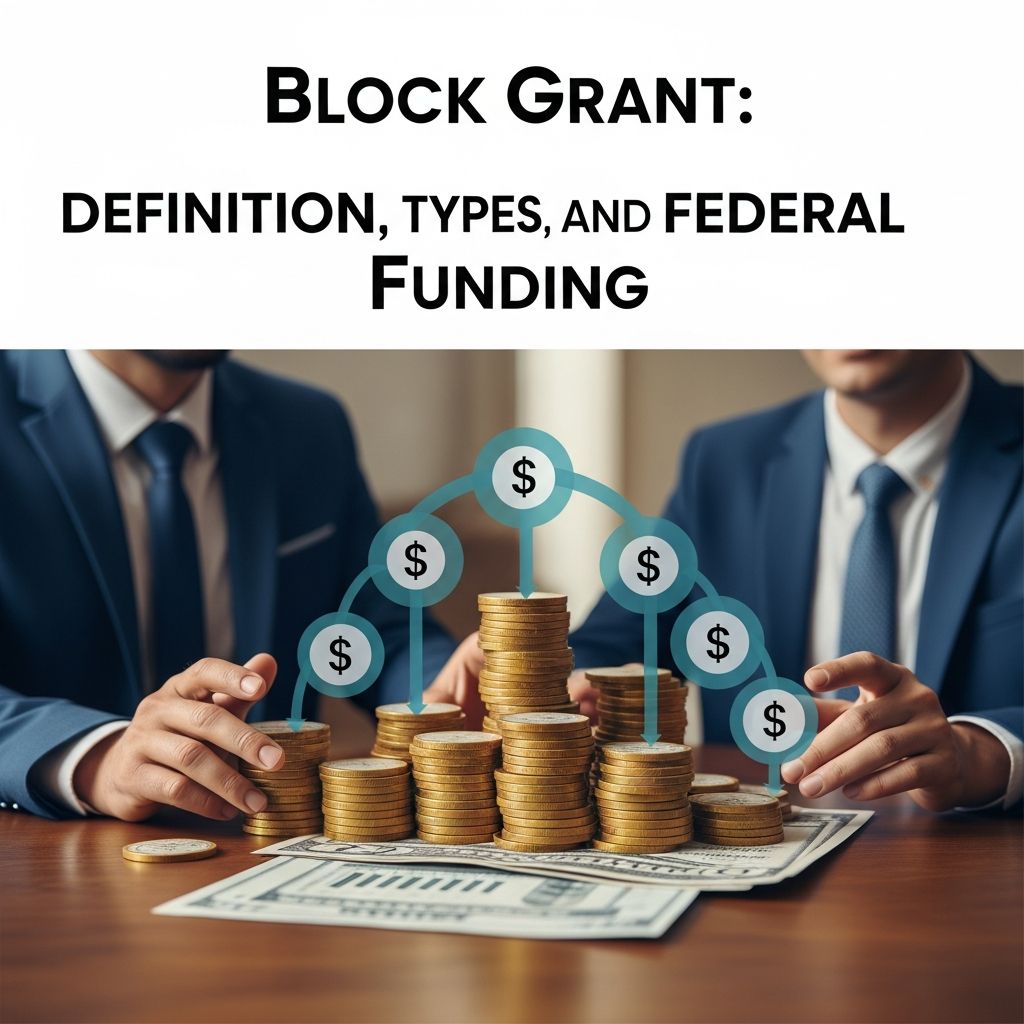
Block Grant: Definition, Types, and Federal Funding
Understanding block grants: How federal governments fund state and local programs with flexibility and accountability.
What Is a Block Grant?
A block grant is a form of federal financial assistance provided by a larger government entity to smaller regional governments or local authorities. Block grants represent a significant mechanism through which the federal government distributes funds to states and localities to support broadly defined functions and policy areas. Unlike more restrictive forms of federal aid, block grants provide recipient governments with substantial flexibility in how they allocate and spend the funds within the designated functional area.
The defining characteristic of a block grant is that it offers a fixed, specified amount of funding to state and local governments for administering and providing certain services. This fixed-sum nature distinguishes block grants from entitlement programs, which have open-ended funding that expands or contracts based on the number of eligible recipients and their needs. Block grants have become an integral part of the American federal system since their introduction in 1966, representing a middle ground between highly restrictive categorical grants and more loosely defined general revenue sharing programs.
Key Characteristics of Block Grants
Block grants possess several distinctive features that set them apart from other federal funding mechanisms:
- Fixed Funding Amounts: The federal government allocates a predetermined sum of money, which gives states and localities predictability in budgeting and planning.
- Broad Functional Areas: Block grants support general purposes such as community development, social services, public health, law enforcement, and education.
- Formula-Based Distribution: Funds are allocated among recipient governments using established formulas, often based on factors like population, per capita income, or specific needs.
- Recipient Discretion: State and local governments have significant flexibility in designing and implementing programs within the broadly defined functional area.
- Minimal Federal Oversight: Block grants involve relatively light federal oversight and administrative conditions compared to categorical grants, typically limited to periodic reporting and standard accounting procedures.
How Block Grants Work
The mechanics of block grant programs are straightforward. The federal government establishes legislation that defines the broad purposes for which block grant funds can be used. State and local governments then receive their allocated share based on predetermined formulas. Recipients implement the programs within those broadly defined functions and parameters. This structure allows states and localities considerable autonomy in tailoring programs to their specific populations and circumstances.
For example, in a block grant program for community development, the federal government might provide a fixed amount of funding to cities and counties on a formula basis, allowing these local governments to determine how best to use those funds within the community development framework. Similarly, block grants for social services enable states to design assistance programs that reflect their unique demographic and economic conditions. This flexibility is a core advantage of the block grant mechanism, as it allows governments closer to the people they serve to make decisions about resource allocation.
Block Grants vs. Categorical Grants
Understanding the differences between block grants and categorical grants is essential for comprehending federal funding mechanisms. These two types of grants represent distinct approaches to federal aid distribution:
| Characteristic | Block Grants | Categorical Grants |
|---|---|---|
| Scope of Use | Broad functional areas with recipient discretion | Narrowly defined specific programs |
| Allocation Method | Formula-based distribution | Competitive application process or formula |
| Recipient Flexibility | High discretion in program design and implementation | Limited discretion; must follow specific requirements |
| Federal Oversight | Light oversight with minimal conditions | Extensive oversight and detailed requirements |
| Administrative Burden | Lower administrative requirements | Higher administrative and compliance burden |
| Funding Predictability | Fixed amounts; predictable funding levels | Variable amounts; may be competitive |
Categorical grants, which represent the majority of federal grant-in-aid assistance, can only be used for specifically aided programs and are usually limited to narrowly defined activities. They require recipients to meet specific conditions and demonstrate compliance with detailed federal requirements. Block grants, by contrast, sit at the midpoint of the recipient discretion continuum, offering more flexibility than categorical grants but more structure than general revenue sharing programs.
Major Block Grant Programs
Several significant block grant programs operate within the federal system, addressing various policy areas. The Community Development Block Grant (CDBG) program is one of the most well-known, providing funding directly to cities and counties on a formula basis for community development activities. Other prominent block grants include:
- Social Services Block Grant
- Substance Abuse Prevention and Treatment Block Grant
- Community Mental Health Services Block Grant
- Medicaid block grant proposals (though Medicaid remains an entitlement program)
- Public Health Block Grants
- Law Enforcement Block Grants
As of 2014, there were 21 funded block grants, totaling approximately $50.8 billion in fiscal year 2014, representing less than 10 percent of total federal grant-in-aid assistance. This relatively small percentage of total federal aid reflects the dominance of categorical grants and entitlement programs in federal funding distribution.
Advantages of Block Grants
Proponents of block grants present several compelling arguments for their use in federal funding mechanisms:
- Cost Efficiency: Block grants reduce federal administrative costs by minimizing paperwork requirements and compliance burden on state and local governments.
- Decentralization and Accountability: Block grants redistribute power and accountability by moving decisionmaking authority from the federal level to state and local governments, which are often better positioned to understand local needs.
- Program Effectiveness: By allowing recipients to design programs tailored to their specific circumstances, block grants can lead to more effective and responsive programs.
- Fiscal Predictability: The fixed-sum nature of block grants provides states and localities with predictable funding levels, facilitating long-term planning and budgeting.
- Deficit Reduction: Block grants help control federal spending by establishing predetermined funding caps, which can contribute to deficit reduction efforts.
- Flexibility: Recipients have broad discretion in how to allocate funds within the functional area, allowing for innovative program design and implementation.
Criticisms and Disadvantages of Block Grants
Despite their advantages, block grants face significant criticism from various perspectives. Critics raise several concerns about block grant mechanisms:
- Funding Inadequacy: Fixed funding amounts may not keep pace with population growth or changing service needs, potentially leaving recipients with insufficient resources.
- Inequality in Distribution: Formula-based allocation may not adequately address regional variations in need or economic capacity, potentially disadvantaging poorer communities.
- Loss of Accountability: While decentralization is presented as an advantage, critics argue it can lead to reduced federal oversight and accountability for how public funds are spent.
- Program Inconsistency: Allowing recipients broad discretion may result in inconsistent service levels and quality across different jurisdictions.
- Difficulty for Beneficiaries: Unlike entitlements that guarantee benefits to eligible individuals, block grants do not create enforceable individual rights to services.
- Political Challenges: Lawmakers often face greater electoral incentives to fund narrowly targeted categorical grants or set-asides than broadly distributed block grants.
Block Grants vs. Entitlement Programs
An important distinction exists between block grants and entitlement programs like Medicaid and Food Stamps. Entitlement programs create individual legal rights to benefits for prescribed populations, with no aggregate limit on funding. The federal government must finance benefits for all eligible individuals, regardless of cost. Funding automatically expands or contracts based on the number of recipients and their needs.
Block grants operate in the opposite manner. Federal and state spending are set in advance and capped, meaning that eligibility and benefits rise and fall based on the predetermined funding amount rather than individual eligibility. This distinction has significant policy implications. For entitlement programs, Congress can control costs through specific eligibility or benefit changes. For block grants, the primary cost control mechanism is adjusting the fixed funding amount, which is often politically easier but may place difficult decisions on state and local governments regarding service levels and eligibility.
Block Grants in Practice: Medicaid Considerations
Medicaid illustrates the ongoing debate about block grants versus entitlements. Currently, Medicaid operates as an entitlement program, guaranteeing comprehensive health benefits to eligible low-income and disabled persons, with federal-state cost sharing. Periodic proposals have suggested converting Medicaid to a block grant program, which would provide states with fixed funding but require them to manage eligibility and benefits within that fixed amount. Such a conversion would fundamentally change how the program operates, shifting more responsibility and risk to states while providing the federal government with greater spending predictability and control.
The Continuum of Federal Grants
Federal grants exist along a continuum characterized by three defining dimensions: the range of federal control over who receives the grant, the range of recipient discretion concerning aided activities, and the type, number, detail, and scope of grant program conditions. Project categorical grants represent one extreme, with narrow focus, competitive application processes, and extensive federal conditions. General revenue sharing represents the other extreme, with broad purposes, formula-based distribution, few restrictions, and minimal administrative conditions.
Block grants occupy the middle ground on this continuum, balancing federal interests with recipient flexibility. They provide more structure than general revenue sharing but more autonomy than categorical grants. This positioning makes block grants attractive to policymakers seeking a middle path between federal control and local flexibility.
Frequently Asked Questions About Block Grants
Q: What is the main purpose of block grants?
A: Block grants enable the federal government to provide funding for broad functional areas while allowing state and local governments flexibility in designing and implementing programs tailored to their specific needs and circumstances.
Q: How do block grants differ from categorical grants?
A: Block grants support broad purposes with recipient discretion and minimal federal oversight, while categorical grants fund narrowly defined programs with specific requirements and extensive federal conditions. Categorical grants dominate federal aid distribution.
Q: Are block grants considered entitlements?
A: No. Block grants are fixed-sum grants, while entitlements create individual legal rights to benefits with open-ended funding. Block grants do not guarantee individual rights to services.
Q: How are block grant funds allocated to states and localities?
A: Block grant funds are typically allocated using predetermined formulas based on factors such as population, per capita income, or specific needs related to the functional area.
Q: What are some examples of block grant programs?
A: Examples include the Community Development Block Grant (CDBG), Social Services Block Grant, Substance Abuse Prevention and Treatment Block Grant, and various public health and mental health services block grants.
Q: Do block grants provide less federal oversight than other grant types?
A: Yes. Block grants involve relatively light federal oversight compared to categorical grants, typically limited to periodic reporting requirements and standard government accounting procedures.
References
- Block Grants: Perspectives and Controversies — U.S. Congressional Research Service. 2014. https://www.congress.gov/crs_external_products/R/PDF/R40486/R40486.18.pdf
- Block Grant — Wikipedia. https://en.wikipedia.org/wiki/Block_grant
- What Is a Block Grant? — Grants.gov Community Blog. 2020-01-21. https://grantsgovprod.wordpress.com/tag/what-is-a-block-grant/
- Making Medicaid a Block Grant Program: An Analysis of the Implications — National Institutes of Health, Public Medicine Central. https://pmc.ncbi.nlm.nih.gov/articles/PMC2690386/
- Block Grants — Urban Institute. https://www.urban.org/sites/default/files/publication/57626/310991-Block-Grants.PDF
- Block Grants: Perspectives and Controversies — U.S. Congress.gov. https://www.congress.gov/crs_external_products/R/PDF/R40486/R40486.18.pdf
Similar Articles








Read full bio of medha deb