Block Format Cover Letter Example and Guide
Master professional block format cover letters with complete examples and formatting tips.
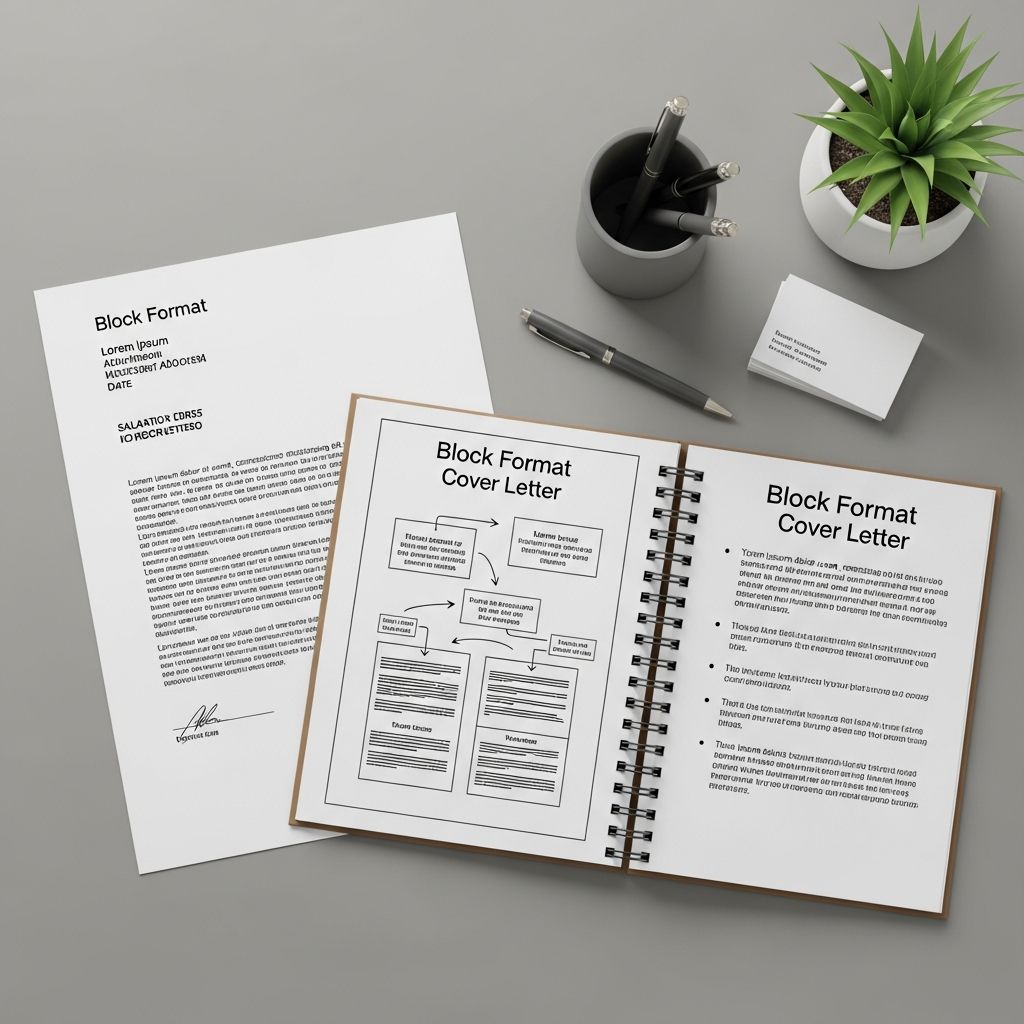
A block format cover letter is one of the most professional and widely accepted styles for business correspondence. Whether you’re applying for a corporate position, legal role, or entry-level job, understanding how to properly format and write a block format cover letter is essential for making a strong first impression. This comprehensive guide will walk you through everything you need to know about creating an effective block format cover letter, complete with examples and formatting specifications.
What Is Block Format?
Block format is a standard business letter layout where all text is aligned to the left margin with no indentations. The letter consists of distinct sections arranged in blocks, which is where the format gets its name. This style is considered highly professional and formal, making it particularly popular in industries such as law, finance, and corporate business. Many professionals prefer block format because of its clean, organized appearance and straightforward approach to formal communication.
Unlike modified block or semi-block formats, which feature centered elements or indented paragraphs, the block format maintains consistent left alignment throughout the entire document. This creates a streamlined, professional aesthetic that is easy to read and professional to the eye.
Why Choose Block Format for Your Cover Letter?
The block format offers several advantages that make it an excellent choice for your cover letter:
- Professional appearance that signals formality and business acumen
- Easy to read with clear visual organization and separation of content blocks
- Universally accepted across industries and hiring organizations
- Simple to create without complex formatting requirements
- Appropriate for competitive job markets where professionalism matters
Choosing block format demonstrates that you understand professional business standards and are serious about your application.
Block Format Cover Letter Structure and Components
A properly formatted block format cover letter contains several key components arranged in a specific order. Understanding each element ensures your letter meets professional standards and presents your qualifications effectively.
Your Contact Information
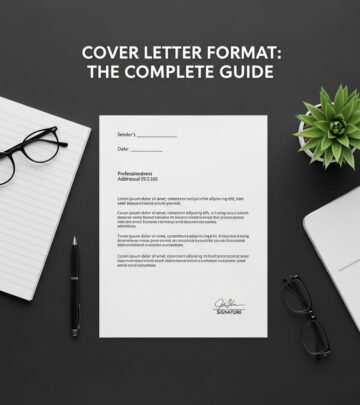
Begin your cover letter with your contact information at the top of the page. This should include your full street address, city, state, and zip code. Position this information at the left margin, and use single spacing within this section. Your contact information appears before the date and provides the employer with your location details.
The Date
Include the full date two spaces below your address. Write the date in a professional format, such as April 10, 2024, rather than abbreviations. This timestamp documents when you submitted your application and maintains proper business correspondence standards.
Recipient’s Address Block
Add four hard spaces between the date and the employer’s address. The recipient’s address block should include the contact person’s name (if known), their professional title, the organization name, street address, city, state, and zip code. Position all of this information at the left margin in single-spaced format.
The Salutation
Use “Dear Mr./Ms. Last Name:” to address your recipient. If you don’t know the contact person’s name, research the organization to find the appropriate hiring manager or department head. Use “Ms.” for women unless told otherwise. For positions in law or government, use appropriate titles such as “Dear Judge Smith:” or “Dear Commissioner Johnson:” followed by a colon, not a comma.
Formatting Guidelines for Block Format Cover Letters
Margins and Font
Proper margins are crucial for professional appearance. Set your margins to one inch on all sides (left, right, top, and bottom). Some professional standards recommend two inches at the top and bottom with one inch on the sides for a more formal appearance. Select a professional, easy-to-read font such as Arial, Calibri, Times New Roman, or Helvetica. Use 10 to 12-point font size to ensure readability without appearing too casual.
Spacing and Length
Your entire cover letter should be single-spaced throughout the body text. Double space between paragraphs to create visual separation and improve readability. The complete letter should fit on one page, which typically accommodates three to four substantive paragraphs plus the header and closing. Never extend your cover letter beyond one page, as employers prefer concise, focused applications.
Text Alignment
Maintain left alignment for all text throughout your cover letter. This means no indented paragraphs, no centered closing, and no right-aligned elements. Everything from your address to your signature line appears flush with the left margin, creating the distinctive block appearance.
Writing the Body Paragraphs
Opening Paragraph: Introduction and Purpose
Your opening paragraph should immediately establish why you’re writing and grab the reader’s attention. Introduce yourself by stating where you attend school, your anticipated graduation date or current academic year, and the specific position for which you’re applying. However, do not introduce yourself simply by stating your name—instead, lead with the position and opportunity.
Within this paragraph, express your genuine interest in the organization and geographic location. If someone referred you to the company or position, mention their name and relationship to you. If applicable, note your professional licensing status or relevant credentials. This opening sets the stage for why you’re genuinely interested in this particular role and organization.
Body Paragraph: Qualifications and Experience
Your second paragraph should present concrete evidence of why you’re an excellent fit for the position. Begin with a strong topic sentence that highlights two or three main attributes, skills, or qualifications most relevant to the job posting. Follow this topic sentence with specific examples and accomplishments that demonstrate these qualities in action.
Use quantifiable results when possible—mention projects you’ve completed, improvements you’ve implemented, or skills you’ve developed. Rather than writing “I have strong communication skills,” explain how you’ve applied these skills in a meaningful context. Describe specifically what you have accomplished with particular employers or in relevant situations, avoiding vague generalizations. Connect your experiences directly to the job requirements mentioned in the posting.
Closing Paragraph: Call to Action
Your final paragraph should express your enthusiasm for an interview and indicate your availability. State when you will be in the geographic area where the employer is located, if applicable. Mention that you would appreciate the opportunity to discuss your qualifications further. Indicate that you’ll follow up within a specific timeframe (typically one to two weeks) if you haven’t heard from them, or invite them to contact you at their convenience.
Thank the employer for their time and consideration. Keep this paragraph brief—typically three to four sentences—and maintain a professional, confident tone without sounding desperate or overly casual.
Closing and Signature Line
Two lines below your final paragraph, include your professional closing. Use “Sincerely” or “Very truly yours” followed by a comma, not a period. Leave four hard spaces (approximately one blank line) for your handwritten signature. Below the signature line, type your full name.
Two lines below your typed name, include an enclosures line: “Enclosures:” or “Enc:” followed by a list of what you’re including—typically “Resume,” “Transcript,” and “References.” Do not include your name in the header of your document.
Block Format Cover Letter Example
Here is a complete example of a properly formatted block format cover letter:
123 Campway BoulevardSaratoga Springs, New York 12020April 10, 2024Camrin St. MarksDevelopment DirectorThe Pinkstreet Foundation555 Halbin Way, Suite 3013Ithaca, New York 14851Dear Ms. Marks:I am a second-year student at Cornell Law School seeking a summer associate position with The Pinkstreet Foundation's Public Interest Law Program. I am particularly drawn to your organization's commitment to environmental justice and community development initiatives in upstate New York communities. Your recent work expanding legal resources to underserved rural populations resonates deeply with my career goals of using legal expertise to address systemic inequities.My background uniquely positions me to contribute meaningfully to your organization. During my first-year summer internship at the Environmental Law Clinic, I researched and drafted policy recommendations that led to changes in local zoning ordinances, directly impacting three communities. Additionally, my work on the Law Review, where I edit articles addressing social justice topics, has strengthened my legal writing and analytical skills. I have also completed coursework in environmental law, administrative law, and nonprofit law, providing me with specialized knowledge relevant to your foundation's mission. My experience organizing community outreach initiatives demonstrates my ability to engage stakeholders and build relationships across diverse populations.I am confident that my legal skills, passion for public interest work, and commitment to community development would make me a valuable addition to your team. I would welcome the opportunity to discuss how my background aligns with your organization's needs. I will be in the Ithaca area throughout June and July and am available for an interview at your convenience. Thank you for considering my application. I look forward to hearing from you.Sincerely,Jessica WilliamsEnclosures: Resume, Law School Transcript, ReferencesCommon Mistakes to Avoid
When writing your block format cover letter, watch out for these common errors that can undermine your professional presentation:
- Using indented paragraphs instead of maintaining left alignment throughout
- Centering the date or closing when block format requires left alignment
- Double-spacing the entire letter instead of single-spacing body text with double spaces between paragraphs
- Including your name in the document header (it should only appear typed below your signature)
- Writing more than one page or extending content beyond a single sheet
- Using inconsistent fonts, sizes, or formatting styles
- Addressing the letter to “Hiring Manager” or “To Whom It May Concern” instead of researching the specific person’s name
- Writing generic content that could apply to any organization rather than tailoring to the specific position
- Repeating information from your resume without adding new insight or context
- Using casual language, contractions, or unprofessional tone
Block Format vs. Other Cover Letter Formats
While block format is the most formal and widely used style, other formats exist. Understanding the differences helps you choose the right format for your situation:
| Format Type | Text Alignment | Date and Closing | Paragraphs | Formality Level |
|---|---|---|---|---|
| Block | All left-aligned | Left-aligned | Single-spaced with double space between | Most Formal |
| Modified Block | Body left-aligned | Centered | Single-spaced with double space between | Formal |
| Semi-Block | Body left-aligned, first sentence indented | Centered | Indented first sentence with double space between | Semi-Formal |
Block format is considered the most appropriate for formal business communication and is the style most generally used for professional business writing, particularly in fields like law, accounting, and corporate management.
Tips for Success
Follow these professional tips to ensure your block format cover letter stands out:
- Research the organization thoroughly to demonstrate genuine interest and knowledge
- Tailor every paragraph to the specific position and company, not a generic template
- Use strong action verbs and specific examples with measurable results
- Keep your tone professional yet personable—show personality without sacrificing formality
- Proofread multiple times for spelling, grammar, and formatting consistency
- Have someone else review your letter before submitting
- Save and send your letter as a PDF to preserve formatting across different computers
- Use a professional email address when submitting electronically
- Follow all application instructions regarding format and submission method
- Update your contact information to ensure employers can reach you
Frequently Asked Questions
Q: What is the difference between a cover letter and a letter of interest?
A: A cover letter responds to a specific job posting and explains why you’re applying for that particular position. A letter of interest expresses your curiosity about a company or organization even when no position is currently posted, often used for networking or exploratory inquiries.
Q: Should I always use block format, or are there situations where other formats are acceptable?
A: Block format is universally appropriate for formal business communication. If unsure of an employer’s preference, block format is always a safe choice. Some creative industries might accept modified block or semi-block, but block format remains the most professional option across all industries.
Q: How long should my cover letter be?
A: Your cover letter should be exactly one page, single-spaced. This typically accommodates three to four substantive paragraphs plus your header and closing. Aim for 250-400 words total to maintain employer interest while providing sufficient detail.
Q: Should I include a photo or any visual elements in my block format cover letter?
A: No. Block format emphasizes simplicity and professionalism. Avoid images, logos, colored text, or other visual elements. Use only black text on white paper with standard formatting for maximum professionalism.
Q: What font should I use for my cover letter?
A: Choose professional, easy-to-read fonts such as Arial, Calibri, Times New Roman, or Helvetica in 10-12 point size. Avoid decorative, script, or overly casual fonts that might appear unprofessional or difficult to read.
Q: How should I address my cover letter if I don’t know the hiring manager’s name?
A: Research the company website, LinkedIn, or call the organization to find the appropriate contact person’s name. If absolutely impossible to find a specific name, address it to the department, such as “Dear Hiring Manager for the Marketing Department:” rather than generic salutations.
Q: Can I use a cover letter template, or should I write completely from scratch?
A: Using a template as a starting framework is acceptable, but you must thoroughly customize it for each position. Generic templates lack the specific details and tailored content that make cover letters effective. Use templates as structural guides only.
Q: Should I mention salary expectations in my block format cover letter?
A: No. Cover letters are not the appropriate place to discuss salary. Wait until you receive an interview or a job offer before discussing compensation. Focus your letter on your qualifications and enthusiasm for the role.
References
- Cover Letter Format Block Style — University of Richmond School of Law. https://law.richmond.edu/docs/cdo/timeline-template/cover-letter-format_blockstyle.pdf
- Cover Letters Part 1 — Purdue Online Writing Lab (OWL). https://owl.purdue.edu/owl/job_search_writing/skilled_labor_job_search_resources/cover_letters/cover_letters_part_1.html
- How To Write a Letter in Block Format (With Example) — Indeed Career Guide. https://www.indeed.com/career-advice/resumes-cover-letters/how-to-write-a-letter-in-block-format
- General Outline for Cover Letters — West Virginia University College of Law. https://www.law.wvu.edu/files/d/f47eec81-1899-43d8-a0c9-066e37e8dac8/general-outline-for-cover-letters.pdf
- Writing Your Cover Letter — University of Connecticut Center for Career Development. https://career.uconn.edu/writing-your-cover-letter/
- Sample Cover Letter (Block style) — Gallaudet University Student Success. https://gallaudet.edu/student-success/tutorial-center/english-center/writing/how-to-write-letters/sample-cover-letter-block-style/
- Cover Letter Advice & Samples — Yale Law School Career Development. https://law.yale.edu/student-life/career-development/students/toolkit-student-job-seekers/cover-letter-advice-samples
Similar Articles








Read full bio of Sneha Tete