Accelerating Mortgage Payoff: Biweekly vs Monthly
Discover how switching payment schedules can save thousands in interest
When you take out a mortgage, one of the most significant decisions you’ll make—beyond the loan amount and interest rate—is how frequently you’ll make payments. The payment schedule you choose directly affects how long you’ll carry the debt and how much interest you’ll ultimately pay. While monthly payments remain the industry standard and the most straightforward approach for many borrowers, biweekly payment structures have gained considerable attention among homeowners seeking to build equity faster and reduce long-term borrowing costs.
How Monthly Mortgage Payments Function
The traditional monthly payment system divides your annual mortgage obligation into twelve equal installments, distributed across the calendar year. This approach aligns naturally with most budgeting cycles, as people think about their finances on a monthly basis. Monthly payments represent the baseline calculation from which all other payment frequencies are derived by most lenders.
When you choose monthly payments, your mortgage servicer collects a fixed amount each month, typically on the same date. This consistency makes forecasting your cash flow relatively straightforward. For someone earning a monthly salary or running a business on a monthly profit cycle, this alignment can simplify financial planning considerably.
The Biweekly Payment Alternative Explained
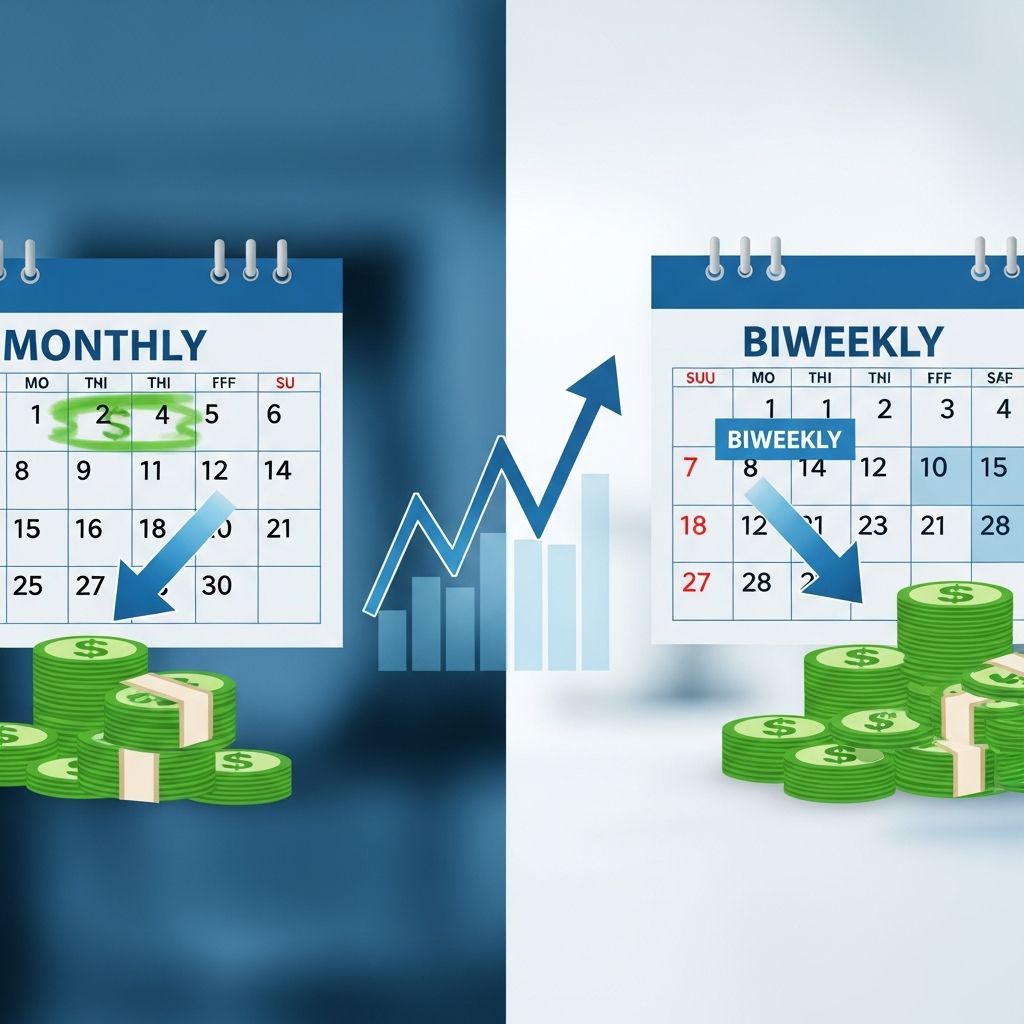
Biweekly payments involve submitting half of your monthly mortgage obligation every fourteen days. Rather than making twelve payments annually, you’ll make twenty-six payments throughout the year. The mathematical advantage emerges from this frequency difference: twenty-six half-payments equal thirteen full monthly payments, meaning you effectively make one additional full payment each year compared to the traditional twelve-payment schedule.
To illustrate: if your monthly mortgage payment equals $2,000, your annual payment under a traditional schedule totals $24,000. Switching to biweekly means paying $1,000 every two weeks, which amounts to $26,000 annually—an extra $2,000 per year directed toward your loan balance.
Financial Impact: Interest Reduction and Timeline Acceleration
The cumulative effect of this additional payment each year produces substantial long-term savings. Consider a $350,000 mortgage at 6.63% interest over thirty years: With monthly payments, borrowers pay approximately $436,076 in interest over the full loan term. Switching to biweekly payments reduces total interest paid to roughly $342,701—a difference exceeding $93,000. Beyond interest savings, the biweekly schedule compresses the repayment timeline by approximately five and a half years, allowing homeowners to achieve complete mortgage freedom years earlier.
This acceleration occurs because each extra payment chips away at the principal balance, and paying principal faster means less of your future payments go toward accruing interest. The mathematical snowball effect compounds over decades, making biweekly payments an increasingly attractive option for those seeking to minimize lifetime borrowing costs.
Comparing Payment Frequencies at a Glance
| Payment Schedule | Annual Payments | Payment Amount (on $2,359 monthly base) | Interest Savings vs. Monthly (25-year term) | Time Savings vs. Monthly |
|---|---|---|---|---|
| Monthly | 12 | $2,359 | $0 | 0 years |
| Semi-Monthly | 24 | $1,179.50 | ~$1,205 | ~1 month |
| Biweekly | 26 | $1,088 | ~$1,320 | ~1 month |
| Accelerated Biweekly | 26 | $1,179 | ~$50,548 | ~3.5 years |
Who Benefits Most From Biweekly Payment Schedules
Biweekly payments work exceptionally well for individuals whose income aligns with biweekly pay cycles. If your employer distributes paychecks every two weeks, structuring your mortgage payment to correspond with your incoming funds creates natural cash flow synchronization. This alignment eliminates the awkward timing gap where you might need to hold funds in reserve until your monthly payment comes due.
Beyond paycheck alignment, biweekly payments appeal to borrowers prioritizing faster debt elimination. If you’re motivated by the prospect of owning your home outright sooner rather than later, the five-to-six-year timeline compression represents genuine, measurable progress toward that goal. For individuals in mid-career earning years, reaching mortgage freedom before retirement becomes more achievable with biweekly acceleration.
Practical Considerations and Potential Obstacles
Before committing to biweekly payments, examine your lender’s specific policies and any associated costs. Not all mortgage servicers accept biweekly payment arrangements, and some that do may impose administrative fees or setup charges. These fees can range from nominal amounts to several hundred dollars, potentially offsetting years of interest savings if they’re excessive.
Additionally, certain mortgages contain prepayment penalties—charges imposed if you pay off the loan faster than the original schedule requires. These penalties typically apply during the initial three to five years and can significantly diminish the financial advantage of accelerated payments. Always review your mortgage documentation to identify any such restrictions before restructuring your payment plan.
Cash flow flexibility represents another important consideration. Making biweekly payments increases your annual mortgage obligation from $24,000 to $26,000 in our earlier example. While this additional expense occurs gradually throughout the year, some households may find the increased outflow challenging during lean months or periods of income volatility. Budget comprehensively before committing to a payment schedule you cannot maintain.
Alternative Acceleration Strategies
If biweekly payments don’t align with your lender’s offerings or your financial situation, other approaches can achieve similar results. Making one additional full monthly payment annually—whether in a lump sum or divided across the year—produces comparable outcomes to biweekly acceleration. This flexibility allows you to increase that payment during profitable years while maintaining standard monthly payments during tighter periods.
Some borrowers round up their monthly payments by small amounts, dedicating the difference to principal reduction. Increasing a $2,000 payment to $2,200 monthly creates meaningful cumulative impact over a thirty-year loan term. This approach requires less coordination than biweekly scheduling and provides adaptability when circumstances change.
Interest Accrual and Payment Application Mechanics
Understanding how your payments apply to principal versus interest proves crucial for maximizing acceleration benefits. Each mortgage payment comprises two components: principal reduction and interest accrual. Early in your loan term, the interest portion dominates; a typical $2,000 payment might allocate $1,600 to interest and only $400 to principal. As the loan seasons and your balance decreases, this proportion gradually shifts.
With biweekly payments, your principal receives compounding benefits. That extra annual payment goes entirely toward reducing your balance (beyond the interest portion of regular payments), which in turn reduces the total interest calculated on remaining principal. The earlier you make these principal reductions, the greater the compound effect over the remaining loan term.
Alignment With Personal Finance Goals
Your decision between payment schedules should reflect broader financial objectives. If you’re simultaneously saving for retirement, investing in education, or building emergency reserves, accelerating mortgage payoff might compete with these priorities. The optimal strategy balances accelerated debt elimination with diversified financial security.
For individuals in secure employment with stable income and adequate emergency savings, biweekly payments represent a low-risk wealth-building strategy. For those facing income uncertainty, managing multiple debt obligations, or maintaining tight monthly budgets, maintaining standard monthly payments while pursuing other financial goals may prove more prudent.
Frequently Asked Questions
How do biweekly payments differ from semi-monthly payments?
Though sometimes confused, these represent distinct approaches. Semi-monthly payments divide your monthly obligation into two equal installments paid on specific dates—typically the first and fifteenth of each month—totaling 24 payments annually. Biweekly payments occur every fourteen calendar days, yielding 26 annual payments. This difference of two additional payments annually makes biweekly slightly more advantageous for principal reduction.
What happens during months with three biweekly payments?
Since biweekly payments align with calendar weeks rather than months, certain months will naturally include three payment dates while others include just two. This occurs approximately five to six times annually and requires budgeting awareness. Your monthly obligations remain consistent even when the calendar presents three payment dates in a single month.
Can I switch back to monthly payments if circumstances change?
Most lenders permit payment schedule modifications, though some may impose administrative fees for the change. Contact your mortgage servicer to understand their specific policies regarding payment schedule adjustments. Maintaining flexibility to revert to monthly payments if needed provides important financial security.
Do all lenders offer biweekly payment options?
Not all mortgage servicers accept biweekly arrangements. Some lenders lack the systems infrastructure to accommodate non-standard payment frequencies, while others restrict these options to specific loan products. Before assuming biweekly availability, directly inquire with your lender or servicer regarding their offerings and any associated fees.
Could I achieve similar results through additional lump-sum payments?
Yes. Making one extra full payment annually—whether through biweekly automation or occasional lump-sum contributions—produces comparable principal reduction and interest savings. This approach offers greater flexibility, allowing you to adjust additional payments based on annual income fluctuations and financial circumstances.
Making Your Decision
Choosing between monthly and biweekly mortgage payments ultimately depends on your specific circumstances, lender policies, and financial priorities. The mathematical advantage of biweekly acceleration is undeniable—saving $93,000 in interest while compressing repayment by five-plus years represents genuine wealth creation. However, this advantage only materializes if the payment schedule aligns with your income timing, your lender supports the arrangement without excessive fees, and your budget accommodates the increased annual outflow.
Take time to calculate potential savings specific to your loan balance, interest rate, and remaining term. Request complete fee disclosures from your lender. Honestly assess whether biweekly payments fit your cash flow patterns and financial priorities. For many borrowers, particularly those paid biweekly, the answer aligns strongly with accelerated payment structures. For others, maintaining payment flexibility while pursuing alternative acceleration strategies proves more appropriate.
Regardless of your chosen frequency, the most important action is intentional engagement with your mortgage payoff strategy. Whether through biweekly scheduling, additional monthly payments, or consistent scheduled installments, homeowners who actively think about mortgage acceleration strategies consistently build equity faster and pay less interest over time.
References
- Mortgage Payment Frequency | Monthly vs Weekly vs Biweekly — Nesto. 2024. https://www.nesto.ca/mortgage-basics/mortgage-payment-frequency/
- Biweekly vs. Monthly Mortgage Payments — Rocket Mortgage. 2024. https://www.rocketmortgage.com/learn/biweekly-vs-monthly-mortgage-payments
- How Does a Biweekly Mortgage Payment Work? — Bankrate. 2024. https://www.bankrate.com/mortgages/bi-weekly-mortgage-calculator/
- Biweekly vs. Monthly Mortgage Payments: What’s Better — Chase Bank. 2024. https://www.chase.com/personal/mortgage/education/financing-a-home/monthly-vs-biweekly-mortgage-payments
- Compare a Bi-Weekly Mortgage to a Monthly Mortgage — Heartland Zions Credit Union. 2024. https://advice.hzcu.org/home-ownership/mortgage/tools/compare-a-bi-weekly-mortgage-to-a-monthly-mortgage
Similar Articles








Read full bio of medha deb