Bitcoin Mining: What It Is, How It Works And How To Start
Complete guide to understanding Bitcoin mining, the process of creating new bitcoins and verifying transactions on the blockchain.
What Is Bitcoin Mining?
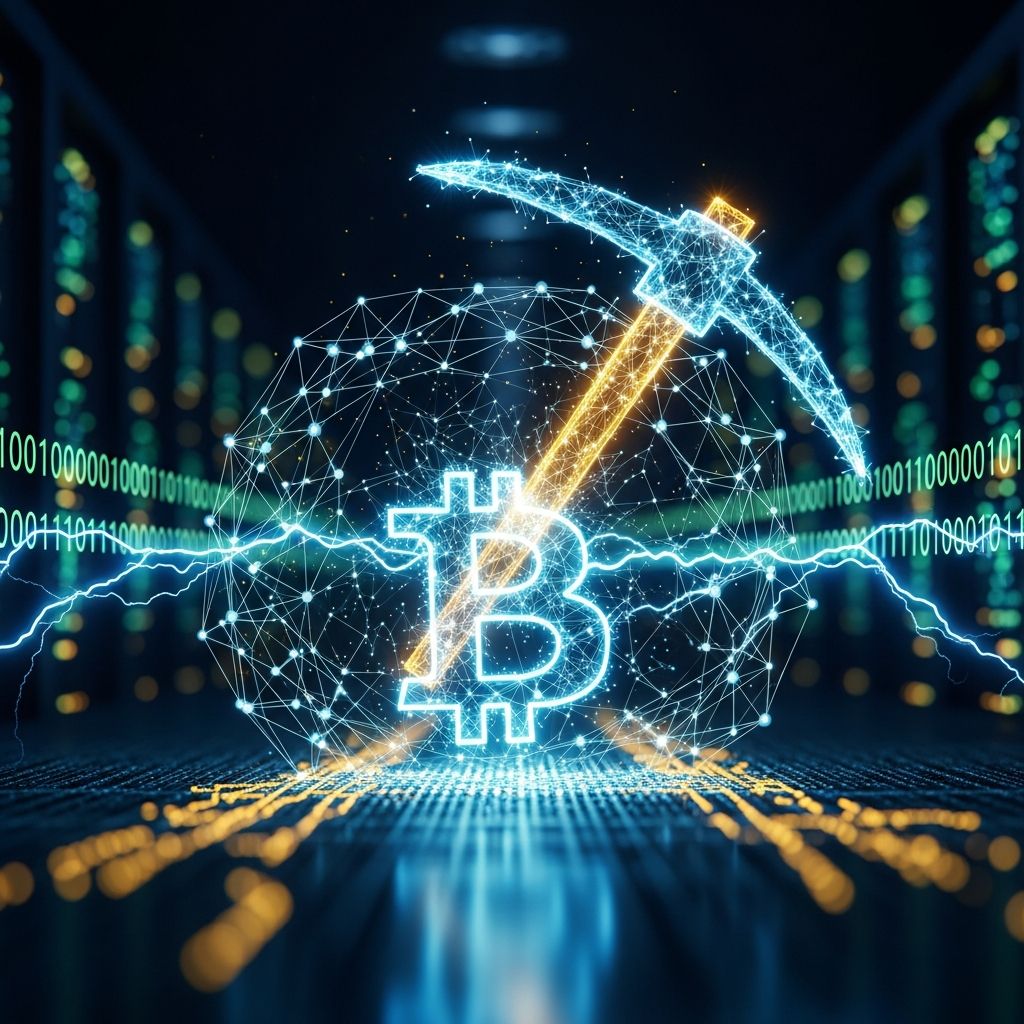
Bitcoin mining is the process of creating new bitcoins by solving extremely complicated math problems that verify transactions in the currency. It serves a dual purpose: introducing new bitcoins into circulation while simultaneously validating and securing transactions on the blockchain network. Miners play a crucial role in maintaining the integrity and decentralization of the Bitcoin network by collecting pending transactions, organizing them into blocks, and solving complex cryptographic puzzles to add these blocks to the blockchain.
The process is called “mining” because, much like traditional mining, it requires significant computational effort and resources to extract value—in this case, newly created bitcoins. Miners compete to solve mathematical puzzles, and the first to find the solution is rewarded with a block reward consisting of newly minted bitcoins plus transaction fees from the transactions included in that block.
How Bitcoin Mining Works
Bitcoin mining operates through a mechanism called Proof-of-Work (PoW), which involves solving complex mathematical problems using computational power. The process can be broken down into several key steps that occur roughly every ten minutes on the Bitcoin network.
Transaction Verification and Block Creation
Miners begin by selecting pending transactions from the mempool—a collection of unconfirmed transactions awaiting verification. They compile these transactions into a new block, prioritizing transactions with higher fees due to limited block space. These selected transactions form the foundation of what will become the next block on the blockchain.
The Merkle Root Calculation
Once transactions are selected, they are organized into a Merkle tree structure. In this process, transactions are hashed together in pairs, and then those hashes are hashed together repeatedly until a single hash remains—known as the Merkle root. This root serves as a unique fingerprint for all transactions in the block and is stored in the block header.
Block Header Construction
The block header contains critical information necessary for mining and validation:
– The version number of the Bitcoin software- The hash of the previous block in the chain- The Merkle root (representing all transactions in the current block)- A timestamp indicating when the block was created- The difficulty target that the hash must meet- A nonce (number used once)—a variable value that miners adjust during the mining process
Solving the Proof-of-Work Puzzle
The most computationally intensive step involves solving the Proof-of-Work puzzle. Miners must find a nonce value that, when combined with the block header and processed through the SHA-256 hashing algorithm, produces a hash meeting the network’s difficulty target. The resulting hash must be a 64-digit hexadecimal number with a specific number of leading zeros, determined by the current difficulty level.
Finding this nonce requires trial and error. Miners use specialized hardware to rapidly guess millions or billions of nonce values, incrementing with each attempt. The probability of finding a valid hash on any single attempt is astronomically low, necessitating powerful computing resources and significant electricity consumption.
Network Validation and Block Addition
Once a miner discovers a valid hash, they broadcast the solution to the Bitcoin network. Other nodes validate the solution’s accuracy and verify that all transactions in the block are legitimate. If consensus is reached and the proof-of-work is correctly solved, the new block is accepted and added to the blockchain. This validation process ensures the network’s security and prevents fraudulent or invalid blocks from being added to the ledger.
Miner Rewards
The successful miner receives newly created bitcoins (known as the block reward) and transaction fees from all transactions included in the block. This reward mechanism incentivizes miners to participate in securing the network and validating transactions.
Understanding Difficulty Adjustment
Bitcoin’s network automatically adjusts mining difficulty approximately every 2,016 blocks (roughly every two weeks) to maintain consistent block creation times. This self-adjusting mechanism is fundamental to Bitcoin’s stability and functionality.
As more miners join the network and total computational power increases, finding valid hashes becomes easier and faster. To counteract this, the difficulty target becomes more stringent, requiring hashes to meet stricter criteria. Conversely, when miners leave the network and computational power decreases, the difficulty decreases to prevent blocks from taking excessive time to create. This dynamic adjustment ensures that new blocks are added to the blockchain approximately every ten minutes, regardless of fluctuations in network mining power.
Bitcoin Mining Requirements
Successful bitcoin mining requires specific hardware, software, and setup components. Understanding these requirements is essential before beginning a mining operation.
Hardware Requirements
Modern Bitcoin mining demands specialized computing equipment designed specifically for this purpose:
– ASIC (Application-Specific Integrated Circuits): These are the most efficient mining devices, custom-designed exclusively for Bitcoin mining using the SHA-256 algorithm. Popular ASIC manufacturers include Antminer, Ebang, AvalonMiner, and Minedollars. ASICs far outperform general-purpose computers.- GPU (Graphics Processing Unit): While less efficient than ASICs, GPUs can still perform mining, though they consume more electricity relative to the hashes they produce.- FPGA (Field Programmable Gate Array): These represent an intermediate option between GPUs and ASICs in terms of specialization and efficiency.- SSD Storage: Solid-state drives are recommended for storing blockchain data and mining software.
When selecting hardware, two critical factors warrant consideration:
– Hash rate (performance): Measured in terahashes per second (TH/s), indicating how many calculations the hardware can perform- Electricity consumption: Measured in watts, directly affecting operational costs
Software Requirements
Bitcoin miners require specialized mining software to operate their hardware and connect to the mining network. Popular mining software options include ECOS, BeMine, and Kryptex Miner. This software coordinates the hardware’s computational efforts, downloads blockchain data, and manages communication with mining pools or the Bitcoin network.
Bitcoin Wallet
Miners must establish a secure Bitcoin wallet to receive and manage their mining rewards. A wallet serves as both a storage mechanism and a transaction interface on the Bitcoin network. Security is paramount, as wallets contain private keys necessary to access and transfer bitcoins.
Mining Pool Participation
Many miners join mining pools rather than operating independently. A mining pool combines the computational power of multiple miners, increasing the probability of solving blocks and earning more consistent rewards. Pool members share rewards based on their contributed computational power, though the pool typically takes a small percentage as a fee.
How to Start Bitcoin Mining
Beginning a bitcoin mining operation involves several steps and requires technical knowledge and careful planning.
Step 1: Acquire Mining Hardware
Invest in appropriate mining hardware based on your budget and commitment level. ASIC devices represent the most cost-effective option for serious miners, though they require significant upfront investment. Research current models and their hash rates relative to electricity consumption to determine profitability.
Step 2: Set Up a Bitcoin Wallet
Create a secure Bitcoin wallet using reputable services. Ensure you understand how to back up your private keys and maintain security. This wallet will receive your mining rewards.
Step 3: Install Mining Software
Download and configure mining software on the computer controlling your mining hardware. Configure the software to connect either to a mining pool or directly to the Bitcoin network. This step requires technical knowledge and careful attention to configuration details.
Step 4: Download the Blockchain
The mining software typically requires a copy of the blockchain to validate transactions and participate in the network. This can require significant storage space and bandwidth for the initial download.
Step 5: Join a Mining Pool (Optional but Recommended)
Unless operating a substantial mining operation, joining a mining pool increases the likelihood of consistent rewards. Select a reputable pool, configure your mining software to connect to it, and specify your wallet address for receiving rewards.
Step 6: Start Mining
Once all components are configured, initiate the mining process. The system will operate autonomously, though regular maintenance, monitoring for system failures, and staying informed about network changes remain important.
Profitability Considerations
Bitcoin mining profitability depends on several interconnected factors. Hardware costs represent a significant initial investment, while electricity consumption determines ongoing operational expenses. Mining difficulty, which fluctuates based on network participation, directly affects your chances of earning rewards. Bitcoin’s market price also influences profitability—higher prices make mining more rewarding, while price declines can make operations unprofitable.
Many miners calculate break-even points and potential returns before investing in hardware. Online tools and calculators can help estimate profitability based on hardware specifications, electricity costs, and current network conditions.
Frequently Asked Questions
Q: Why does Bitcoin mining exist?
A: Bitcoin mining serves two critical functions: it creates new bitcoins that enter circulation through block rewards, and it validates transactions while securing the entire blockchain network through the Proof-of-Work mechanism. This dual function eliminates the need for centralized authorities to issue currency or verify transactions.
Q: How long does it take to mine one bitcoin?
A: The time required depends on your hardware’s computational power and current network difficulty. Solo miners with modest equipment might take years, while miners in large pools with powerful ASIC hardware might earn bitcoins within days or weeks. On average, a new block is created every 10 minutes, and each block contains newly minted bitcoins.
Q: Is Bitcoin mining profitable?
A: Profitability depends on equipment costs, electricity prices, Bitcoin’s market value, and mining difficulty. In regions with cheap electricity and with efficient ASIC hardware, mining can be profitable. However, high electricity costs or older equipment may result in losses. Most serious miners use profitability calculators before investing.
Q: What is the difference between solo mining and pool mining?
A: Solo mining means competing independently to solve blocks and receive full rewards, but success is rare without enormous computational power. Pool mining combines resources with other miners, increasing the probability of earning consistent rewards, though rewards are split among pool members based on contributed computational power.
Q: Does Bitcoin mining consume a lot of electricity?
A: Yes, Bitcoin mining is electricity-intensive because of the immense computational power required to solve complex mathematical puzzles. This electricity consumption is a significant operational expense and an important consideration when evaluating mining profitability.
References
- Bitcoin Mining: Complete Guide for Beginners — Blockpit. 2024. https://www.blockpit.io/en-us/blog/what-is-bitcoin-mining
- What is Bitcoin Mining and how does it work? — Crypto for Innovation. 2024. https://cryptoforinnovation.org/what-is-bitcoin-mining-and-how-does-it-work/
- What is Bitcoin: How to Mine Bitcoin, Process, Tools and Risks — Simplilearn. 2024. https://www.simplilearn.com/bitcoin-mining-explained-article
- What is bitcoin mining? How does crypto mining work? — Fidelity. 2024. https://www.fidelity.com/learning-center/trading-investing/crypto/what-is-mining
- Bitcoin Mining: What It Is, How It Works And How To Start — Bankrate. 2024. https://www.bankrate.com/investing/what-is-bitcoin-mining/
Similar Articles








Read full bio of medha deb