Bill Of Materials (BOM): Complete Guide For Manufacturers
Master BOMs: Essential documentation for efficient product manufacturing and supply chain management.
What Is a Bill of Materials (BOM)?
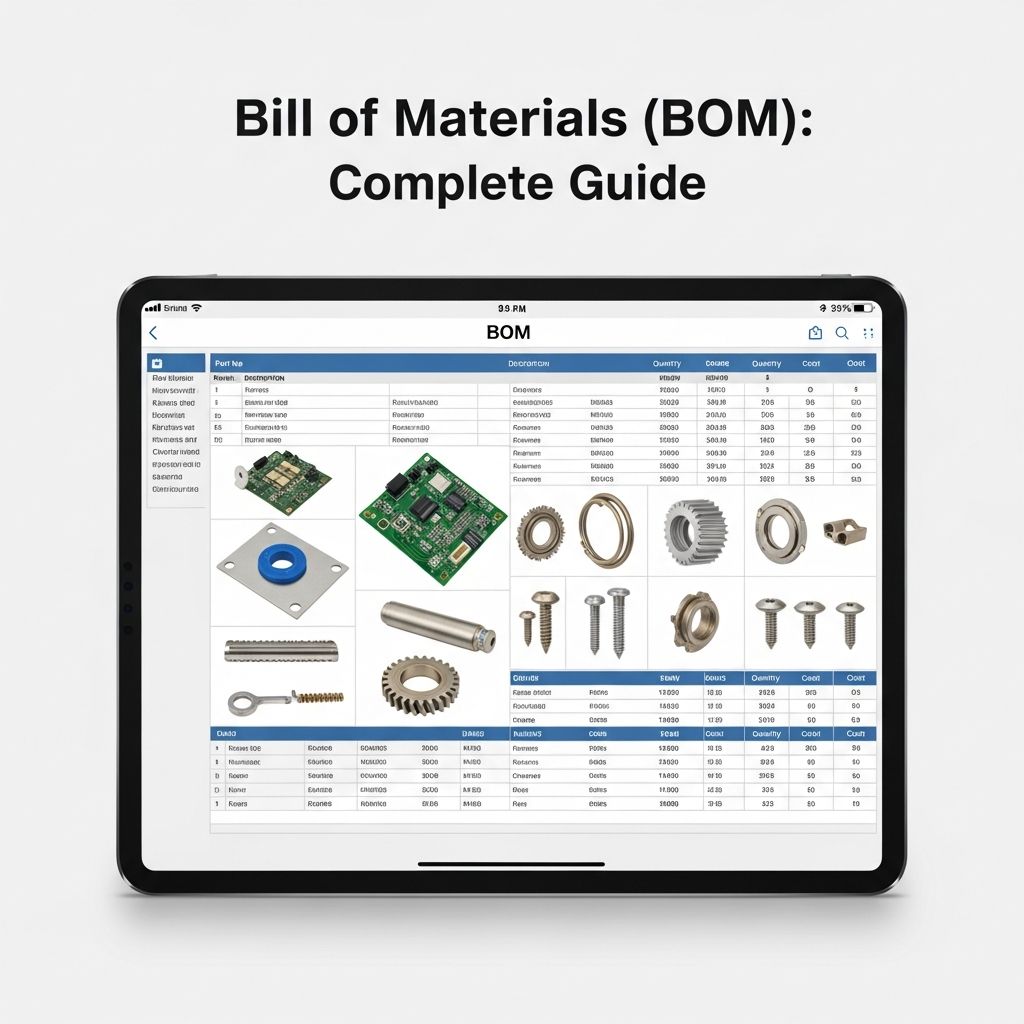
A Bill of Materials (BOM) is a structured, comprehensive list of all the materials, components, parts, and assemblies required to manufacture, build, or repair a finished product. It serves as a critical document in the manufacturing industry, functioning as a central record that captures detailed information about every element needed for production. The BOM includes not only the items themselves but also quantities, part numbers, descriptions, specifications, costs, and procurement instructions. This fundamental document bridges the gap between product design and actual manufacturing, ensuring that engineers, manufacturers, procurement teams, and supply chain partners all have access to the same accurate information.
The roots of the Bill of Materials can be traced back to the early days of industrial manufacturing, when detailed documentation of parts became essential for coordinating complex production processes. Today, BOMs remain a cornerstone of modern manufacturing operations, serving as an information link between engineering and manufacturing partners while enabling various departments to communicate and manage information throughout product development cycles.
Understanding the Core Components of a BOM
An effective Bill of Materials must include several essential elements to support accurate product development and manufacturing processes. These components work together to create a comprehensive inventory that guides every stage of production.
Essential BOM Information
Every BOM must contain unique identifiers and detailed information for each component:
- Part Numbers and Names: Unique identifiers that distinguish each component from all others in the system
- Detailed Descriptions and Specifications: Clear explanations of what each part is and its technical requirements
- Required Quantities: The exact number of each component needed per unit of the finished product
- Units of Measurement: Standardized measurements (pieces, kilograms, meters, etc.) for each component
- Cost Information: Unit costs, total costs, and pricing details for budgeting and financial planning
- BOM Notes: Essential instructions, comments, or special requirements related to manufacturing or assembly
Additionally, a comprehensive BOM features detailed information about raw materials, intermediate assemblies, finished products, and procurement types. This hierarchical documentation ensures that all stakeholders understand exactly what is needed and how components fit together in the final product.
Types of Bills of Materials
Different manufacturing scenarios require different types of BOMs. Understanding these variations helps organizations select the right approach for their specific needs.
Engineering Bill of Materials (eBOM)
The eBOM is created by engineering teams during the product design phase. It represents the complete product structure as designed, including all components, sub-assemblies, and materials exactly as they appear in engineering drawings and specifications. This version focuses on design intent and captures the theoretical structure of the product before it goes into production.
Manufacturing Bill of Materials (mBOM)
The mBOM, also called the production BOM or assembly BOM, is derived from the eBOM and tailored specifically for the manufacturing process. It includes additional manufacturing-specific information such as assembly instructions, routing details, manufacturing quantities, and detailed work instructions. The mBOM provides a precise breakdown of how the product will be assembled on the manufacturing line, including the sequence of operations, special tools required, and any specific fixtures needed.
Sales Bill of Materials (sBOM)
The sBOM is used for sales and marketing purposes, presenting the product in terms that customers understand. It typically shows what customers receive and might include packaging, documentation, and accessories bundled with the main product.
Service Bill of Materials (sBOM)
This type is used for repair and maintenance operations, listing all the replacement parts and components that might be needed to service or repair a product throughout its lifecycle.
Configurable Bill of Materials
This BOM is used for finished products that are configured and designed to meet specific customer requirements. It identifies all materials and components, including any labeling or packaging requirements needed to manufacture the product to those unique customer specifications.
Single-Level vs. Multi-Level BOMs
BOMs can be structured in different ways depending on product complexity and organizational needs.
Single-Level BOMs
A single-level BOM lists all components and sub-assemblies required to build a product with stark clarity and straightforward organization. This structure works well for relatively simple products with few components or assemblies.
Multi-Level BOMs
A multi-level BOM delves deeper into product complexity, depicting a hierarchical visualization of how each part fits into the overall product structure. These BOMs show assemblies, sub-assemblies, intermediate assemblies, and individual components in a structured hierarchy. Multi-level BOMs are essential for complex products where components are combined into sub-assemblies, which are then combined into larger assemblies, ultimately forming the finished product.
How BOMs Are Created
The process of creating a BOM varies depending on the tools and systems an organization uses.
Creating BOMs in PLM Systems
When using a Product Lifecycle Management (PLM) system, Quality Management System (QMS), or Enterprise Resource Planning (ERP) software, the creation process follows a structured approach. First, you create the item master record for each part or component. Then you create the BOM assembly by including all components and subassemblies that comprise the structure, along with quantities, reference designators, and other detailed information required for design and manufacturing. If any items have their own assemblies with existing BOM structures, the software system automatically leverages the subassembly BOM to create a multilevel BOM, ensuring consistency and reducing manual data entry errors.
Manual BOM Creation
When creating a BOM using manual approaches such as spreadsheets or other document types, you must identify and manually add all components and subassemblies that comprise the BOM structure. While this approach offers flexibility, it requires careful attention to detail and introduces greater risk of errors or inconsistencies compared to automated systems.
Key Differences: BOM vs. BOQ
While Bills of Materials and Bills of Quantities sound similar, they serve distinctly different purposes in different industries.
| Feature | Bill of Materials (BOM) | Bill of Quantities (BOQ) |
|---|---|---|
| Primary Purpose | Manufacturing and product development | Construction and project management |
| Structure | Hierarchical, showing product assembly structure | Itemized list of materials and labor costs |
| Components | Parts, materials, assemblies, sub-assemblies | Materials, parts, labor, and associated costs |
| Organization | Organized by assemblies and subassemblies | Grouped by work sections |
| Industry Focus | Manufacturing, electronics, automotive | Construction, civil engineering, projects |
| Primary Users | Engineers, manufacturers, procurement | Contractors, project managers, builders |
Critical Importance of Accurate BOMs
The accuracy and completeness of a BOM directly impacts multiple aspects of manufacturing operations. A single error in a BOM can lead to significant production delays, materials shortages, excess inventory, or costly rework. Accurate BOMs enhance supply chain efficiency, reduce the risk of production errors, and support strategic management of resources.
Production Planning and Inventory Management
BOMs form the foundation for production planning, enabling organizations to calculate exactly what materials need to be procured, when they’re needed, and in what quantities. This precision minimizes waste, reduces carrying costs, and ensures that production schedules stay on track.
Quality and Traceability
An accurate BOM enables quick identification of the cause of product failures and facilitates rapid replacement of faulty parts, materials, and components. During recalls or quality investigations, BOMs provide the detailed record needed to understand exactly what went into each product.
Cost Management
BOMs support accurate cost estimation and financial planning by capturing detailed pricing information for all components. This information is essential for competitive bidding, profit margin calculations, and cost reduction initiatives.
BOM Management and Digital Systems
Modern manufacturing organizations increasingly use sophisticated software systems to manage BOMs. Enterprise Cloud PLM solutions centralize the entire product record, including BOMs, engineering change processes, quality documentation, and design files (electrical, mechanical, and software) along with associated drawings in a single integrated system. Everything is connected, providing product teams and supply chain partners real-time access from any location.
Automated Change Processes and Version Control
Digital BOM management systems apply automated change processes and revision controls to ensure that everyone always accesses the most current and accurate product information. When engineering changes occur, the system automatically manages updates across all affected BOMs and notifies relevant stakeholders of modifications.
Supply Chain Integration
Digital BOMs integrate seamlessly with supply chain operations, enabling real-time coordination between procurement, manufacturing, and logistics teams. Supplier information, lead times, and availability data are linked directly to BOM components, streamlining purchasing decisions and identifying potential supply chain risks.
BOM Applications Across Departments
Different departments within a manufacturing organization use BOMs for specific purposes:
Procurement
The procurement team uses BOMs to add supplier information, lead times, and unit costs for each item. The BOM helps flag availability issues and recommend alternative materials based on sourcing constraints.
Materials Management
Materials management teams verify inventory levels for listed components, identify reorder requirements, and confirm that all listed parts are in stock or can be procured on schedule.
Manufacturing and Production
Manufacturing teams review the BOM for assembly feasibility and add process notes, tools required, or special instructions necessary for successful production and assembly.
Quality and Compliance
Quality teams use BOMs to track component specifications, certifications, and compliance requirements, ensuring that only approved materials and suppliers are used in production.
Why BOMs Matter in Modern Manufacturing
The Bill of Materials underpins the entire production process, from initial production planning to final inventory management, ensuring the seamless transition of materials through various stages of creation. By meticulously itemizing every requirement, a BOM enhances supply chain efficiency, reduces the risk of production errors, and supports the strategic management of resources. The BOM embodies the critical link between the design phase and the delivery of the final product to consumers, making it indispensable for successful manufacturing operations in today’s complex, global supply chains.
Frequently Asked Questions
Q: What is the main purpose of a Bill of Materials?
A: The main purpose of a BOM is to provide a comprehensive list of all materials, components, and assemblies required to manufacture a product. It serves as a central reference document that guides production planning, procurement, quality management, and supply chain operations.
Q: What is the difference between an eBOM and an mBOM?
A: An eBOM (engineering BOM) is created by design teams and represents the theoretical product structure as designed. An mBOM (manufacturing BOM) is derived from the eBOM and includes manufacturing-specific information such as assembly instructions, routing details, and production quantities needed for actual manufacturing.
Q: Can a BOM be used for service and repair?
A: Yes, a service BOM lists all replacement parts and components needed to service or repair a product throughout its lifecycle. This type is crucial for maintaining products after they’re delivered to customers.
Q: How does a BOM help reduce production costs?
A: A BOM helps reduce costs by enabling accurate material planning, minimizing waste, identifying cost reduction opportunities through alternative materials or suppliers, and preventing production delays that result from missing or incorrect components.
Q: What happens if there’s an error in the BOM?
A: Errors in a BOM can lead to significant production delays, material shortages, excess inventory, and costly rework. Inaccurate BOMs may also result in quality issues and customer dissatisfaction, making accuracy critical.
Q: How should BOMs be updated when product designs change?
A: Modern PLM systems use automated change management processes to update BOMs when designs change. These systems track revisions, notify stakeholders of modifications, and ensure that everyone accesses the most current version of the BOM.
References
- Bill of Materials (BOM) Definition — Arena Solutions. 2025. https://www.arenasolutions.com/resources/glossary/bill-of-materials/
- What Is a Bill of Materials (BOM)? — Aras Corporation. 2025. https://aras.com/en/glossary/bill-of-materials
- What Is a Bill of Materials (BOM)? The Complete Guide to BOMs — NetSuite. 2025. https://www.netsuite.com/portal/resource/articles/erp/bill-of-materials-bom.shtml
- Bill of Materials (BOM): Definition, Impact, and Components — Inbound Logistics. 2025. https://www.inboundlogistics.com/articles/bill-of-materials/
- BOM Management Solutions | What Is Bill of Materials (BOM) — OpenBOM. 2024. https://www.openbom.com/blog/what-is-bom-bill-of-materials
Similar Articles








Read full bio of medha deb