Bigger Paycheck or Bigger Tax Refund: Which Should You Pick?
Discover whether you'd rather enjoy larger paychecks throughout the year or a substantial tax refund at filing time—and how to make it happen.
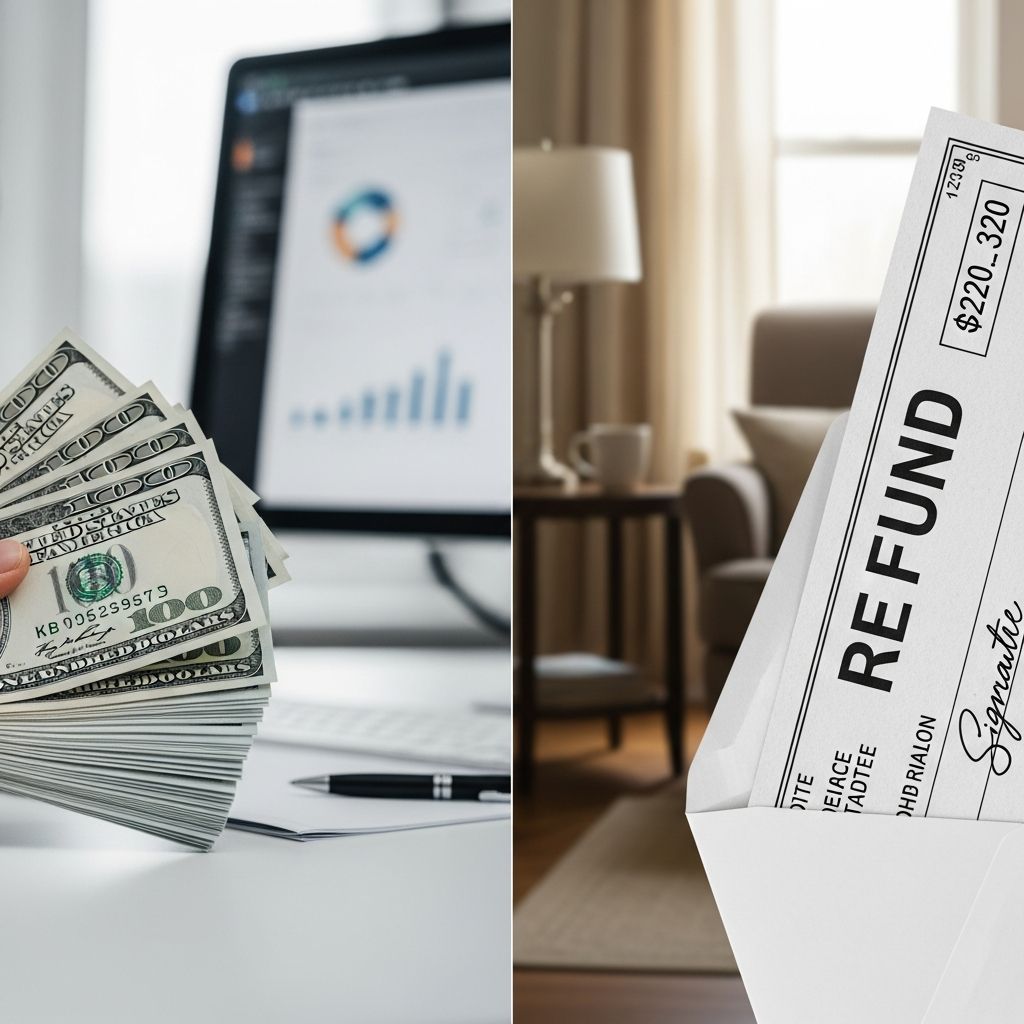
Every year, millions of Americans face a fundamental financial choice: should you tweak your tax withholding to receive larger paychecks biweekly or hold out for a hefty tax refund come filing season? This decision impacts your monthly budget, savings potential, and overall financial discipline. A bigger paycheck means more money in your pocket now, potentially earning interest or paying down debt faster. Conversely, a large refund acts like a forced savings account—interest-free for the government, but a windfall many use for big purchases or emergencies. According to IRS data and expert analyses, the average refund hovers around $3,000, equating to roughly $250 extra per month if redistributed. This article breaks down the mechanics, arguments for each side, adjustment steps, and tools to help you decide what’s best for your situation.
Understanding Tax Withholding: The Foundation of Your Choice
Tax withholding is the amount your employer deducts from each paycheck for federal income taxes, based on your Form W-4. This form tells the IRS how much to hold back, influenced by your filing status, dependents, other income, and deductions. If too much is withheld, you get a refund; too little, and you owe at tax time. The IRS emphasizes accurate withholding to avoid surprises, as overwithholding essentially lends money interest-free to the government.
Form W-4 has evolved; the 2020 redesign simplified it by eliminating allowances in favor of step-by-step calculations for multiple jobs, dependents, and extra income. Line 4(c) allows ‘extra withholding’ to boost deductions per check, ideal for guaranteeing a refund. Life events like marriage, divorce, births, or side gigs necessitate W-4 updates to reflect your true tax liability.
Key Takeaways: Quick Insights on Paycheck vs. Refund
- Bigger paycheck: Submit a precise W-4 to your employer, reducing overwithholding and aligning deductions with actual liability for more take-home pay.
- Bigger refund: Use W-4 line 4(c) to add extra withholding per paycheck, ensuring a lump-sum return.
- Tools matter: IRS or TurboTax withholding calculators provide personalized W-4 guidance based on your full financial picture.
- Average impact: A $3,079 refund means $250/month extra if shifted to paychecks—funds for savings, debt, or investments.
Understanding Your Paycheck and Refund Amounts
Your paycheck size directly ties to withholding accuracy. Many overwithhold due to outdated W-4s or conservative estimates, leading to refunds. For 2026 filings (2025 taxes), inflation adjustments increase standard deductions—e.g., single filers see $15,000 (2024) rise to about $16,200, potentially shrinking refunds unless compensated. A $1,150 deduction hike saves $253 in the 22% bracket.
| Filing Status | 2024 | 2025 | Increase |
|---|---|---|---|
| Single | $14,600 | $15,750 | $1,150 |
| Married Filing Jointly | $29,200 | $31,500 | $2,300 |
Refunds average lower for higher earners ($71,000 income) who owe, versus $50,000 households favoring refunds. New jobs or raises can push income into higher brackets (e.g., 12% up to $48,475 in 2025), reducing refunds.
The Case for a Bigger Paycheck (And Smaller Refund)
Financial experts overwhelmingly favor bigger paychecks. Derek Pszenny of Carolina Wealth Management calls refunds an ‘interest-free loan’—$3,000 at 5% APY earns $150 yearly. That $250/month could supercharge a 401(k): $200/month at 9% over 10 years grows to $38,000; over 40 years, nearly $1 million.
More cash flow aids budgeting, debt payoff, or high-yield savings (current rates ~4-5%). Behavioral finance shows people save or invest lump sums less reliably than steady increments. Adjust W-4 for precision: use calculators to match withholding to liability, avoiding both refunds and bills. Mid-year checkups—double half-year data for annual estimates—prevent end-of-year shocks.
The Case for a Bigger Tax Refund
Despite math favoring paychecks, refunds suit certain behaviors. Lower-income families ($50k avg.) treat them as savings vehicles for appliances, debt, or emergencies. A lump sum curbs spending temptation; small paycheck boosts often fund wants, not needs.
If disciplined, refunds fund big goals. JPMorgan notes refund recipients skew lower-income, using funds productively. For 2026, potential OBBBA deductions could boost refunds further.
How to Fatten Your Paycheck Without Losing a Refund
Balance both via calculators. Steps:
- Input details into IRS/TurboTax withholding estimator for zero-refund W-4.
- Decide desired refund (e.g., $2,400/year).
- Divide by pay periods (24 biweekly: $100/check).
- Add to line 4(c) ‘Extra withholding’.
Example: Calculator suggests $0 extra; want $240 refund (bi-monthly pay)? $240/24=$10. Enter $10 on 4(c). Paycheck shrinks minimally, refund secured.
Tools and Calculators for Precision
- IRS Withholding Estimator: Free, official tool for W-4 completion.
- TurboTax Calculator: Guides line-by-line, handles complexities.
- Tax Software Projections: Mid-year runs estimate outcomes.
Common Mistakes and When to Adjust
Avoid outdated W-4s post-life changes. Mistakes: ignoring side income, dependents, or credits. New 2025 brackets (e.g., 22% to $103,350 single) alter math. Table shows impact:
| Tax Rate | 2024 Brackets/Tax | 2025 Brackets/Tax |
|---|---|---|
| 10% | Up to $11,600: $1,160 | Up to $11,925: $1,193 |
| 12% | $11,601-$47,150: $4,266 | $11,926-$48,475: $4,386 |
| 22% | $47,151-$100,525: $11,742 | $48,476-$103,350: $12,072 |
| 24% | $100,526-$105,400: $1,170 | $103,351-$104,250: $216 |
| Total | $18,338 | $17,866 |
Frequently Asked Questions (FAQs)
Q: Is a big tax refund a good thing?
A: Financially, no—it’s overpaid taxes. But for forced savings, some prefer it over spending extra paycheck money.
Q: How do I get a bigger paycheck immediately?
A: Submit an updated W-4 to your employer reflecting accurate withholding; changes apply to next pay.
Q: Can I still get a refund with a fatter paycheck?
A: Yes, add to line 4(c) extra withholding after calculator baseline.
Q: When should I check my withholding?
A: Mid-year (July), or after life events like raises, births, or marriages.
Q: Will 2026 refunds be bigger?
A: Possibly, with inflation-adjusted deductions and potential new laws like OBBBA.
Final Thoughts: Choose What Fits Your Life
Run the numbers: if disciplined, opt for paychecks to harness compound growth. Need a nudge? Engineer a modest refund. Tools make it simple—start today for 2026 optimization.
References
- Fatten Your Paycheck and Still Get a Tax Refund — TurboTax Intuit. 2025. https://turbotax.intuit.com/tax-tips/tax-refund/fatten-your-paycheck-and-still-get-a-tax-refund/L5HaySdDP
- Will Your Tax Refund Be Bigger or Smaller in 2026? — Experian. 2025-12-01. https://www.experian.com/blogs/ask-experian/will-your-tax-refund-be-bigger-or-smaller-this-year/
- Tax Refund Debate: Big Refund or Zero Refund? — CBS News. 2025-02-24. https://www.cbsnews.com/news/tax-refund-debate-big-refund-zero-refund-cbs-news-explains/
- Is a Bigger Paycheck or Tax Refund Better? — YouTube (Video Transcript). 2025. https://www.youtube.com/watch?v=2zMXMtRdjxI
Similar Articles








Read full bio of Sneha Tete