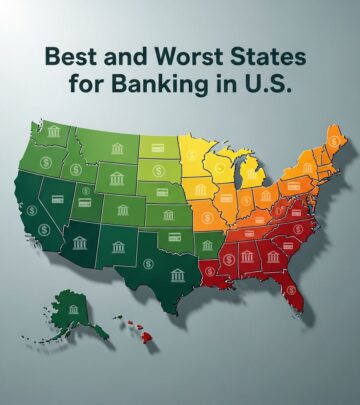
Best and Worst States for Financial Literacy in 2023
Discover which states lead in financial literacy and which lag behind, based on policies, education, and economic resilience.
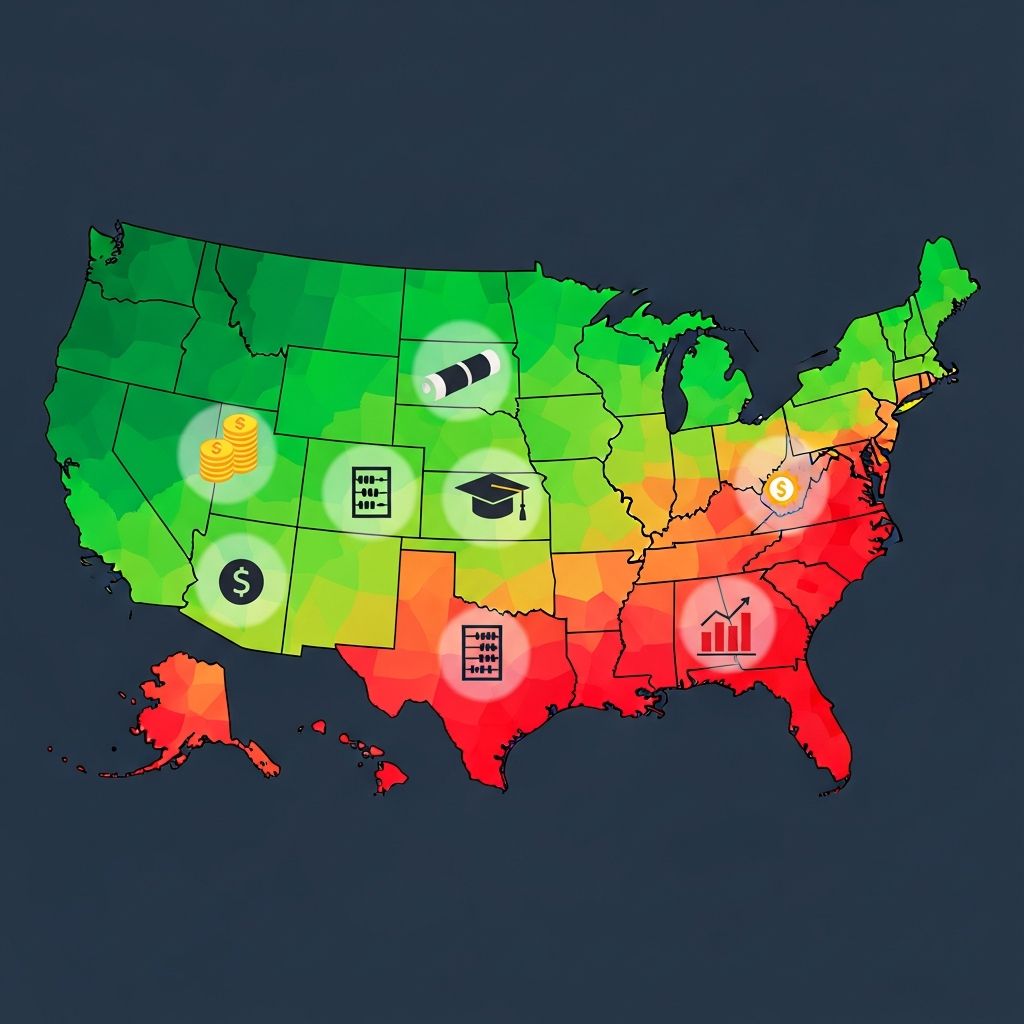
How much do your money smarts depend on where you live? State policies significantly influence whether residents receive adequate financial literacy education and support for financial resilience. To assess this, The Penny Hoarder analyzed all 50 states using 27 evaluation criteria across six key categories: personal consumption, household earnings, financial knowledge, investing and savings, state policy, and resilience. This comprehensive evaluation ranks states from best to worst, emphasizing the role of proactive policies in fostering financial well-being.
The Best States for Financial Literacy
The top 10 states for financial literacy all scored above 70% overall, demonstrating strong performances in policy support, education mandates, and economic indicators. These states prioritize financial education in schools and exhibit robust resident financial health, including higher credit scores and lower debt levels. Their success underscores how targeted state initiatives can build a foundation for lifelong financial competency.
| Rank | State | Score |
|---|---|---|
| 1 | New Hampshire | 79.9% |
| 2 | Virginia | 79.7% |
| 3 | Nebraska | 78.6% |
| 4 | North Carolina | 76.0% |
| 5 | Georgia | 75.0% |
| 6 | Ohio | 74.6% |
| 7 | Maryland | 72.0% |
| 8 | Connecticut | 71.4% |
| 9 | New Jersey | 70.4% |
| 10 | Rhode Island | 70.1% |
New Hampshire leads with a score of 79.9%, excelling in state policies that mandate financial education and promote resilience programs. Virginia follows closely at 79.7%, with strong household earnings and low pay disparities. States like Nebraska and North Carolina benefit from accessible standalone financial literacy courses for students, contributing to higher self-reported knowledge levels.
The Worst States for Financial Literacy
In contrast, the bottom 10 states scored between 40% and 50%, revealing significant gaps in policy support, education requirements, and financial knowledge. These states often lack mandatory high school financial literacy courses and show weaker resilience metrics, such as higher unemployment histories and lower credit scores. While individual financial success varies, systemic shortcomings hinder widespread literacy.
| Rank | State | Score |
|---|---|---|
| 41 | Hawaii | 49.8% |
| 42 | Texas | 49.1% |
| 43 | Indiana | 46.6% |
| 44 | Delaware | 45.3% |
| 45 | Alaska | 45.0% |
| 46 | Idaho | 44.0% |
| 47 | Kentucky | 43.8% |
| 48 | Louisiana | 43.5% |
| 49 | California | 42.9% |
| 50 | Nevada | 40.0% |
Nevada ranks dead last at 40.0%, with the lowest scores in policies supporting resilience and education. Delaware and Louisiana also struggle, with Louisiana hitting rock bottom in financial knowledge metrics. These rankings highlight opportunities for policy reforms to elevate financial literacy nationwide.
Ranking Factors for Financial Literacy
The evaluation employed a weighted scoring system across six categories totaling 27 criteria, including credit scores, unemployment rates, income disparities, and education mandates. Weights reflect the relative importance of policy-driven factors over individual outcomes, ensuring the focus remains on state-level support for financial literacy.
- Personal Consumption (25% weight): Assesses spending habits, debt levels, and credit utilization, as these reflect practical financial management skills.
- Earning (10% weight): Examines median household incomes ($66,644 nationally) and pay disparities across demographics like race, ethnicity, and gender.
- Knowledge (2.5% weight): Based on self-reported understanding of core concepts from FINRA surveys.
- Investing and Savings (2.5% weight): Evaluates participation rates and access to savings vehicles.
- State Policy (50% weight): The heaviest factor, drawing from Next Gen Personal Finance’s 2023 report on education mandates.
- Resilience (10% weight): Measures recovery from economic shocks via unemployment history and emergency fund access.
This methodology prioritizes actionable state interventions, revealing that policy weight (50%) drives the top rankings.
Earning (10% of Score)
State policies can mitigate wage gaps, boosting overall resilience. The analysis calculated disparities relative to white male earnings, showing how equitable pay structures support broader financial stability. For instance, top states exhibit smaller gaps for Black, Hispanic, and female workers compared to the national median household income of $66,644.
Financial Knowledge (2.5%)
Drawn from FINRA’s survey, this category tests comprehension of inflation (understood by 54%), compound interest (70%), mortgage interest (71%), and bonds (25%). Low bond knowledge underscores gaps in advanced topics, correlating with poorer financial decisions during inflation spikes.
State Policy Around Resilience and Education (50%)
The dominant category, sourced from Next Gen Personal Finance’s 2023 report, evaluates high school graduation requirements for financial literacy courses and standalone class access. Top-10 states earned passing grades here, mandating courses for large student populations. Conversely, 46% of states lack adequate support, per the analysis.
Why State Policies Matter for Financial Literacy
Financial literacy empowers better decisions on budgeting, investing, and debt management. Yet, as TIAA’s 2023 P-Fin Index shows, U.S. adults average only 48% correct on literacy questions—53% for men, 43% for women, with Gen Z lagging most. High-literacy individuals were 80% less likely to halt retirement savings amid 2022 inflation, where 12% of workers (24% Hispanic) paused contributions. State mandates bridge these gaps, as top-ranked areas demonstrate higher well-being.
In lower-ranked states, absent policies perpetuate cycles of low knowledge and vulnerability. For example, Louisiana’s poor knowledge score aligns with limited course access, while Nevada’s policy deficits exacerbate consumption issues.
Frequently Asked Questions (FAQs)
What makes a state rank high in financial literacy?
High rankings stem from strong state policies (50% weight), including mandatory financial education in high schools, low pay disparities, and solid resilience metrics like credit scores and unemployment recovery.
Why is state policy weighted so heavily?
At 50%, it directly measures government efforts to promote literacy via education mandates and programs, which influence long-term resident outcomes more than individual factors.
How was financial knowledge measured?
Using FINRA survey data on understanding inflation, compound interest, mortgages, and bonds, revealing national gaps like only 25% grasping bonds.
Can individuals improve literacy in low-ranked states?
Yes, through personal education via free resources, though systemic policy changes offer broader impact. Top states show policy drives population-level gains.
Has inflation affected these rankings?
Indirectly; TIAA data links low literacy to inflation-induced behaviors like stopping retirement savings, amplifying needs for strong state support.
Improving Financial Literacy Nationwide
To elevate rankings, states should adopt Next Gen’s recommendations: require personal finance courses for graduation, reaching all students. Top performers like New Hampshire integrate these seamlessly, yielding resilient economies. Nationally, bridging demographic gaps—e.g., 34-38% literacy among Black and Hispanic adults vs. 53-55% for Whites/Asians—requires inclusive policies.
Residents in bottom states can advocate for reforms while building skills independently. Ultimately, financial literacy isn’t just personal—it’s a policy priority determining economic health.
References
- Best and Worst States for Financial Literacy in 2023 — The Penny Hoarder. 2023-04-05. https://www.thepennyhoarder.com/save-money/financial-literacy-report/
- Financial well-being and literacy in a high-inflation environment — TIAA Institute. 2023. https://www.tiaa.org/public/institute/publication/2023/financial-well-being-and-literacy-in-a-high-inflation-environmen
- Why Financial Literacy is Important — The Penny Hoarder. 2023. https://www.thepennyhoarder.com/budgeting/why-financial-literacy-is-important/
- 46% of states lack adequate support for financial literacy — GlobeNewswire (The Penny Hoarder analysis). 2023-04-05. https://www.globenewswire.com/news-release/2023/04/05/2641622/0/en/46-of-states-lack-adequate-support-for-financial-literacy.html
Similar Articles








Read full bio of medha deb