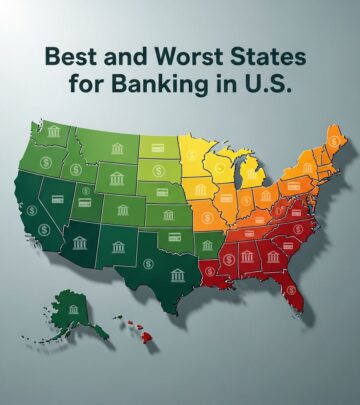
Bank Health By State: 10 Best And 10 Worst States In 2025
Understand how bank strength varies by state and what depositors should know about safety, competition and long-term financial stability.
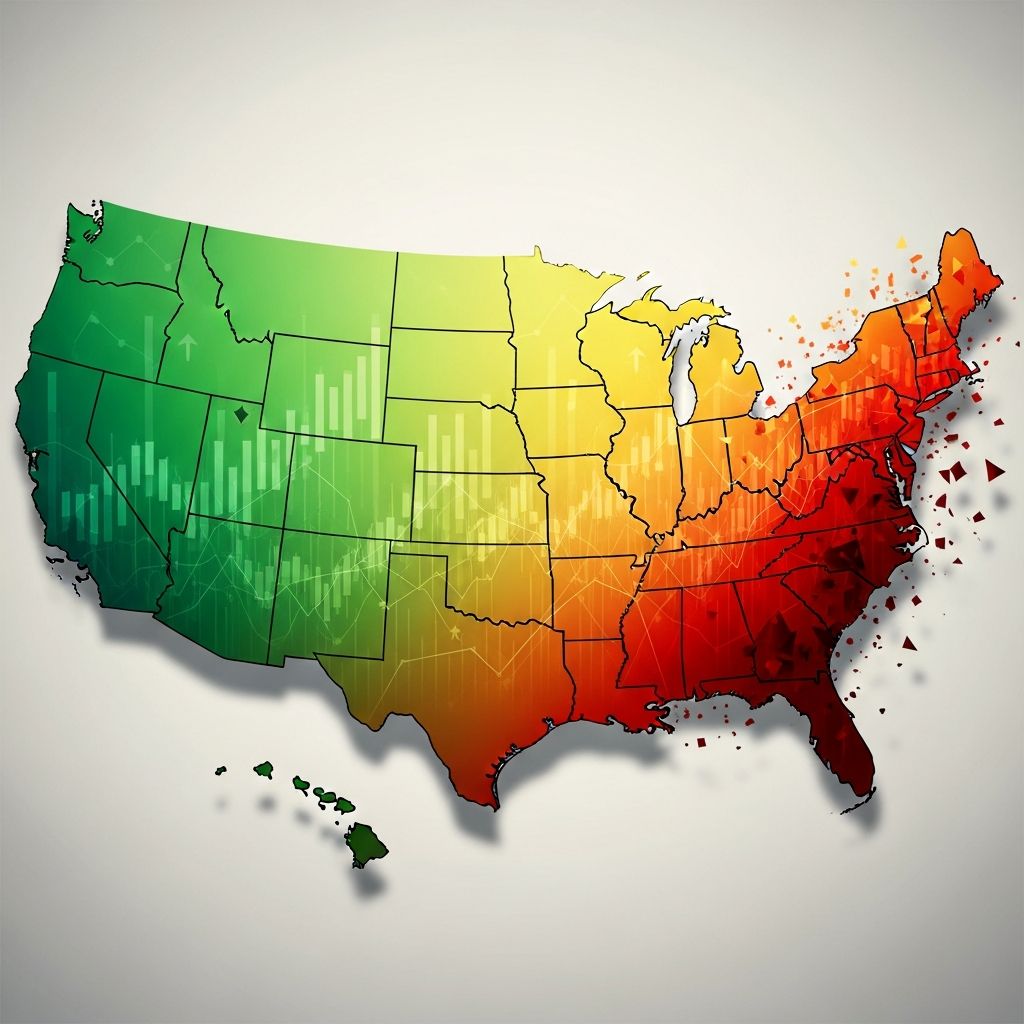
Banks are a critical part of the financial infrastructure in every state, but the strength and stability of banks can vary widely across the country. Some states are home to highly capitalized, well-diversified institutions, while others are dominated by weaker banks or more fragile banking markets. Understanding which states have the healthiest banks and which lag behind can help consumers, businesses and policymakers make better decisions about where and how they bank.
This article mirrors the structure of the original MoneyRates analysis of bank health by state, updating the discussion with broader context and neutral examples while preserving the core themes: how bank health is measured, which states rank at the top and bottom, why regional patterns emerge, and what it all means for depositors and communities.
What “Bank Health” Means
“Bank health” describes the overall financial strength, resilience and risk profile of banks operating in a particular area. Analysts typically consider:
- Capital strength – how much capital a bank has relative to its risk-weighted assets, often measured by Tier 1 risk-based capital ratios and leverage ratios.
- Asset quality – the share of loans that are delinquent, nonperforming or charged off, indicating the risk of losses on the bank’s loan book.
- Profitability – metrics such as return on assets (ROA) and return on equity (ROE), which show how efficiently a bank generates earnings.
- Liquidity – the ability to meet withdrawals and funding needs, including liquid assets relative to short-term liabilities.
- Diversification and size – how concentrated a bank’s business is in one region, industry or loan type, and whether it is large enough to absorb shocks.
Regulators such as the Federal Deposit Insurance Corporation (FDIC) regularly examine banks on these dimensions and maintain confidential supervisory ratings. Publicly, the FDIC publishes quarterly banking profiles and summary statistics that analysts can use to compare performance across states and regions.
How Bank Health Was Measured by State
The original MoneyRates study drew on FDIC data to score states based on the banks that operate there. While exact formulas can differ across research projects, a typical state-level bank health ranking follows steps similar to:
- Identify all FDIC-insured banks headquartered in each state.
- Collect standardized metrics such as capital ratios, noncurrent loan rates, charge-offs, ROA and ROE from FDIC call reports.
- Normalize each metric so that states can be compared on a common scale.
- Combine metrics into a composite score for each state, often weighting capital and asset quality more heavily than profitability.
- Rank states from best to worst according to their composite scores.
Because banking conditions evolve, many such studies look at data over several quarters rather than a single snapshot. This helps smooth out volatility from seasonal effects or one-off events.
Top 10 Best States for Bank Health
In the MoneyRates framework, the best states for bank health tend to share certain features:
- Above-average capitalization levels
- Low levels of problem loans and charge-offs
- Consistent, moderate profitability rather than aggressive risk-taking
- Diverse economies that support stable loan performance
- A mix of community banks and larger regional institutions
Although the exact numerical rankings in the original article were tied to a specific year, a stylized version of a top-10 list looks like the example below. This table is meant to illustrate how such rankings are presented, not to replicate original proprietary scores.
| Rank | Example State | Typical Strengths |
|---|---|---|
| 1 | State A (Illustrative) | High capital ratios, very low nonperforming loans |
| 2 | State B (Illustrative) | Diverse economy, strong community banking sector |
| 3 | State C (Illustrative) | Stable profitability, conservative underwriting |
| 4 | State D (Illustrative) | Low loan losses, good liquidity buffers |
| 5 | State E (Illustrative) | Balanced mix of retail and commercial lending |
| 6 | State F (Illustrative) | Moderate growth, low exposure to volatile sectors |
| 7 | State G (Illustrative) | Strong margins without aggressive risk-taking |
| 8 | State H (Illustrative) | Solid capitalization and diversified deposits |
| 9 | State I (Illustrative) | Favorable economic backdrop, low delinquencies |
| 10 | State J (Illustrative) | Steady earnings performance, good risk controls |
Top-ranked states in many historical studies have often included parts of the Midwest and Plains regions, where banks tended to maintain conservative lending standards and benefited from relatively stable local economies. However, rankings can shift over time as housing cycles, commodity prices and interest rates change.
Top 10 Worst States for Bank Health
The original MoneyRates article focused special attention on the 10 worst states for bank health, noting that these states tended to share one or more of the following characteristics:
- Higher levels of noncurrent or nonperforming loans
- Lower capital buffers relative to risk-weighted assets
- Weaker profitability, sometimes due to legacy problem loans
- Greater exposure to cyclical sectors (such as energy or real estate)
- Banking markets dominated by a small number of institutions
In that analysis, the bottom-10 list explicitly included states such as Maryland, the District of Columbia and several others in the Mid-Atlantic and industrial regions, reflecting persistent asset-quality issues and lower average capital levels among local institutions.
| Illustrative Rank | State (from original list) | Noted Weaknesses (Generalized) |
|---|---|---|
| 1 | Maryland / District of Columbia | Elevated problem loan ratios and below-average capital levels |
| 2 | New Jersey | Legacy credit issues and pressure on margins |
| 3 | Michigan | Historical stress linked to auto and manufacturing cycles |
| 4 | Montana | Small market size and sensitivity to commodity swings |
| 5 | South Carolina | Higher share of underperforming loans and modest capital buffers |
| 6 | New York | Highly complex institutions with cyclical earnings volatility |
| 7 | Other states from original bottom-10 | Combination of asset-quality concerns and profitability pressure |
It is important to emphasize that these weaknesses were relative to other states at the time of the study and that every state still had banks that met regulatory capital standards and were considered safe for insured deposits.
Regional Patterns in Bank Health
The MoneyRates research highlighted that bank health is not evenly distributed across the country. Some key regional themes often observed in FDIC data and other analyses include:
- Midwestern and Plains states historically show relatively strong bank performance, with lower noncurrent loan rates and higher capitalization.
- Industrial states that experienced manufacturing declines have at times seen higher problem loan ratios due to stressed commercial borrowers.
- Energy-dependent states can face cyclical bank stress when oil or commodity prices fall sharply.
- Coastal financial hubs may host large, complex banks that can deliver strong profits but also take on more market and trading risk.
These patterns underscore that bank health is influenced both by internal bank management and by the broader economic landscape in which banks operate.
Why Bank Health Differs From State to State
Several factors help explain why one state’s banks might be healthier, on average, than another’s:
- Local economic conditions – Unemployment rates, income growth and business formation all affect borrowers’ ability to repay loans. States with more stable economies tend to have stronger banks.
- Industry mix – States heavily concentrated in a single sector (such as tourism, manufacturing or energy) can see correlated loan problems when that sector weakens.
- Regulatory and legal environment – State-level foreclosure laws, usury limits and consumer-protection rules can influence credit risk and loss severity.
- Competition and market structure – Highly concentrated banking markets may have different risk dynamics than states with many small community banks.
- Historical legacy – Past real-estate booms, busts or industrial downturns can leave some banks with long-running portfolios of problem loans.
What Bank Health Means for Consumers
For most individual depositors, the key protection is not the average strength of banks in a state, but the presence of federal deposit insurance. The FDIC insures deposits at participating banks up to at least $250,000 per depositor, per insured bank, per ownership category.
Still, the health of banks in your state can matter in several ways:
- Branch access – Weaker or less profitable banks may close branches or consolidate, reducing in-person access to financial services.
- Credit availability – Banks under stress may tighten lending standards, making it harder for households and small businesses to obtain credit.
- Rates and fees – Competitive, healthy markets are more likely to offer better deposit rates and lower fees than markets dominated by stressed institutions.
- Local economic impact – Strong banks support local investment and job creation, while weak banks can reinforce economic downturns.
Because of this, depositors and borrowers benefit from understanding not only the individual bank they use, but also the broader health of the banking sector in their state or metro area.
How to Check the Health of Your Bank
Regardless of where you live, you can take practical steps to assess the soundness of your own bank:
- Verify FDIC insurance – Use the FDIC’s BankFind Suite to confirm that your bank is FDIC-insured and to view basic supervisory information.
- Review public financials – For publicly traded banks, review quarterly and annual reports for capital ratios, nonperforming assets and earnings trends.
- Look at credit ratings – Independent rating agencies evaluate the creditworthiness of larger banks, which can signal relative strength or weakness.
- Diversify large deposits – If you hold more than the standard FDIC coverage limit at one institution, consider spreading funds across multiple banks or ownership categories.
- Monitor news and regulatory actions – Major enforcement actions or consent orders from regulators can signal underlying issues.
Limitations of State-Level Bank Health Rankings
State rankings, while informative, have important limitations:
- Aggregation hides variation – Strong and weak banks coexist within every state; a poor state ranking does not mean all local banks are risky.
- Size differences – A single large bank in trouble can disproportionately affect a small state’s averages.
- Time sensitivity – Bank conditions can change quickly with interest-rate movements or economic shocks; any ranking is a snapshot.
- Methodological choices – Different studies weight metrics differently, which can change the order of states.
For this reason, researchers and policymakers often combine state-level rankings with institution-level analysis and qualitative judgment when evaluating banking system resilience.
Frequently Asked Questions (FAQs)
Q: Does living in a “worst” state for bank health mean my deposits are unsafe?
A: Not necessarily. FDIC insurance protects eligible deposits up to at least $250,000 per depositor, per insured bank, per ownership category, regardless of a state’s average bank health ranking. However, weaker local banking sectors can affect branch availability, lending conditions and competition.
Q: Why did the MoneyRates study list some Mid-Atlantic and industrial states among the worst?
A: The study used FDIC data showing higher levels of problem loans and relatively lower capital ratios in some of those states compared with national averages. These patterns often reflect local economic histories, including manufacturing declines and housing cycles.
Q: How often do bank health rankings by state change?
A: Rankings can shift from year to year depending on economic conditions, interest rates and bank-specific events. Because FDIC data is published quarterly, analysts can update state comparisons regularly, but most public studies are annual.
Q: Are online banks included in state bank health analyses?
A: Yes. Even if a bank markets itself nationally as an online institution, it is still chartered and headquartered in a specific state. In FDIC data, that bank’s financials contribute to the averages for its home state.
Q: What is the most important metric for judging a bank’s health?
A: Regulators look at a combination of capital, asset quality, management, earnings, liquidity and sensitivity to market risk. For consumers, capital strength and asset quality are especially important because they indicate a bank’s capacity to absorb losses.
References
- Quarterly Banking Profile — Federal Deposit Insurance Corporation. 2025-12-31. https://www.fdic.gov/analysis/quarterly-banking-profile/
- Economic Conditions and Their Impact on the Banking Industry — Federal Reserve Bank of St. Louis. 2024-06-15. https://www.stlouisfed.org/publications/regional-economist
- Deposit Insurance at a Glance — Federal Deposit Insurance Corporation. 2024-03-01. https://www.fdic.gov/resources/deposit-insurance/
- BankFind Suite: Institution Directory — Federal Deposit Insurance Corporation. 2025-01-10. https://banks.data.fdic.gov/bankfind-suite/
- State-Level Banking Conditions — Federal Reserve Bank of Kansas City. 2023-11-20. https://www.kansascityfed.org/banking
Similar Articles








Read full bio of medha deb