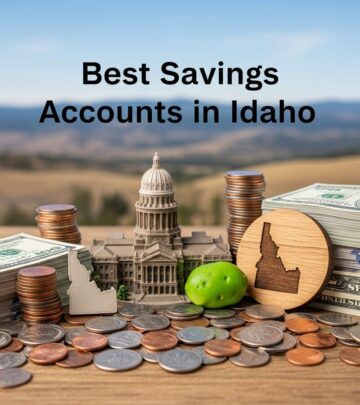
Best Savings Accounts In Wyoming: 5 Top Options For 2025
Compare top savings accounts in Wyoming, from local banks and credit unions to online institutions, to find the best place to grow your money.

Wyoming residents have access to an unusually wide mix of savings options, from small community banks and regional credit unions to large national and online institutions. Choosing the best savings account in Wyoming means comparing interest rates, fees, accessibility, and safety features so your money can grow while staying easy to reach.
This guide mirrors the structure of a typical statewide savings-account comparison and walks you through how to compare local and online choices, what to look for in an account, and how Wyoming-specific factors like branch availability and credit union membership come into play.
How to Compare the Best Savings Accounts in Wyoming
Before you focus on specific banks or credit unions, it helps to understand the main criteria used to evaluate savings accounts in Wyoming and nationwide. Federal regulators such as the Federal Deposit Insurance Corporation (FDIC) and the National Credit Union Administration (NCUA) emphasize factors like deposit insurance, disclosure of fees, and interest calculation methods when evaluating products, and those same criteria are useful for consumers as well.
Key Factors to Consider
- Interest rate / APY – The annual percentage yield (APY) shows how much your savings will earn in a year, including compounding. Online banks often advertise higher APYs than traditional branches, while some Wyoming credit unions offer tiered-rate accounts that reward higher balances.
- Minimum balance requirements – Many Wyoming banks let you open a basic savings account with as little as $25, but higher-yield accounts and money market accounts may require $1,000 or more to earn the best rate or avoid monthly service charges.
- Monthly fees – A low or no-fee account can be more valuable than a high-rate account with steep fees. Look closely at maintenance charges and how to waive them, such as by maintaining a minimum balance or setting up automatic transfers.
- Account type – Besides basic savings, many Wyoming institutions offer:
- Money market accounts (higher rates, higher minimums)
- Kids or youth savings accounts
- Special-purpose accounts such as “rainy day” or holiday savings
- Retirement-focused savings like IRAs and HSAs
- Accessibility – Consider branch locations, ATM networks, online banking, and mobile apps. Some Wyoming credit unions and community banks have only a handful of branches, while regional and national banks offer large ATM networks and robust digital tools.
- Deposit insurance – Bank accounts should be FDIC-insured and credit union accounts NCUA-insured, generally up to at least $250,000 per depositor, per institution, per ownership category.
Wyoming-Specific Considerations
Wyoming is a largely rural state, so the trade-off between local branch access and online convenience is more significant than in many urban areas. When choosing an account, ask:
- Do you need frequent in-person access, or is online and mobile banking enough?
- Is your preferred institution part of a local or national ATM network?
- Are you eligible for membership at a Wyoming credit union, which might require that you live, work, worship, or attend school in specific counties?
Top Types of Savings Accounts Available in Wyoming
Instead of focusing on a single “best” account, it is more helpful to look at categories of products available from Wyoming banks and credit unions as well as national online providers. Within each category, specific features such as dividend rates, fees, and minimum balances can vary widely.
1. Basic Statement Savings Accounts
Basic savings accounts are the starting point at most Wyoming banks and credit unions. These accounts typically require a low opening deposit and pay a modest interest rate.
- Typical minimum opening deposit: $25–$50
- Interest rate: Usually lower than dedicated high-yield or money market accounts; may be tiered by balance at some institutions.
- Best for: New savers, emergency funds under a few thousand dollars, and customers who primarily value branch access.
| Feature | Typical Bank Savings | Typical Credit Union Savings |
|---|---|---|
| Opening deposit | $25–$100 | $5–$25 share requirement |
| APY | Low, often flat | Low–moderate, sometimes tiered |
| Monthly fee | May apply if balance falls below minimum | Often no monthly fee |
| Insurance | FDIC | NCUA |
2. Money Market Savings Accounts
Many Wyoming credit unions and banks offer money market accounts (MMAs), which combine checking-like access with savings-style yields. These accounts are especially common at credit unions based in Wyoming and neighboring states.
- Higher APYs on larger balances – Money market rates often increase in tiers as your balance grows, making them attractive if you maintain a substantial emergency fund.
- Check-writing or debit access – Some MMAs allow limited check-writing and debit card transactions, though the number of monthly withdrawals may be capped.
- Higher minimums – It is common to see minimum balances of $1,000 to $2,500 or more to avoid a monthly fee or earn the full advertised APY.
- Best for: Savers who want liquidity but are comfortable keeping a larger balance.
3. Special-Purpose and “Rainy Day” Savings Accounts
Several Wyoming-area credit unions market branded savings accounts designed to encourage consistent saving, such as automatic monthly deposits and limited withdrawal access. These accounts may offer slightly better dividend rates than regular savings to reward disciplined behavior.
- Automatic monthly transfers from checking are often required.
- Withdrawals may be restricted to a few times per year or require advance notice, with penalties for early or unscheduled withdrawals.
- Some institutions pair these with IRA or education-focused options so you can save for retirement or college with tax advantages, subject to IRS rules.
4. Youth and Student Savings Accounts
Kids and teen savings products are increasingly common at Wyoming credit unions and community banks, sometimes offering higher APYs on modest balances to encourage saving from an early age.
- Eligibility: Usually under 18, often tied to a parent or guardian account.
- Benefits: No monthly fees, low opening deposits, and in some cases, bonus programs or prize drawings for regular saving.
- Best for: Teaching children and teens about budgeting and long-term savings.
5. Online High-Yield Savings Accounts Accessible in Wyoming
Even though Wyoming is the focus, residents are not limited to institutions with physical branches in the state. Many FDIC-insured online banks and NCUA-insured online credit unions accept applications nationwide, often paying higher APYs than traditional branch-based accounts because of their lower overhead.
- Pros: Typically very competitive rates, no monthly maintenance fees, easy digital account opening, and strong mobile tools.
- Cons: No in-person cash deposits at branches, and customer service is primarily by phone or online chat.
- Best for: Savers focused on maximizing yield and comfortable banking digitally.
Local Wyoming Banks and Credit Unions vs. Online Banks
Choosing between a Wyoming-based institution and an online provider comes down to how you value rate, service, and convenience. Many national rankings of “best banks” in each state use factors like savings APYs, checking requirements, ATM access, mobile app ratings, and breadth of services when evaluating institutions.
| Type of Institution | Advantages | Potential Drawbacks |
|---|---|---|
| Wyoming community banks | Personalized service, local decision-making, familiarity with regional needs, convenient branches in specific towns and cities. | Often lower savings APYs than online banks; fewer ATMs outside their service area. |
| Wyoming credit unions | Member-focused, competitive dividend rates, lower average fees, and specialized accounts for kids or targeted savings goals. | Membership eligibility requirements; fewer branches than large national banks. |
| Regional & national banks | Large ATM networks, full-service product lines (mortgages, auto loans, investments), and polished mobile apps. | Savings rates can be modest; monthly maintenance fees may apply if balance or activity requirements are not met. |
| Online banks | High-yield savings rates, minimal fees, 24/7 digital access, and nationwide availability. | No physical branches; depositing cash can require workarounds such as linked local accounts or cash-accepting ATMs. |
How to Choose the Right Wyoming Savings Account for You
To narrow down your options, match your financial goals and habits to the kinds of accounts and institutions described above.
Step 1: Define Your Savings Goals
- Emergency fund: Quick access is essential, so look for a liquid savings or money market account with strong online banking.
- Short-term goals (1–3 years): Vacation, car down payment, or home repairs may be well-suited to a dedicated savings or money market account with a competitive APY.
- Long-term goals (5+ years): Retirement and education savings often benefit from tax-advantaged accounts like IRAs or education savings accounts, which some Wyoming credit unions and banks offer alongside basic savings.
Step 2: Decide How Much Branch Access You Need
- If you frequently deposit cash or prefer in-person help, a Wyoming community bank or credit union may make the most sense.
- If you are comfortable with direct deposit, mobile check deposit, and electronic transfers, an online high-yield account can be a good fit.
- Some savers keep a small balance at a local institution for cash needs and a larger balance in an online high-yield account to maximize earnings.
Step 3: Compare Rates, Fees, and Requirements
Use each institution’s rate sheet or savings comparison page to review the following details side by side, much like how regional credit unions publish APYs by balance tier and account type.
- APY by balance tier
- Opening deposit and minimum ongoing balance
- Monthly maintenance or low-balance fees
- Transaction limits and any penalties for excessive withdrawals
- Availability of tools like automatic transfers and mobile apps
Understanding Safety: FDIC and NCUA Insurance
Whichever savings account you choose in Wyoming, safety of your deposits should be a top priority. Fortunately, traditional banks and credit unions offer strong federal protections.
- FDIC insurance: Covers deposits at insured banks up to at least $250,000 per depositor, per institution, per ownership category, including savings, checking, and money market deposit accounts.
- NCUA insurance: Provides similar coverage at federally insured credit unions through the National Credit Union Share Insurance Fund, generally up to $250,000 per member, per institution, per ownership category.
- You can verify coverage and calculate your protected limit using FDIC and NCUA online tools if you hold large balances or multiple accounts.
Frequently Asked Questions (FAQs)
Q: What is a good interest rate on a savings account in Wyoming?
A: Good rates change over time with general interest-rate conditions, but online banks and some money market accounts typically offer significantly higher APYs than standard branch savings accounts. Compare current rate sheets and online offers rather than assuming any one bank has the best yield.
Q: Are Wyoming credit unions safer than banks?
A: Both banks and credit unions can be very safe when they are federally insured. Banks are typically insured by the FDIC, and credit unions by the NCUA; each agency generally protects up to $250,000 per depositor or member, per institution, per ownership category.
Q: Can I open an online savings account if I live in Wyoming?
A: Yes. Most online banks and some online credit unions accept applications from residents of all 50 states, including Wyoming. As long as the institution is FDIC- or NCUA-insured and you are comfortable banking digitally, you can choose an online savings account for its higher APY and low fees.
Q: How many savings accounts should I have?
A: There is no set limit, but many people use multiple accounts for different goals—such as a local savings account for cash needs and emergencies, and a separate high-yield account for long-term or larger balances. Just be sure you can easily keep track of fees and minimum balances.
Q: What documents do I need to open a savings account in Wyoming?
A: Banks and credit unions typically require government-issued identification, a Social Security number or taxpayer ID, and basic contact information. Some credit unions may also require a small initial deposit to establish membership and may limit eligibility by geography or employer group.
References
- Deposit Insurance FAQs — Federal Deposit Insurance Corporation (FDIC). 2024-01-01. https://www.fdic.gov/resources/deposit-insurance/
- Share Insurance Toolkit — National Credit Union Administration (NCUA). 2023-11-01. https://www.ncua.gov/support-services/share-insurance
- Savings Accounts — Western Vista Federal Credit Union. 2024-01-01. https://www.wvista.com/banking/savings-products/
- Savings Accounts | WY Money Market Accounts | IRAs — UniWyo Federal Credit Union. 2024-01-01. https://www.uniwyo.com/Bank/Savings/Compare-Savings-Accounts
- SD, MT, and WY Savings Rates — Black Hills Federal Credit Union. 2024-01-01. https://www.bhfcu.com/rates/savings-rates
- Personal Savings Accounts — Bank of Jackson Hole. 2024-01-01. https://bankofjacksonhole.com/personal-banking/checking-savings/savings-accounts/
- Home | Jonah Bank of Wyoming — Jonah Bank of Wyoming. 2024-01-01. https://www.jonah.bank
Similar Articles








Read full bio of medha deb