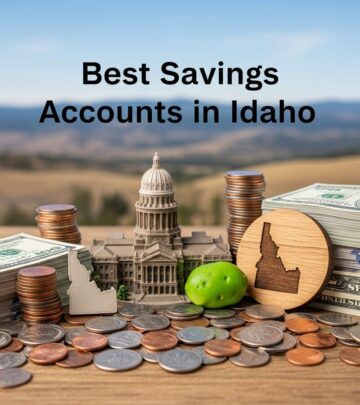
Best Savings Accounts in Utah for Savers
Compare Utah banks, credit unions, and online options to find the best high-yield savings account for your money.

Utah savers have access to a wide range of savings accounts, from fully online banks with competitive annual percentage yields (APYs) to local banks and credit unions that offer in-person service. Choosing the best savings account in Utah comes down to comparing interest rates, fees, balance requirements, and how you prefer to manage your money.
This guide walks through some of the strongest options available to Utah residents, explains how to compare them, and outlines the methodology behind picking standout accounts.
Top Savings Accounts for Utah Residents
While many of the best savings accounts are online and available nationwide, Utah residents can also choose from strong regional banks and credit unions. National consumer research consistently finds that online savings accounts tend to pay significantly higher APYs than traditional brick-and-mortar banks, largely because of lower overhead costs. At the same time, local institutions may provide relationship benefits and specialized products.
Here are key types of institutions that typically offer competitive savings options to Utah savers:
- National online banks with high-yield savings accounts and no physical branches.
- Large national banks that combine savings with extensive ATM networks and digital tools.
- Utah-based community banks that offer personal service and local expertise.
- Credit unions serving Utah residents, which are member-owned and may offer favorable rates and lower fees.
Below are detailed overviews of representative options in each of these categories, mirroring the key topics covered in the original guide.
Citi: Large Bank with Accelerate-Style Savings Options
Citi is an example of a large national bank that offers dedicated high-yield savings products alongside full-service checking, credit cards, and lending. These savings accounts are typically:
- Low or no minimum to open the account.
- Subject to a monthly service fee that can usually be waived with a qualifying minimum daily balance or linked checking relationship.
- Accessible via a robust mobile banking app, ATM network, and online banking platform.
This combination can appeal to Utah residents who want one institution for day-to-day checking, credit, and savings, even if the APY is not always the very highest in the market.
Key Features to Look for with Large National Banks
- Waiver rules for monthly fees (for example, a minimum daily balance requirement).
- Access to linked checking accounts and automatic transfers for savings goals.
- Nationwide ATM network and branch access when traveling.
- Whether the bank offers FDIC insurance up to standard limits for deposit safety.
American Express® National Bank, Member FDIC
American Express® National Bank operates primarily online for deposit products, offering a high-yield savings account that typically emphasizes:
- No monthly maintenance fee.
- $0 minimum to open in many cases.
- A strong mobile app and online interface for transfers.
- 24/7 customer service access via phone or chat for account questions.
American Express high-yield savings products are frequently listed among competitive high-yield accounts in national rankings. Although they do not provide checking accounts or a large ATM network through the bank itself, many Utah savers use these savings accounts as a dedicated, high-APY “parking place” for emergency funds or short-term goals.
Pros and Cons of Online-Only High-Yield Accounts
| Pros | Cons |
|---|---|
| Typically higher APYs than large brick-and-mortar banks. | No traditional branch network for in-person service. |
| Often no monthly maintenance fees and low opening minimums. | Cash deposits usually require a linked external bank or other workaround. |
| Convenient online and mobile banking access 24/7. | Some customers prefer face-to-face advice when opening or managing accounts. |
Synchrony Bank: Flexible Access to Cash
Synchrony Bank is another online-focused institution, known for high-yield savings, money market accounts, and CDs. Its high-yield savings accounts typically include:
- No minimum balance requirement to earn interest.
- No minimum opening deposit in many cases.
- No monthly maintenance fee for the savings account.
- Access to funds via online transfers, a mobile app, and an optional ATM card.
Utah customers who do not need a local branch may find Synchrony useful because it combines high yields with flexible access. Many high-yield accounts do not provide ATM cards, but Synchrony commonly offers ATM access, which can be appealing if you want a quicker way to get to your cash without transferring to another bank first.
Ally Bank: Digital Tools and Savings “Buckets”
Ally Bank is a popular online bank with a suite of products, including high-yield savings, checking, CDs, and investment accounts. Ally’s savings product often stands out for its digital features:
- No minimum balance to open and no monthly maintenance fees on savings.
- Online tools and calculators that help you track spending and savings progress.
- A “buckets” feature that lets you divide one savings account into multiple goal categories (e.g., travel, emergency fund, car repair) without opening separate accounts.
- Strong customer service availability by phone and chat.
In some cases, online banks like Ally use tiered APY structures, where higher balances can earn slightly higher rates. However, Ally and similar banks typically keep rates competitive even for smaller balances, and often run promotions that reward consistent saving behavior instead of large lump-sum deposits.
Why Goal-Based Tools Matter
Behavioral finance research shows that clearly labeling savings goals and tracking progress can help people save more consistently over time. Tools like Ally’s buckets (and similar goal-setting features in other apps) make this easier by visually separating money intended for different purposes, while still paying the same interest rate on the total balance.
Prime Alliance Bank: Utah-Based Community Bank
Prime Alliance Bank is an example of a Utah-based bank that offers online services along with local roots. Community banks commonly provide:
- Competitive interest rates on savings and checking compared with larger regional banks.
- Personalized customer service and familiarity with the local Utah economy.
- Online and mobile banking options for transfers, bill pay, and mobile check deposit.
- FDIC insurance protection up to standard limits for depositors.
Many community banks offer the same rate to all savings customers, regardless of balance, making the product simpler to understand. Interest may post monthly or quarterly, depending on the bank’s policies.
Local Bank vs Online Bank: Quick Comparison
| Feature | Local Utah Bank | Online Bank |
|---|---|---|
| Branch Access | In-person service and local branches | No branches; service via phone/chat |
| Typical APY | Often moderate | Often higher due to lower overhead |
| Account Complexity | May have more fee-waiver rules and balance tiers | Typically streamlined with fewer fees |
| Relationship Banking | Potential for local advice and custom solutions | Primarily self-service with standardized products |
Chevron Federal Credit Union: Credit Union Option
Credit unions are not-for-profit financial cooperatives owned by their members rather than shareholders. Research from the U.S. National Credit Union Administration (NCUA) has found that credit unions often offer lower loan rates and competitive deposit rates compared with banks, in part because they return earnings to members through better pricing and fewer fees.
Chevron Federal Credit Union, like many credit unions, typically offers:
- A primary savings account that doubles as a membership share.
- Low minimum opening deposits (for example, around $25) to become a member.
- A required minimum daily balance to earn interest.
- Interest credited regularly, often monthly, with statements provided at least quarterly.
Utah residents may qualify for membership based on employer groups, associations, geographic areas, or family relationships. For those who do, credit unions can be a strong alternative to both large national banks and online-only institutions.
How We Picked: Methodology for Evaluating Utah Savings Accounts
To identify the best savings accounts available to Utah residents, analysts typically review a broad mix of banks and credit unions, including:
- Online banks that operate nationwide.
- National banks with branches or services available to Utah customers.
- Regional and community banks headquartered or operating in Utah.
- Credit unions that serve Utah residents, workers, or students.
Research commonly includes banks based in cities such as Salt Lake City, Provo, and Orem, as well as online-only institutions that accept applications from Utah residents.
Key Factors Considered
When ranking or highlighting savings accounts, reputable comparison reports typically evaluate:
- APY (Annual Percentage Yield): The effective annual rate that reflects interest plus compounding. APY is the most direct measure of how much your savings will grow.
- Fees: Monthly maintenance fees, excess withdrawal fees, and other charges that can reduce returns.
- Minimum requirements: Opening deposit, minimum balance to earn interest, and balance needed to avoid fees.
- Accessibility: ATM access, branch availability, and ease of moving funds between internal and external accounts.
- Digital experience: Quality of mobile apps, online tools, budgeting features, and customer support availability.
- Account flexibility: Transfer limits, ability to link checking or brokerage accounts, and availability of companion products (CDs, money market accounts, etc.).
Regulators such as the Federal Deposit Insurance Corporation (FDIC) and the Federal Reserve regularly track deposit rates and confirm that rates change frequently as market interest rates move. Therefore, any listing of “best savings accounts” reflects a snapshot in time and is subject to change.
Why Rates Change
Savings account APYs tend to move with broader interest-rate conditions in the U.S. economy. When the Federal Reserve raises or lowers its benchmark rates, banks usually adjust deposit rates accordingly, although not always at the same pace. This is why personal finance experts recommend:
- Checking banks’ current APYs directly before opening an account.
- Reviewing your savings rate periodically and switching if your bank becomes uncompetitive.
How to Choose the Best Savings Account in Utah
Because Utah residents can open accounts with both local and nationwide institutions, the “best” savings account will depend on your priorities. Consider the following steps before making a decision.
1. Compare APYs and Account Types
Start by comparing the APYs on high-yield savings accounts from both online banks and local Utah institutions. Resources such as Bankrate and NerdWallet publish regularly updated lists of top rates, which can help you understand the current market range.
- Look for APYs that are well above the national average for savings accounts.
- Note whether rates are tiered by balance or the same for all customers.
- Check if the account is a standard savings, money market, or hybrid product.
2. Review Fees and Balance Requirements
Even a high APY can be undermined by monthly fees or strict balance requirements. Before opening an account, make sure you understand:
- Any monthly maintenance fee and how to waive it.
- The minimum opening deposit.
- The minimum balance needed to earn the advertised APY.
- Potential charges for paper statements, wire transfers, or excessive withdrawals.
3. Consider Access and Convenience
Think about how you prefer to use your savings:
- If you value branch access, a Utah-based bank or credit union may be more convenient.
- If you rarely visit branches and want maximum yield, an online high-yield savings account may be ideal.
- Consider whether you need an ATM card for your savings and how easy it is to move money to a checking account.
4. Evaluate Digital Tools and Customer Support
High-quality mobile apps, budgeting tools, and goal-setting features can make a meaningful difference in how effectively you save. Industry reviews often factor in:
- App ratings in major app stores.
- Availability of 24/7 support by phone or chat.
- Features such as automatic transfers, buckets or subaccounts, and alerts.
Frequently Asked Questions (FAQs)
Q: Are online high-yield savings accounts safe for Utah residents?
A: Yes, as long as the bank is FDIC-insured (for banks) or NCUA-insured (for credit unions), deposits are protected up to at least $250,000 per depositor, per institution, per ownership category. Online banks must meet the same regulatory standards for deposit insurance as traditional banks.
Q: Do I need to live in Utah to open these savings accounts?
A: Many of the best savings accounts mentioned are offered by online and national banks that accept customers nationwide, including Utah residents. Some Utah-based banks and credit unions may have geographic or membership restrictions, so always check eligibility requirements before applying.
Q: How often do savings account interest rates change?
A: Banks and credit unions can change variable savings rates at any time in response to market conditions and central bank policy. Industry data shows that deposit rates often adjust when the Federal Reserve changes benchmark interest rates, so it is wise to review your rate periodically.
Q: Is a credit union better than a bank for savings?
A: Neither option is inherently better, but credit unions are member-owned and historically have offered competitive savings and loan rates, along with lower average fees. Banks may offer more extensive product lines, larger ATM networks, or more advanced digital tools. The best choice depends on your priorities.
Q: Can I open more than one savings account?
A: Yes, you can open multiple savings accounts at different institutions. Some people maintain a high-yield online savings account for long-term goals, plus a local Utah bank or credit union account for quick access and in-person service. Just be sure to monitor minimum balances and fee requirements for each account.
References
- Best high-yield savings accounts of January 2026 — Bankrate. 2026-01-02. https://www.bankrate.com/banking/savings/best-high-yield-interests-savings-accounts/
- Best High-Yield Savings Accounts for January 2026 — NerdWallet. 2026-01-01. https://www.nerdwallet.com/banking/best/high-yield-online-savings-accounts
- Savings Accounts — UT Federal Credit Union (NCUA insured). 2025-06-01. https://www.utfcu.org/personal/accounts/savings-accounts
- Personal Savings Accounts — Bank of Utah. 2025-05-10. https://www.bankofutah.com/personal/checking-savings/savings
- What is deposit insurance? — Federal Deposit Insurance Corporation (FDIC). 2024-02-15. https://www.fdic.gov/resources/deposit-insurance/
- Credit Union and Bank Rates — National Credit Union Administration (NCUA). 2024-03-01. https://ncua.gov/analysis/credit-union-and-bank-rates
Similar Articles








Read full bio of medha deb