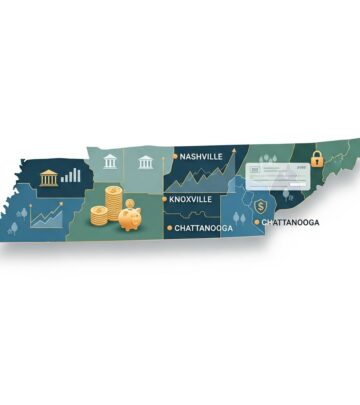
Best Savings Accounts In Tennessee: 4 Top Options For 2025
Explore top Tennessee savings accounts, compare rates, terms, and features, and learn how to choose the right account for your financial goals.

If you live in Tennessee and want to grow your cash safely, choosing the right savings account can make a meaningful difference in how quickly your money grows. Between local community banks, large regional institutions, credit unions, and online banks available nationwide, Tennesseans have many options to compare. This guide explains how savings accounts work, profiles common account types, and shows you how to pick an account that fits your goals, budget, and banking habits.
How Savings Accounts Work
A savings account is a deposit account at a bank or credit union designed to help you store money securely and earn interest over time. Savings accounts are typically used for short- and medium-term goals such as emergency funds, vacation savings, or future big purchases.
In the U.S., most savings accounts at banks are insured by the Federal Deposit Insurance Corporation (FDIC), while credit union accounts are insured by the National Credit Union Administration (NCUA), protecting deposits up to at least $250,000 per depositor, per insured institution, for each account ownership category.
Key Features of a Savings Account
- Interest earnings: Your bank or credit union pays you interest on your balance, usually expressed as an annual percentage yield (APY). APY reflects the total amount of interest you earn over a year, including compounding.
- Liquidity: Savings accounts allow quick access to your cash through transfers, ATM withdrawals (if linked), or in-branch withdrawals, making them more liquid than certificates of deposit (CDs).
- Safety: As long as you stay within FDIC or NCUA insurance limits, your principal is protected even if the institution fails.
- Variable rates: Most savings account APYs can change at any time based on market conditions and bank policy.
How APY and Compounding Work
The APY on a savings account shows you how much your money will grow in one year if interest rates stay the same and interest is compounded on the schedule the bank uses (daily, monthly, quarterly, etc.). The more frequently your interest compounds, the faster your balance can grow.
For example, if you deposit $5,000 into a high-yield account paying 4.00% APY with monthly compounding and make no further deposits or withdrawals, you would earn a bit more than $200 in interest in one year. If you kept the same money in a traditional account paying 0.05% APY, your interest earnings for the year would be only a few dollars.
Types of Savings Accounts in Tennessee
Tennessee residents can choose from several account types, each with different benefits and trade-offs. Many of these are available statewide, either through large regional banks, local community banks, credit unions, or national online banks that accept Tennessee customers.
Traditional Bank Savings Accounts
Traditional savings accounts are often offered by large national and regional banks with branches in Tennessee. They provide in-person service and broad access to ATMs but may pay relatively low interest compared to high-yield online accounts.
- Pros: Easy branch access, full-service banking (loans, checking, mortgages), strong customer support.
- Cons: Lower APYs, potential monthly maintenance fees if you do not meet balance or activity requirements.
Online and High-Yield Savings Accounts
Many of the highest-yield savings accounts are offered by online-only banks and fintech institutions that serve customers in Tennessee and across the U.S. According to national comparisons, leading high-yield savings accounts can offer APYs dozens of times higher than the national average at traditional banks, often with low or no minimums.
- Pros: Competitive APYs, low fees, easy digital account opening, strong online and mobile tools.
- Cons: No local branches, cash deposits may be inconvenient, support is typically phone or chat-based.
Money Market Accounts
Money market deposit accounts combine elements of savings and checking. They may offer a higher APY than regular savings (especially on larger balances) and can allow limited check-writing or debit card access.
- Pros: Higher potential yields, some transaction flexibility, FDIC/NCUA insurance protection.
- Cons: Higher minimum balance requirements, possible monthly fees if requirements are not met.
Credit Union Savings Accounts
Credit unions are member-owned, not-for-profit financial cooperatives. In Tennessee, many local and employer-based credit unions offer savings accounts with competitive dividend rates and low minimum opening deposits.
- Pros: Member-focused service, competitive rates, lower fees, NCUA insurance protection.
- Cons: Membership eligibility requirements, more limited branch networks than large national banks.
Comparing Savings Accounts: What to Look For
Choosing the best savings account in Tennessee means looking beyond the interest rate alone. Several factors work together to determine how convenient and rewarding your account will be over time.
| Feature | Why It Matters | What to Aim For |
|---|---|---|
| APY (Interest Rate) | Determines how quickly your savings grow through interest earnings. | Rates significantly above the national average, especially for high-yield accounts. |
| Fees | Monthly maintenance or excess withdrawal fees can erode earnings. | No monthly maintenance fee or an easy way to waive it; clear fee schedule. |
| Minimum Balance Requirements | Some accounts require a minimum to earn the advertised APY or to avoid fees. | Minimums you can realistically maintain based on your savings habits. |
| Access and Convenience | Impacts how easily you can deposit, withdraw, and manage your funds. | Mobile app, online banking, ATM network, and branch access that fit your lifestyle. |
| Account Type | Different accounts (savings, money market, CDs) suit different goals. | Match the account to your time horizon, liquidity needs, and risk tolerance. |
| Insurance Coverage | FDIC or NCUA insurance protects deposits up to legal limits. | Ensure your total deposits at any one institution are within insured limits. |
Online vs. Local Tennessee Institutions
One of the biggest decisions for Tennessee savers is whether to use an online bank, a local community bank, a regional bank, or a credit union. Each category has potential strengths.
Advantages of Online Savings Accounts
- Higher APYs: Online banks usually have lower overhead costs and can pass savings on through higher rates. National surveys of high-yield accounts show APYs in the 3–4% range at many online banks when traditional accounts may pay 0.01% to 0.10%.
- Low fees: Many online accounts have no monthly maintenance fees and low minimum opening deposits.
- Strong digital tools: Mobile check deposit, budgeting tools, customizable alerts, and fast transfers are standard at many online institutions.
Advantages of Local Tennessee Banks and Credit Unions
- In-person service: Branches in Tennessee can be helpful if you prefer face-to-face support or need to handle complex transactions.
- Full-service relationships: It may be easier to manage mortgages, auto loans, and business accounts under one roof.
- Community focus: Many community banks and credit unions emphasize local lending and support of regional development.
How to Choose the Best Savings Account for You
The best Tennessee savings account depends on how you plan to use it. Consider these questions before you open a new account:
- How much can you deposit initially, and how regularly will you contribute?
- How often will you need to withdraw money from the account?
- Is branch access important, or are you comfortable with online-only banking?
- Are you also looking for checking, loans, or other products with the same institution?
Step-by-Step Selection Process
- Define your goal and time frame. Emergency funds and short-term goals usually call for liquid savings or money market accounts. Longer-term goals might benefit from a combination of savings and CDs.
- Compare APYs from multiple institutions. Review several Tennessee-based banks and credit unions plus a few nationwide online banks to see the spread of rates.
- Check fees and minimums. Make sure you can meet any minimum balance requirements and understand how to avoid monthly maintenance fees.
- Verify FDIC or NCUA insurance. Confirm that the institution is federally insured and that your total deposits will remain within coverage limits.
- Evaluate convenience. Look at mobile app ratings, ATM access, transfer times, and how quickly you can access cash when needed.
Strategies to Maximize Your Savings Returns
Beyond finding the right Tennessee savings account, how you use the account affects your long-term results.
Automate Your Savings
Setting up automatic transfers from your checking account into savings on payday can help you consistently build your balance without having to think about it. Many banks and credit unions encourage automated savings through tools that let you schedule recurring transfers or round up debit card purchases and move the difference into savings.
Use Multiple Accounts for Different Goals
Some savers open more than one account to keep goals organized:
- One high-yield online account for a large emergency fund.
- A local bank savings account linked to checking for everyday cash-flow buffers.
- Special-purpose accounts for vacations, down payments, or education savings.
Revisit Your Rate Periodically
Because savings rates change over time, it is wise to periodically compare what your account is paying versus current market rates. If your Tennessee institution is paying far below what’s available from reputable online banks, you may benefit from moving part of your balance.
Safety, Insurance, and Regulatory Protections
Whether you choose a Tennessee bank, an out-of-state bank, or a credit union, deposit insurance is critical. FDIC and NCUA insurance are backed by the full faith and credit of the U.S. government and protect eligible deposits up to at least $250,000 per depositor, per insured institution, per account category.
FDIC Insurance (Banks)
- Covers deposits at insured banks, including savings accounts, checking accounts, money market deposit accounts, and CDs.
- Standard insurance amount is $250,000 per depositor, per insured bank, for each account ownership category.
- Coverage is automatic when you open an account at an FDIC-insured bank; no application is required.
NCUA Insurance (Credit Unions)
- Covers deposits at federally insured credit unions, including regular shares (savings), share drafts (checking), money market accounts, and share certificates.
- Standard share insurance amount is $250,000 per member, per insured credit union, for each account ownership category.
- NCUA insurance operates similarly to FDIC insurance but applies to credit unions instead of banks.
Frequently Asked Questions (FAQs)
Q: What is a good APY for a savings account in Tennessee right now?
A: APYs vary by institution and change over time, but national rate surveys show that many of the most competitive high-yield savings accounts pay several percentage points more than the average traditional bank account. Comparing multiple Tennessee institutions and national online banks is the best way to identify a strong APY.
Q: Are online savings accounts available to Tennessee residents?
A: Yes. Most online banks and fintech institutions that operate nationally accept customers from Tennessee as long as you meet their identification and eligibility requirements. These institutions are typically insured by the FDIC, just like traditional banks.
Q: Is my money safe in a Tennessee credit union savings account?
A: If the credit union is federally insured by the NCUA, your savings deposits are protected up to at least $250,000 per member, per insured credit union, for each account ownership category, similar to FDIC protection at banks.
Q: How often should I move my savings to chase higher rates?
A: It rarely makes sense to move accounts for a tiny rate difference, but if your Tennessee institution is paying far below high-yield competitors and you hold a large balance, moving part of your savings may be worthwhile. Compare net benefits after considering any fees, convenience factors, and how you use the account.
Q: Will opening a new savings account hurt my credit score?
A: Generally, opening a standard savings account does not involve a hard credit inquiry, so it should not impact your credit score. Banks may use identity verification tools or soft checks that do not affect credit.
References
- Deposit Insurance FAQ — Federal Deposit Insurance Corporation (FDIC). 2024-05-01. https://www.fdic.gov/resources/deposit-insurance/
- Share Insurance Toolkit — National Credit Union Administration (NCUA). 2024-02-15. https://www.ncua.gov/support-services/share-insurance
- National Rates and Rate Caps — Federal Deposit Insurance Corporation (FDIC). 2025-01-01. https://www.fdic.gov/resources/bankers/national-rates/
- Best High-Yield Savings Accounts of January 2026 — Bankrate. 2026-01-05. https://www.bankrate.com/banking/savings/best-high-yield-interests-savings-accounts/
- Personal Savings Accounts — F&M Bank (Tennessee). 2025-08-10. https://www.myfmbank.com/personal-banking/personal-savings-accounts
Similar Articles








Read full bio of medha deb