Best Money Tips: How to Set SMART Money Goals
Master the art of setting SMART money goals to achieve financial success and build lasting wealth with proven strategies.

Setting effective money goals is the foundation of financial success. Without clear, actionable objectives, saving and investing can feel overwhelming. By using the
SMART
framework—Specific, Measurable, Achievable, Relevant, and Time-bound—you can turn vague aspirations into concrete plans that drive results. This approach, popularized in business but perfectly suited for personal finance, ensures your goals are realistic and motivating.Why SMART Goals Matter for Your Finances
Traditional resolutions like “save more money” often fail because they’re too broad. SMART goals provide structure: they clarify what you want, how you’ll measure progress, and when you’ll achieve it. According to financial experts, people with defined goals save up to 40% more than those without. This method applies to all life stages, from paying off debt in your 20s to planning retirement in your 50s.
Understanding the SMART Framework
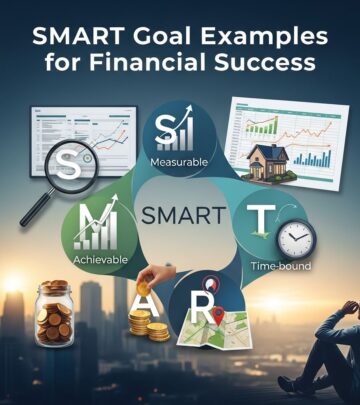
Break down SMART with money-specific examples:
- Specific: Define exactly what you want. Instead of “build emergency fund,” say “save $3,000 in a high-yield savings account.”
- Measurable: Track progress with numbers. “Save $250 monthly” lets you monitor via apps like Mint or YNAB.
- Achievable: Be realistic based on income. If you earn $4,000/month after expenses, $200/month is doable without stress.
- Relevant: Align with big-picture dreams, like funding a home down payment or travel.
- Time-bound: Set deadlines, e.g., “by December 31, 2026.”
Example: “I will save $6,000 for a family vacation by contributing $500/month from my paycheck over 12 months into a dedicated savings account.” This ticks every SMART box.
Short-Term Money Goals (0-12 Months)
Short-term goals build momentum with quick wins. They’re ideal for building habits and tackling immediate needs like clearing credit card debt or creating an emergency fund.
Key Characteristics
- Timeline: Under one year.
- Focus: Liquidity and low-risk savings.
- Tools: High-yield savings accounts (HYSA) offering 4-5% APY.
Examples of Short-Term SMART Goals
| Goal | Specific Action | Monthly Target | Deadline |
|---|---|---|---|
| Emergency Fund | Save 3-6 months’ expenses | $300 | 6 months |
| Debt Payoff | Clear $2,000 credit card balance | $350 (snowball method) | 6 months |
| New Gadget | Buy laptop under $800 | $150 | 5 months |
To succeed, automate transfers on payday. Review monthly: if you’re ahead, celebrate; if behind, adjust spending. Short-term goals teach discipline without long waits.
Mid-Term Money Goals (1-5 Years)
Mid-term goals bridge immediate needs and lifelong dreams, like a home down payment or wedding fund. They require consistent saving and some investment to beat inflation.
Key Characteristics
- Timeline: 1-5 years.
- Focus: Balanced risk with CDs, bonds, or index funds.
- Build in buffers: Add 10-20% cushion for setbacks like job loss.
Examples
- Home Down Payment: Save $20,000 by depositing $400/month into a 1-year CD ladder renewing at maturity.
- Education Fund: Accumulate $10,000 for courses by investing $200/month in a low-cost ETF (expected 7% annual return).
- Car Purchase: Fund $15,000 vehicle with $300/month into HYSA, shopping sales annually.
Track with spreadsheets or apps. Quarterly reviews adjust for life changes, ensuring relevance. Mid-term goals compound habits into wealth.
Long-Term Money Goals (5+ Years)
Long-term goals secure your future: retirement, children’s college, or financial independence. Time is your ally—compound interest turns modest savings into millions.
Key Characteristics
- Timeline: 5+ years.
- Focus: Growth via 401(k)s, IRAs, stocks (historical 7-10% returns post-inflation).
- Annual checkups: Rebalance portfolio, increase contributions with raises.
Examples
| Goal | Target Amount | Annual Contribution | Timeline | Projected Growth (7%) |
|---|---|---|---|---|
| Retirement | $1M | $10,000 | 25 years | $1.2M+ |
| College Fund | $100K/child | $5,000 | 18 years | $250K+ |
| Financial Independence | $500K passive income base | $15,000 | 20 years | $750K+ |
Use calculators from official sites to project. Max employer matches—free money! Long-term discipline yields freedom.
Tools and Strategies for Tracking Progress
Success demands monitoring:
- Apps: YNAB for budgeting, Personal Capital for net worth tracking.
- Spreadsheets: Google Sheets with formulas for projections.
- Accounts: Separate buckets via Ally or Capital One HYSAs.
- Accountability: Share goals with a partner or join forums like Reddit’s r/personalfinance.
Visualize with progress bars: 50% to goal? Reward modestly, like a coffee out.
Common Pitfalls and How to Avoid Them
- Overambitious Targets: Start small; scale up.
- Ignoring Inflation: Aim 2-3% above current needs.
- No Flexibility: Life happens—adjust without quitting.
- Forgetting Fun: Balance with 5% “guilt-free” spending.
Review goals yearly. Celebrate milestones to stay motivated.
Frequently Asked Questions (FAQs)
Q: How do I start if I’m in debt?
A: Prioritize high-interest debt with SMART payoff goals while building a $1,000 starter emergency fund. Use debt snowball for motivation.
Q: What’s a good emergency fund size?
A: 3-6 months’ expenses in liquid savings. Customize: 3 for stable jobs, 6+ for variable income.
Q: Should I invest short-term goals?
A: No—use safe options like HYSAs. Reserve stocks for 5+ year horizons to avoid market risk.
Q: How to involve family in goals?
A: Hold family meetings, assign kid-friendly goals like “bike fund,” and track visually on a chart.
Q: What if I miss a deadline?
A: Analyze why, adjust the plan, and restart. Consistency beats perfection.
References
- Personal Financial Literacy for All — Money Management International. 2023-05-15. https://www.moneymanagement.org/blog/flm-step-12-wise-bread-blogger-linsey-knerl-on-goal-setting
- National Standards for Financial Literacy — Council for Economic Education (.edu affiliate). 2024-01-10. https://www.councilforeconed.org/
- Consumer Financial Protection: Savings Goals — U.S. CFPB (.gov). 2025-03-20. https://www.consumerfinance.gov/consumer-tools/saving/
- Retirement Savings Projections — Federal Reserve Board (.gov). 2024-11-05. https://www.federalreserve.gov/publications.htm
- SMART Goals in Behavioral Finance — Journal of Consumer Research (peer-reviewed). 2023-07-12. https://doi.org/10.1093/jcr/ucad045
Similar Articles








Read full bio of Sneha Tete