Best Money Tips: Get the Most Out of Your 401(k)
Unlock the full potential of your 401(k) with proven strategies to maximize contributions, growth, and tax advantages for a secure retirement.

Your 401(k) is one of the most powerful tools for building retirement wealth, offering tax advantages, employer matches, and compound growth potential. Maximizing it requires strategic planning from contribution limits to investment choices. This guide covers proven strategies to supercharge your savings.
Max Out Your Contributions
Contributing the maximum allowed amount to your 401(k) is the foundation of optimization. For 2025, the standard limit is $23,500 for those under 50, providing significant tax-deferred growth. If you’re 50 or older, take advantage of catch-up contributions up to an additional $7,500, bringing the total to $31,000 annually. These limits adjust periodically for inflation, so check IRS guidelines yearly.
Automate payroll deductions to hit these targets effortlessly. Even incremental increases, like 1% more per paycheck, can add tens of thousands over decades due to compounding. For example, boosting from 6% to 10% on a $60,000 salary adds over $2,400 yearly, growing exponentially at 7% average returns.
- Review your current contribution rate quarterly.
- Adjust for raises or bonuses to accelerate savings.
- Track progress via your plan’s portal or app.
Take Full Advantage of Your Employer Match
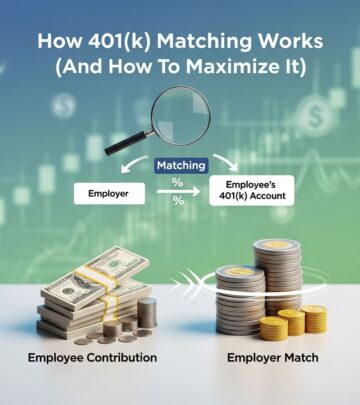
Employer matching is essentially free money—never leave it on the table. Most plans match 50% to 100% of your contributions up to 3-6% of salary. If your employer matches 50% on the first 6%, contribute at least 6% to capture the full $3,000 match on a $50,000 salary.
This match doubles your input instantly, amplifying growth. Vesting schedules may apply, so stay long enough to own it fully. Some plans offer profit-sharing or automatic contributions, boosting totals further.
| Salary | Your Contribution (6%) | 50% Match | Total Year 1 |
|---|---|---|---|
| $50,000 | $3,000 | $1,500 | $4,500 |
| $75,000 | $4,500 | $2,250 | $6,750 |
| $100,000 | $6,000 | $3,000 | $9,000 |
Compare plans if switching jobs; rollover to keep growing tax-free.
Understand Contribution Limits and Catch-Ups
Annual limits prevent over-contribution: $23,500 base for 2025, plus $7,500 catch-up if 50+. These apply across all 401(k)s, including SIMPLE plans. Spousal coordination maximizes household savings.
Catch-ups are crucial later in career; at age 50, an extra $7,500 invested at 6% return grows to over $100,000 in 15 years. Recent SECURE 2.0 Act allows super catch-ups of $10,000 for ages 60-63 starting 2025, accelerating late-game savings.
- Under 50: $23,500 limit.
- 50+: $31,000 total.
- 60-63 (2025+): Up to $33,500.
Choose Low-Cost Index Funds
Fees erode returns; opt for low-cost index funds tracking S&P 500 or total market, with expense ratios under 0.1%. Actively managed funds often underperform after 1-2% fees. Target-date funds auto-adjust risk, ideal for hands-off investors nearing retirement.
Historical data shows low-cost funds outperform 80% of active ones over 10 years. Diversify across stocks, bonds; younger savers tilt equities for growth, conservatives favor stability.
Rebalance Your Portfolio Regularly
Markets shift allocations; rebalance annually to maintain targets like 70/30 stocks/bonds. This sells high, buys low, enhancing returns. Many plans offer auto-rebalancing.
Without it, a bull market could overweight stocks, increasing risk. Tools like Vanguard or Fidelity calculators help set allocations by age.
Consider a Roth 401(k) Option
Roth 401(k)s use after-tax dollars for tax-free withdrawals, ideal if expecting higher future rates or brackets. Combined limits apply; switch if in low-tax years. Hybrids allow traditional and Roth contributions.
Tax diversification hedges uncertainty; Roth grows tax-free, perfect for heirs too.
Rollover When Changing Jobs
Avoid cashing out—taxes and penalties kill 40%+. Rollover to new 401(k) or IRA for continued growth. IRAs offer broader investments.
Direct rollovers prevent withholding; consolidate for simplicity. Don’t despair small balances; compound works wonders.
Delay Social Security to Stretch Savings
Claiming at 62 reduces benefits 30%; waiting to 70 boosts 8% yearly past full retirement age (67 for post-1960 births). This preserves 401(k) longer, especially with catch-ups.
Automate and Track Progress
Automation ensures consistency; apps track net worth (assets minus liabilities). Review quarterly, adjust for life changes.
Catch Up If You’re Behind
Mindset shift: Focus on cash flow coverage. HSAs triple tax-advantaged; frugality frees funds. Experts aid planning.
Frequently Asked Questions (FAQs)
What is the 2025 401(k) contribution limit?
The base limit is $23,500; $7,500 catch-up for age 50+, totaling $31,000. Verify IRS updates annually.
Should I contribute enough for the full employer match?
Yes, it’s free money doubling your input immediately.
What if I change jobs?
Rollover to IRA or new plan to avoid taxes/penalties.
Are target-date funds good?
Yes for simplicity; they adjust risk automatically based on retirement date.
Can I have both traditional and Roth 401(k)?
Many plans allow splitting contributions for tax flexibility.
Avoid Common Pitfalls
Steer clear of high fees, early withdrawals (10% penalty pre-59½), loans (opportunity cost). Stay invested through volatility; time in market beats timing.
Inflation erodes purchasing power; equities historically outpace it. Health maintenance cuts costs long-term.
References
- Key ways to stretch your retirement income — John Hancock. 2024. https://www.johnhancock.com/ideas-insights/key-ways-to-stretch-your-retirement-income.html
- Planning Ahead: Money Moves to Make Before the End of the Year — Experian. 2018-12. https://www.experian.com/blogs/news/about/ways-improve-finances-end-year/
- Don’t Despair Over Small Retirement Savings — Wise Bread. N/A. https://www.wisebread.com/dont-despair-over-small-retirement-savings
- Retirement Topics – 401(k) and Profit-Sharing Plan Contribution Limits — Internal Revenue Service (IRS.gov). 2025-11-06. https://www.irs.gov/retirement-plans/plan-participant-employee/retirement-topics-401k-and-profit-sharing-plan-contribution-limits
- 7 Easiest Ways to Catch Up on Retirement Savings Later in Life — Wise Bread. N/A. https://www.wisebread.com/7-easiest-ways-to-catch-up-on-retirement-savings-later-in-life
Similar Articles








Read full bio of medha deb