Finding the Best APY for Savings Accounts
Unlock superior returns with high-yield savings accounts offering up to 5.00% APY in 2026—far surpassing traditional bank rates.
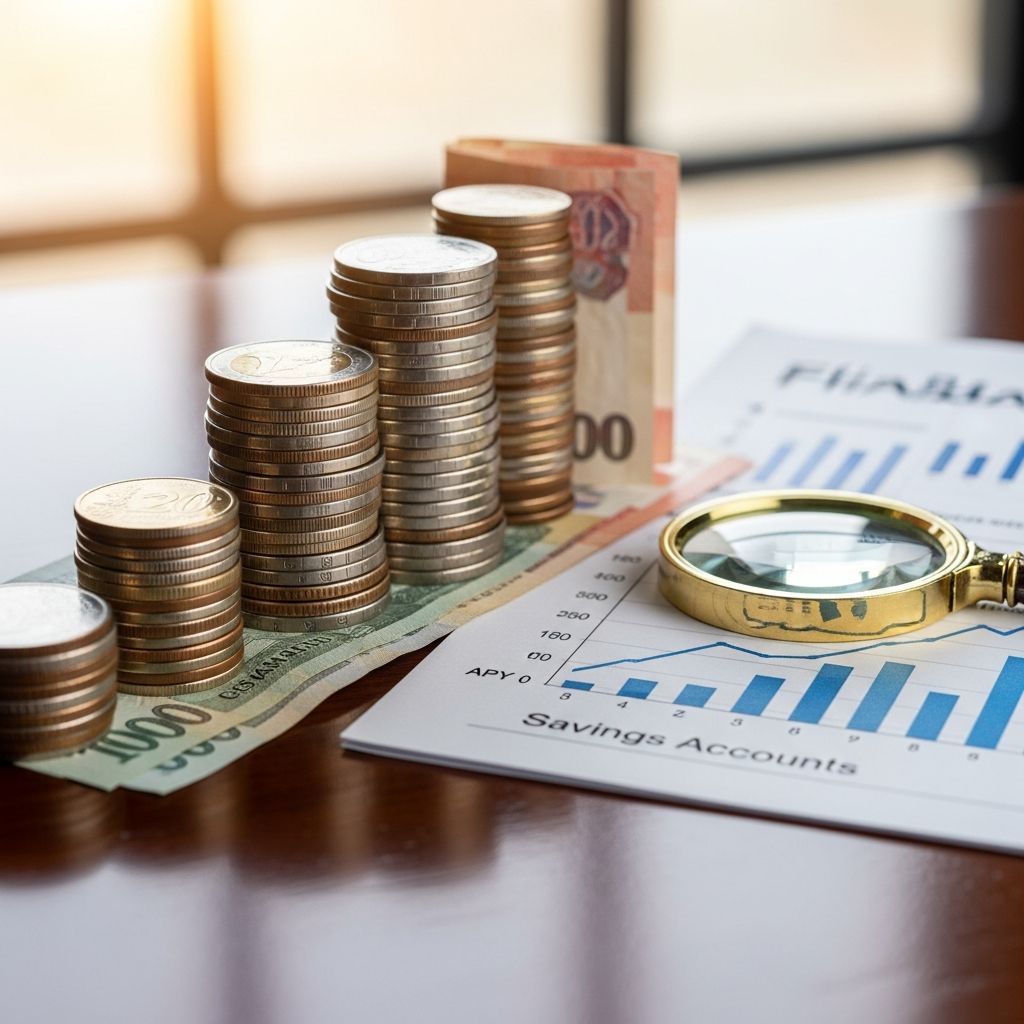
Annual Percentage Yield (APY) measures the real earning power of your savings, accounting for compounding interest over a year. In 2026, top high-yield savings accounts deliver APYs up to 5.00%, dwarfing the national average of 0.39% for traditional accounts.
Why APY Matters More Than Ever for Savers
APY directly impacts how quickly your money grows. For instance, $10,000 at 4% APY generates about $400 annually, versus just $1 at 0.01% typical of big-bank savings. This gap underscores the value of shopping for competitive rates, especially amid fluctuating Federal Reserve policies.
High APYs stem from online-only banks with lower overhead costs, passing savings to customers. Unlike traditional banks tied to physical branches, these digital providers prioritize yield over amenities like free checkbooks.
Current Landscape of Top Savings APYs
As of early 2026, leading rates cluster around 4-5%, with outliers requiring specific conditions. Varo Bank tops lists at 5.00% APY on balances up to $5,000, but only with qualifying direct deposits. Axos Bank and Newtek Bank follow closely at 4.21% and 4.35% (no minimum deposit).
| Bank/Institution | APY | Min. Balance/Deposit | Key Requirements | Est. Earnings on $10K (1 Year) |
|---|---|---|---|---|
| Varo Bank | 5.00% | $0 (up to $5K) | Direct deposits | $500 |
| Axos Bank | 4.21% | $0 | None | $421 |
| Newtek Bank | 4.35% | $0 | None | $435 |
| Openbank | 4.09% | $500 | None | $409 |
| Vio Bank | 4.03% | $100 | None | $403 |
| SoFi Bank | Up to 4.00% | $0 | Direct deposit for boost | $400 |
Estimates assume daily compounding and no withdrawals. Rates are variable and subject to change.
Benchmarks for a Competitive APY
A ‘good’ APY exceeds 4% in 2026, given top offerings hit 5%. Anything above 3.5% beats most national averages and supports meaningful growth. Traditional savings lag at 0.01-0.39%, making high-yield options essential for inflation-beating returns.
- Excellent: 4.5%+ (e.g., Newtek, Varo qualifiers)
- Strong: 4.0-4.49% (e.g., Axos, Openbank)
- Adequate: 3.5-3.99% (common online banks like Ally, Discover)
- Below Average: Under 1% (avoid big banks)
Factors Influencing Savings Account APYs
APYs fluctuate based on Federal Reserve rates, bank funding needs, and competition. Post-2022 hikes, yields peaked but softened as cuts loomed. Online banks adjust swiftly, often weekly.
Balance tiers affect rates: CIT Bank boosts to 4.10% with promo codes or higher balances. Relationship perks, like SoFi’s direct deposit bonus, elevate base rates from 3.30% to 4%.
Strategies to Secure the Highest APYs
- Compare Weekly: Use aggregators to track shifts; rates can drop 0.5% overnight.
- Meet Qualifications: Direct deposits or minimums unlock bonuses (e.g., Varo’s 5%).
- Leverage Promos: CIT’s 0.35% boost on 3.75% base for six months.
- Automate Deposits: Maintain tiers for tiered APYs (e.g., LendingClub’s 4% with $250 monthly).
- Diversify: Spread across FDIC-insured accounts up to $250K per bank.
Understanding APY vs. Interest Rate
APY reflects effective yield with compounding, surpassing simple interest rates. A 4% nominal rate might yield 4.06% APY monthly compounded. Always prioritize APY for apples-to-apples comparisons.
Formula: (1 + r/n)^n – 1, where r is nominal rate, n compounding frequency.
Real-World Earnings Projections
On $5,000 at 4.5% APY: ~$225 year one, compounding to $11,578 after 10 years.
| Initial Deposit | APY | 1-Year Earnings | 5-Year Total | 10-Year Total |
|---|---|---|---|---|
| $1,000 | 0.39% (Avg) | $4 | $1,020 | $1,040 |
| $1,000 | 4.00% | $40 | $1,216 | $1,481 |
| $10,000 | 5.00% | $500 | $12,763 | $16,289 |
Assumes no additions/withdrawals; illustrates compounding power.
Navigating Fees and Limitations
High-yield accounts shine fee-free: no monthly charges, $0 minimums common. Watch transaction limits (6/month under Reg D, though eased). Excess transfers may incur fees or rate drops.
Variable rates mean no guarantees; lock in CDs for fixed yields if rates fall.
FDIC Insurance and Account Safety
All listed banks are FDIC-insured up to $250,000 per depositor, per ownership category. Some like GreenFi extend to $1M via partner networks. Verify via FDIC’s BankFind tool.
Choosing the Right High-Yield Account
- Beginners: Ally or Discover (3.30%, tools, support).
- Maximizers: Varo/SoFi (conditional 5%).
- Simplicity: Capital One (3.30%, branches).
- Tech-Savvy: Wealthfront (4.20%, automated).
Common Pitfalls to Avoid
Chasing unverified rates leads to disappointment—confirm current APYs. Ignoring requirements drops yields (e.g., LendingClub to 3% without deposits). Neglecting taxes: Interest is taxable; track via 1099-INT.
Future Outlook for Savings Rates
With potential Fed cuts, APYs may dip below 4% by late 2026. Act now for peak yields. Monitor economic indicators like inflation (target 2%) and unemployment.
Frequently Asked Questions
What is a realistic good APY for savings in 2026?
Aim for 4%+; top tiers reach 5% with conditions.
Do high-yield accounts have fees?
Rarely; most are $0 monthly with no minimums.
Is my money safe in online savings?
Yes, FDIC covers up to $250K.
How often do APYs change?
Weekly or with Fed announcements.
APY vs. APR: What’s the difference?
APY includes compounding for savings; APR is simple for loans.
Can I lose money in a savings account?
No principal risk if FDIC-insured, but inflation erodes purchasing power below ~2% yields.
References
- The top high-yield savings rates: Up to 5.00% on March 10, 2026 — Fortune. 2026-03-10. https://fortune.com/article/best-savings-account-rates-3-10-2026/
- Best High-Yield Savings Accounts Of March 2026 – Up to 4.21% — Bankrate. 2026-03. https://www.bankrate.com/banking/savings/best-high-yield-interests-savings-accounts/
- Best High-Yield Savings Accounts 2026: Top 10 Rates, Perks — GreenFi. 2026. https://www.greenfi.com/resources/best-high-yield-savings-accounts-2026
- Best High-Yield Savings Accounts for March 2026 – NerdWallet — NerdWallet. 2026-03. https://www.nerdwallet.com/banking/best/high-yield-online-savings-accounts
Similar Articles








Read full bio of medha deb