Best and Worst States for Banking in the U.S.
Explore how your state stacks up for interest rates, branch access, stability, and customer satisfaction.
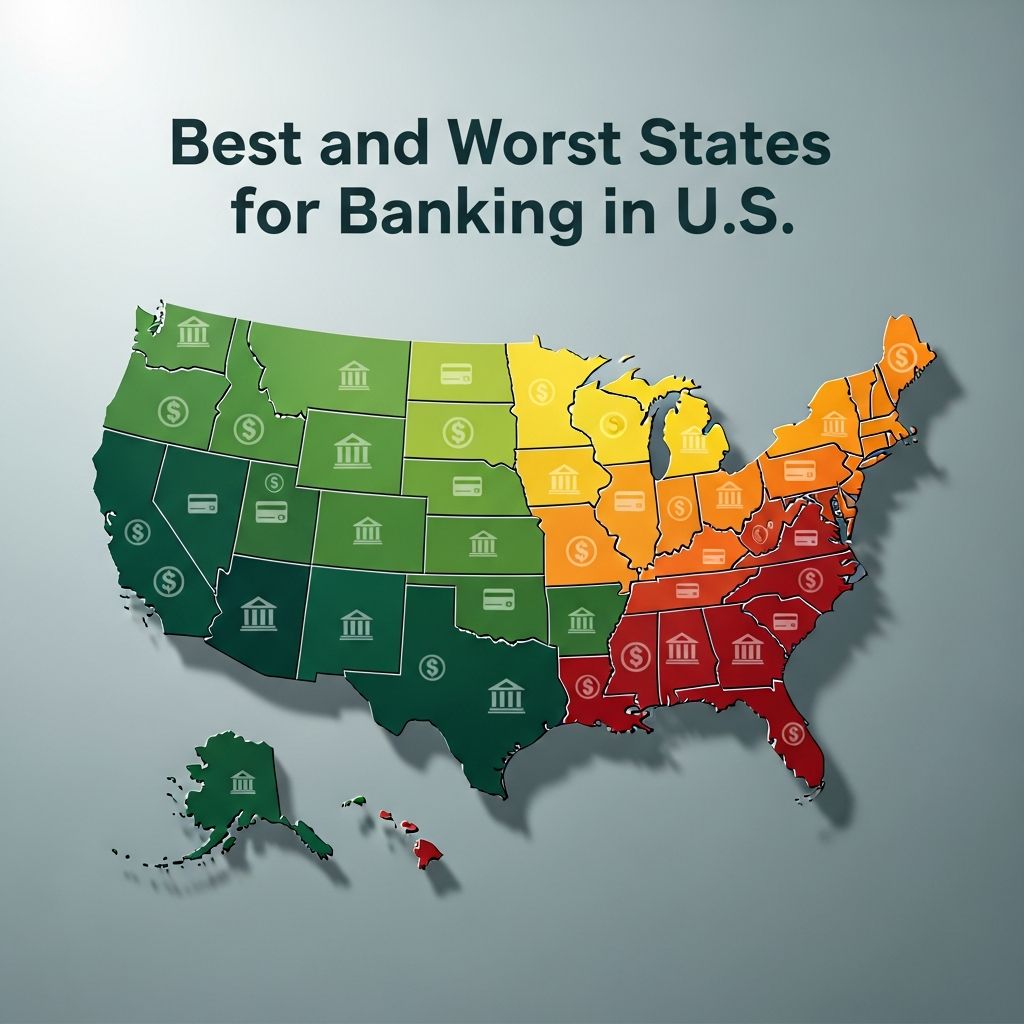
Where you live can quietly shape how easy it is to find a good bank, secure attractive interest rates, and enjoy reliable customer service. While federal regulation and nationwide brands create some uniformity, the actual banking experience still varies widely by state due to differences in competition, demographics, and local economic conditions.
This article takes a state-by-state look at the best and worst states for banking, using a framework similar to ongoing research by MoneyRates. It explains the ranking methodology, highlights standout states at both ends of the spectrum, and offers practical advice on how to get better banking value wherever you live.
How States Were Evaluated for Banking Quality
To compare states, we use four core factors often applied in professional banking studies:
- Customer satisfaction
- Bank stability and safety
- Number of bank choices and branch access
- Access to top deposit rates
Each of these elements reflects a different dimension of the consumer experience.
Customer Satisfaction
Customer satisfaction reflects how consumers rate their banks on service quality, problem resolution, convenience, and overall experience. While individual surveys differ, they typically include measures such as:
- Helpfulness and responsiveness of staff
- Ease of resolving issues and complaints
- Digital tools (apps, online banking) and in-person support
- Transparency of fees and policies
Independent research firms such as J.D. Power frequently report wide variations in satisfaction across regions and banks, with some institutions consistently outperforming peers. States with many branches from high-scoring banks tend to fare better in this category.
Bank Stability and Safety
Stability measures the health and safety of banks based in a state. Historically, analysts have looked at the number of bank failures and supervisory actions relative to the number of institutions in a state.
Key elements influencing perceived stability include:
- Capital levels and asset quality reported to regulators
- Economic diversity in the state’s economy
- Concentration of high-risk lending or investments
- Supervisory ratings and enforcement actions
While the Federal Deposit Insurance Corporation (FDIC) protects depositors up to at least $250,000 per depositor, per insured bank, per ownership category, repeated failures or high-risk profiles in a state can indicate a more volatile banking environment.
Number of Bank Choices and Branch Access
The number of bank choices in a state is often approximated by the count of bank branches and chartered institutions. FDIC data show wide differences in branch density and number of locations across states, reflecting both population and market structure.
States with strong scores in this category tend to share traits such as:
- Multiple large national banks with extensive branch networks
- Well-established regional banks and community institutions
- Competitive local markets where consumers can compare options
On the other hand, rural or less densely populated states can have relatively few branches per capita, which may force consumers to rely more on digital banking or travel farther for in-person services.
Access to Top Deposit Rates
Access to top deposit rates refers to how many of the nation’s highest-yield savings accounts, money market accounts, and certificates of deposit (CDs) have a physical or marketing presence in a state. While many high-yield accounts are now available online nationwide, branch-based banks still influence the rates many consumers see.
Research from the FDIC and from industry surveys shows that:
- Average savings rates at traditional branch-based banks remain low compared with the best online offerings.
- States with more competition and more active online-bank penetration tend to see better rates advertised and promoted to local consumers.
States score higher when multiple top-yield institutions operate branches, market locally, or have a significant regional presence.
Putting the Factors Together
To generate an overall ranking, each state can be scored on:
- Customer satisfaction ranking
- Stability and failure history
- Branch and bank-count ranking
- Availability of top-rate institutions
These rankings are then averaged (with equal weight) to produce a combined score. States that perform consistently well across all four areas rise to the top, while those that lag in multiple dimensions fall toward the bottom.
Best States for Banking
Top-performing states tend to offer a combination of strong bank stability, competitive rates, numerous choices, and above-average customer satisfaction. Many are large economic hubs that attract multiple national and regional banks, but several mid-sized states also stand out.
Features Common to Top Banking States
Although the exact mix differs by state, high-ranking states often share the following characteristics:
- Broad competition: Several large national banks plus healthy regional and community institutions.
- Diverse economies: Less dependence on a single industry, which supports more stable local credit conditions.
- Strong digital adoption: Consumers increasingly use online and mobile platforms, encouraging banks to enhance offerings and cut costs.
- Higher incidence of top-yield accounts: Local presence or strong marketing by top-rate banks and credit unions.
Examples of High-Ranking States
Large and mid-sized states that frequently appear near the top of banking-quality rankings tend to include a blend of the following profiles:
- Large states with many branches: States such as Texas and California have thousands of banking locations and host many leading rate providers, resulting in broad consumer choice.
- Midwestern and Southern states with loyal customers: Certain states in these regions perform well on satisfaction scores due to the strength of long-standing community and regional banks.
- Financial centers with specialized services: States that host major financial hubs often provide sophisticated products and diverse options for both everyday consumers and high-balance savers.
Even when average satisfaction scores are not the highest, a state can still rank prominently if its residents enjoy exceptional access to branches and top-yield institutions.
Worst States for Banking
States at the bottom of the rankings may not be universally bad places to bank, but their overall environment tends to be less favorable on one or more of the key factors. Often, weaknesses in customer satisfaction, bank stability, or branch access drag down their performance.
Common Challenges in Low-Ranking States
States that place near the bottom of national comparisons typically share several of these issues:
- Below-average customer satisfaction: Surveys show residents are less pleased with service quality, digital experience, or problem resolution.
- Higher history of bank failures or supervisory concerns: Some states have seen multiple institutions close or merge under strain, especially following major economic shocks.
- Limited branch networks: Consumers may have fewer physical locations nearby, particularly in rural areas, reducing in-person access.
- Lower visibility of top-rate products: Fewer high-yield savings, money market, or CD accounts are marketed locally, leaving many customers with subpar returns.
In some states, a small number of dominant institutions can reduce competitive pressure, which may translate into lower rates and higher fees for customers.
Illustrative Issues in Poorly Ranked States
Historically, some states have faced:
- Clusters of bank failures during or after national crises, which can shake confidence and reduce local choices.
- Long-standing customer-service complaints related to limited staffing, fewer branches, or underdeveloped digital tools.
- Regional economic vulnerabilities—for example, heavy dependence on a specific industry—that make local lending more cyclical and prone to stress.
However, even in these environments, consumers who are willing to use online and mobile banks or travel slightly farther can often find competitive options.
Comparing Banking Environments by Factor
The table below outlines how the four core factors relate to typical consumer concerns. It is not a ranking of specific states, but a framework for understanding what to look for when comparing banking conditions where you live.
| Factor | What It Measures | Why It Matters to You | What Strong States Look Like |
|---|---|---|---|
| Customer satisfaction | Average survey scores for banks with branches in a state | Indicates how likely you are to receive helpful, reliable service | Multiple banks with high service ratings and good digital tools |
| Stability and safety | History of bank failures, asset quality, and supervisory trends | Signals the resilience of local institutions in economic downturns | Few failures, diversified economies, well-capitalized banks |
| Number of bank choices | Branch density and count of distinct banks in a state | Determines how easy it is to shop around for better terms | Many branches from both large and community banks |
| Access to top deposit rates | Presence of banks and credit unions offering nationally competitive yields | Directly affects how much interest you earn on your savings | Multiple institutions regularly near the top of rate surveys |
How Your State’s Banking Environment Affects You
Even if you never look at state rankings, the conditions in your state influence your everyday banking experience in several ways:
- Interest earnings: In states where low-yield accounts dominate local offerings, many savers earn significantly less than national leaders.
- Fees and account minimums: Limited competition can lead to higher monthly fees, stricter minimums, and less generous fee waivers.
- Access to credit: The health of local banks affects the availability and pricing of mortgages, auto loans, and small-business credit.
- Convenience: Fewer branches or ATMs mean longer travel times and possible reliance on third-party networks, sometimes with added fees.
Despite these structural differences, individual consumers have more options than ever thanks to nationwide online and mobile banking platforms.
Improving Your Banking Outcomes, Wherever You Live
You cannot change your state’s branch density or historical stability record, but you can change where and how you bank. The following strategies help you overcome local disadvantages and make the most of any environment.
1. Expand Your Search Beyond Local Branches
Online and hybrid banks—often operating with lower overhead—are able to offer higher savings yields and lower fees than many traditional branch-based institutions. Many accept customers nationwide, regardless of state of residence.
- Compare APYs for savings, money market accounts, and CDs against national averages.
- Check fee schedules closely to avoid monthly maintenance or out-of-network ATM fees.
- Confirm FDIC insurance for banks or NCUA insurance for credit unions, up to the standard limits.
2. Take Advantage of Credit Unions and Community Banks
Credit unions and smaller community banks often provide competitive rates and high satisfaction, particularly in states where large national banks dominate.
- Credit unions are typically member-owned and may return earnings in the form of better rates.
- Community banks may offer more personalized service and local decision-making on loans.
- Many credit unions now participate in shared branching and ATM networks, improving access.
3. Match Your Bank to Your Priorities
There is no single “best” bank for everyone. Your ideal institution depends on your specific needs:
- If you maintain large savings balances, top interest rates may matter most.
- If you rely on frequent cash deposits or prefer face-to-face help, branch proximity may dominate.
- If you travel often or live in a rural area, ATM access and fee rebates could be critical.
Ranking lists are a useful starting point, but your personal checklist should drive the final choice.
4. Regularly Review Your Accounts
Banking markets evolve quickly. Promotions end, fees change, and new competitors appear. Industry data show that consumers who periodically compare offers are more likely to improve returns and reduce fees over time.
- Review your main accounts at least once a year.
- Compare your APY and fees to national online leaders and strong regional options.
- Be willing to switch if your existing bank falls significantly behind.
Frequently Asked Questions (FAQs)
Q: Does living in a “worst” state for banking mean my money is unsafe?
No. Deposits at FDIC-insured banks and NCUA-insured credit unions are protected up to at least $250,000 per depositor, per insured institution, per ownership category, regardless of the state. A low state ranking usually reflects weaker average customer satisfaction, fewer choices, or less competitive rates—not a lack of deposit insurance.
Q: If online banks are available nationwide, do state rankings still matter?
They matter less than in the past but are still relevant. State conditions affect branch access, local loan markets, and the options most heavily marketed in your area. However, online and hybrid institutions increasingly allow consumers in weaker states to access top-rate accounts and modern digital services.
Q: How can I find out whether my bank is stable?
You can verify FDIC insurance using the FDIC’s BankFind database, review public call reports, and monitor news or regulatory announcements about enforcement actions. Independent rating agencies also publish assessments of bank financial strength, though their methodologies vary.
Q: Are credit unions safer than banks?
Both federally insured credit unions and FDIC-insured banks offer similar levels of deposit protection—generally up to $250,000 per depositor, per institution, per ownership category. Safety depends more on each institution’s financial health and risk management than on whether it is a bank or a credit union.
Q: Should I prioritize rate, fees, or branch convenience?
It depends on your habits. If you keep large balances and rarely visit branches, maximizing yield and minimizing fees will likely provide the greatest benefit. If you rely heavily on in-branch services or cash transactions, branch and ATM access may be more important than the last fraction of a percent in interest.
References
- 2024 U.S. Retail Banking Satisfaction Study — J.D. Power. 2024-05-01. https://www.jdpower.com/business/press-releases/2024-us-retail-banking-satisfaction-study
- Quarterly Banking Profile — Federal Deposit Insurance Corporation (FDIC). 2024-11-21. https://www.fdic.gov/analysis/quarterly-banking-profile/
- National Rates and Rate Caps — FDIC. 2024-10-01. https://www.fdic.gov/resources/bankers/national-rates/
- Average Savings Account Rates in the U.S. — Board of Governors of the Federal Reserve System. 2024-09-16. https://fred.stlouisfed.org/series/SAVR
- Consumers and Mobile Financial Services — Board of Governors of the Federal Reserve System. 2022-12-15. https://www.federalreserve.gov/publications/consumers-and-mobile-financial-services-report-2022.htm
Similar Articles








Read full bio of Sneha Tete