BCG Matrix: Strategic Portfolio Management Tool
Master portfolio management with the BCG Matrix framework for strategic resource allocation.
Understanding the BCG Matrix: A Strategic Business Tool
The Boston Consulting Group (BCG) Matrix, also known as the Growth-Share Matrix, is a fundamental strategic management tool that helps organizations evaluate their product portfolios and make informed decisions about resource allocation and investment priorities. Developed by the Boston Consulting Group in the 1970s, this framework has become an essential instrument for business leaders, financial analysts, and marketing professionals seeking to understand where their products stand in the competitive landscape and how to optimize their investment strategies.
The BCG Matrix operates on a simple yet powerful premise: by analyzing the relationship between a product’s market growth rate and its market share position, companies can classify their offerings into distinct strategic categories and determine the optimal allocation of resources. This approach enables organizations to balance their portfolios effectively, ensuring a mix of products that generate immediate profits while simultaneously investing in future growth opportunities.
The Core Framework: Axes and Dimensions
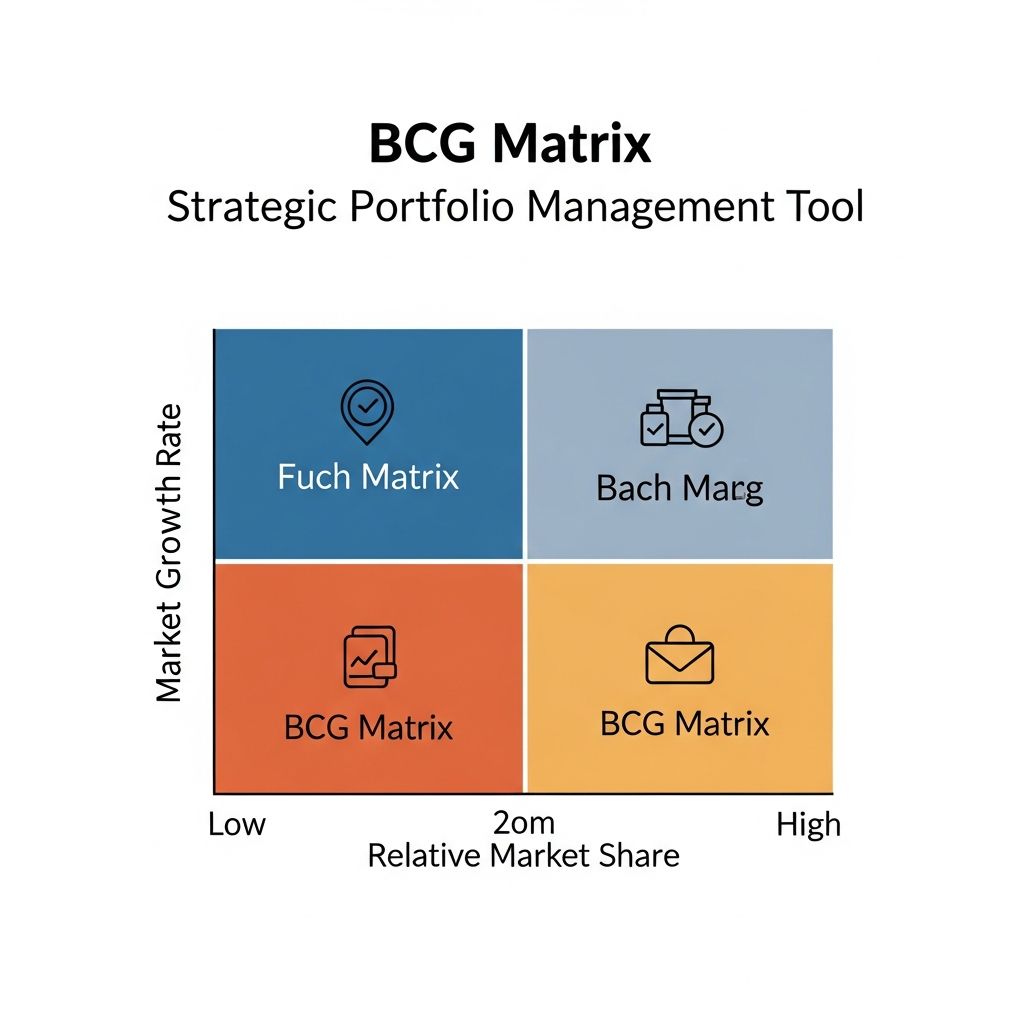
The BCG Matrix is structured around two primary dimensions that form a four-quadrant grid. Understanding these axes is crucial for effectively applying the framework to your business analysis.
Market Growth Rate (Vertical Axis)
The vertical axis represents the market growth rate, which indicates how quickly the overall market for a particular product category is expanding. This dimension reflects the rate at which the industry or market segment is growing. A higher market growth rate suggests a more dynamic and expanding market, whereas a lower rate indicates a mature or declining market. Typically, a growth rate threshold of around 10% is used to distinguish between high and low growth markets, though this benchmark can vary depending on the industry.
Relative Market Share (Horizontal Axis)
The horizontal axis represents the relative market share, which reflects a product’s position compared to its competitors within a specific market. This metric is calculated by comparing your market share to that of your largest competitor. A high relative market share indicates that your product is a market leader in its category, while a low relative market share suggests that competitors have stronger positions.
The Four Strategic Quadrants
The intersection of these two axes creates four distinct quadrants, each representing a unique strategic position and requiring different management approaches:
| High Market Share | Low Market Share | |
|---|---|---|
| High Market Growth | Stars | Question Marks |
| Low Market Growth | Cash Cows | Dogs |
Stars: High Growth, High Market Share
Stars represent the most attractive products in a company’s portfolio, combining high market growth rates with strong market share positions. These products are market leaders in rapidly expanding categories, making them strategically valuable assets. Stars typically require substantial investment to maintain their competitive advantage and fuel continued growth. Although they consume significant amounts of cash, stars also generate large cash flows that can help fund other business initiatives. As markets mature and growth rates decline, successful stars often transition into cash cows, making them a critical component of long-term portfolio planning.
Cash Cows: Low Growth, High Market Share
Cash Cows are products with high market share operating in mature, low-growth markets. These established products generate substantial and stable profits with minimal investment requirements because they operate in markets where customer preferences and competitive dynamics have already stabilized. The primary strategic approach for cash cows is “harvesting,” meaning companies should maintain profitability while gradually reducing investment levels. The cash generated from these products provides a valuable funding source for investing in stars and question marks, making cash cows the financial backbone of many portfolios.
Question Marks: High Growth, Low Market Share
Question Marks represent products in high-growth markets where the company has yet to establish a dominant position. These products present both opportunities and risks. They could potentially develop into stars if given adequate investment and strategic support, or they could fail to gain market traction and become dogs. The BCG Matrix framework requires managers to carefully evaluate question marks and make explicit decisions about whether to invest significantly to build market share or to divest from these products. This strategic choice is critical because question marks consume cash without generating strong returns, making portfolio composition crucial.
Dogs: Low Growth, Low Market Share
Dogs are products with low market share in slowly growing or mature markets. These products often consume resources without generating meaningful profits or cash flows, making them candidates for divestment or repositioning strategies. While some companies choose to maintain dogs in their portfolios for defensive reasons or niche market opportunities, the general recommendation is to liquidate, divest, or fundamentally reposition these products to improve their strategic value.
How to Create and Apply the BCG Matrix
Developing an effective BCG Matrix requires systematic analysis and careful data gathering. The process involves several key steps that ensure accurate categorization and meaningful strategic insights.
Step One: Define Your Market
Begin by clearly defining the relevant market for each product or business unit. Market definition significantly impacts how you calculate both growth rates and market share, so precision is essential. Consider whether you’re analyzing markets by geography, customer segment, product category, or a combination of factors.
Step Two: Gather Growth Rate Data
Collect comprehensive data on market growth rates for each product category. This may include industry reports, market research data, and historical sales trends. Ensure consistency in your time periods and data sources to enable meaningful comparisons.
Step Three: Calculate Market Share
Determine your company’s market share relative to competitors in each market segment. Calculate relative market share by comparing your share to that of the leading competitor. This metric provides a more meaningful competitive perspective than absolute market share figures.
Step Four: Plot Products on the Matrix
Position each product on the matrix based on its calculated growth rate and relative market share. Use visual representation to facilitate strategic discussions and decision-making.
Step Five: Develop Strategic Recommendations
For each product category, determine appropriate resource allocation and strategic direction based on its quadrant position. Consider portfolio balance, cash flow implications, and long-term competitive objectives.
Strategic Implications and Decision Framework
Each quadrant of the BCG Matrix suggests different strategic approaches and resource allocation decisions. Understanding these implications helps organizations optimize their portfolio management and achieve strategic objectives.
For Stars, the recommendation is to maintain and strengthen market position through continued investment in product development, marketing, and capacity expansion. These products deserve priority attention and resource allocation to sustain their growth trajectories and competitive advantages.
Cash Cows require a harvesting strategy where companies maintain profitability while minimizing incremental investment. The cash generated should be systematically allocated to fund stars and select question marks.
Question Marks demand a strategic decision point. Companies must decide whether to aggressively invest to build market share and potentially convert these into stars, or to divert and reallocate resources elsewhere. This decision depends on factors such as competitive dynamics, technological trends, and capital availability.
Dogs typically warrant divestment or repositioning, though exceptions may exist for products that serve strategic purposes or niche markets with loyal customer bases.
Practical Advantages and Limitations
The BCG Matrix offers several significant advantages for portfolio management. It provides a simple, intuitive framework for analyzing complex product portfolios. It facilitates strategic discussions and prioritization of resource allocation. It helps identify cash flow dynamics and funding opportunities. Additionally, it serves as an effective communication tool for explaining strategic positioning to stakeholders.
However, the BCG Matrix has important limitations that managers should recognize. The framework can oversimplify complex market dynamics by reducing products to just two dimensions. It may not account for product interdependencies, synergies, or strategic relationships. The model assumes that market share directly correlates with profitability, which isn’t always true. Additionally, it focuses on current positioning rather than future competitive trends or disruptive technologies.
Practical Examples of BCG Matrix Application
Consider a technology company with diverse product offerings. Smartphones with strong market position in a growing market would be classified as Stars, requiring significant R&D investment and marketing support. Legacy computer peripherals with established market share in a declining market would be Cash Cows, generating steady profits with minimal investment. New IoT products gaining traction would be Question Marks, requiring strategic decisions about investment levels. Obsolete products with minimal market presence would be Dogs, candidates for discontinuation.
In retail, branded clothing lines with strong sales in growing segments represent Stars. Established staple items generating consistent revenue represent Cash Cows. Experimental fashion lines represent Question Marks. Outdated or poorly performing items represent Dogs.
Enhancing BCG Matrix Analysis
To maximize the value of BCG Matrix analysis, managers should combine it with complementary strategic tools and metrics. Consider incorporating profitability analysis, customer satisfaction data, competitive intelligence, and market trend analysis. Use the matrix alongside financial metrics to develop comprehensive investment strategies. Review and update your BCG analysis regularly, as market conditions and competitive positions change continuously.
Frequently Asked Questions
Q: How often should a company update its BCG Matrix analysis?
A: Companies should review their BCG Matrix at least annually or whenever significant market changes occur. More frequent reviews may be appropriate in highly dynamic industries where competitive positions shift rapidly.
Q: Can a product move between quadrants?
A: Yes, products naturally migrate between quadrants as markets mature and competitive positions change. Stars often become Cash Cows as markets mature. Question Marks may become Stars with successful investment or Dogs if they fail to gain market share.
Q: Should companies always divest from Dogs?
A: Not necessarily. Some Dogs may serve strategic purposes, support customer retention, or generate sufficient margins despite low market share. The decision depends on individual circumstances and strategic objectives.
Q: How is relative market share calculated?
A: Relative market share is typically calculated by dividing your market share by the market share of your largest competitor. A ratio greater than 1.0 indicates higher market share than the leading competitor.
Q: What growth rate threshold should be used for the vertical axis?
A: While 10% is commonly used, the appropriate threshold depends on industry norms and economic conditions. Some industries use 5-15% thresholds, and the median growth rate across your products can serve as a practical dividing line.
References
- Boston Consulting Group (BCG) Matrix – Corporate Finance Institute — Corporate Finance Institute. Accessed November 2025. https://corporatefinanceinstitute.com/resources/management/boston-consulting-group-bcg-matrix/
- The Growth Share Matrix – BCG — Boston Consulting Group. Accessed November 2025. https://www.bcg.com/about/overview/our-history/growth-share-matrix
- BCG Matrix: A Strategic Framework for Resource Allocation – Quantive — Quantive. Accessed November 2025. https://quantive.com/resources/articles/bcg-matrix
- Understanding the BCG Growth Share Matrix – SafetyCulture — SafetyCulture. August 2025. https://safetyculture.com/topics/bcg-matrix
- What Is a BCG Matrix – Indeed — Indeed Career Advice. Accessed November 2025. https://www.indeed.com/career-advice/career-development/what-is-bcg-matrix
Similar Articles








Read full bio of Sneha Tete