Bank Ratings Methodology Guide
Discover how agencies evaluate banks using key metrics like CAMELS, viability ratings, and support factors to gauge financial health.
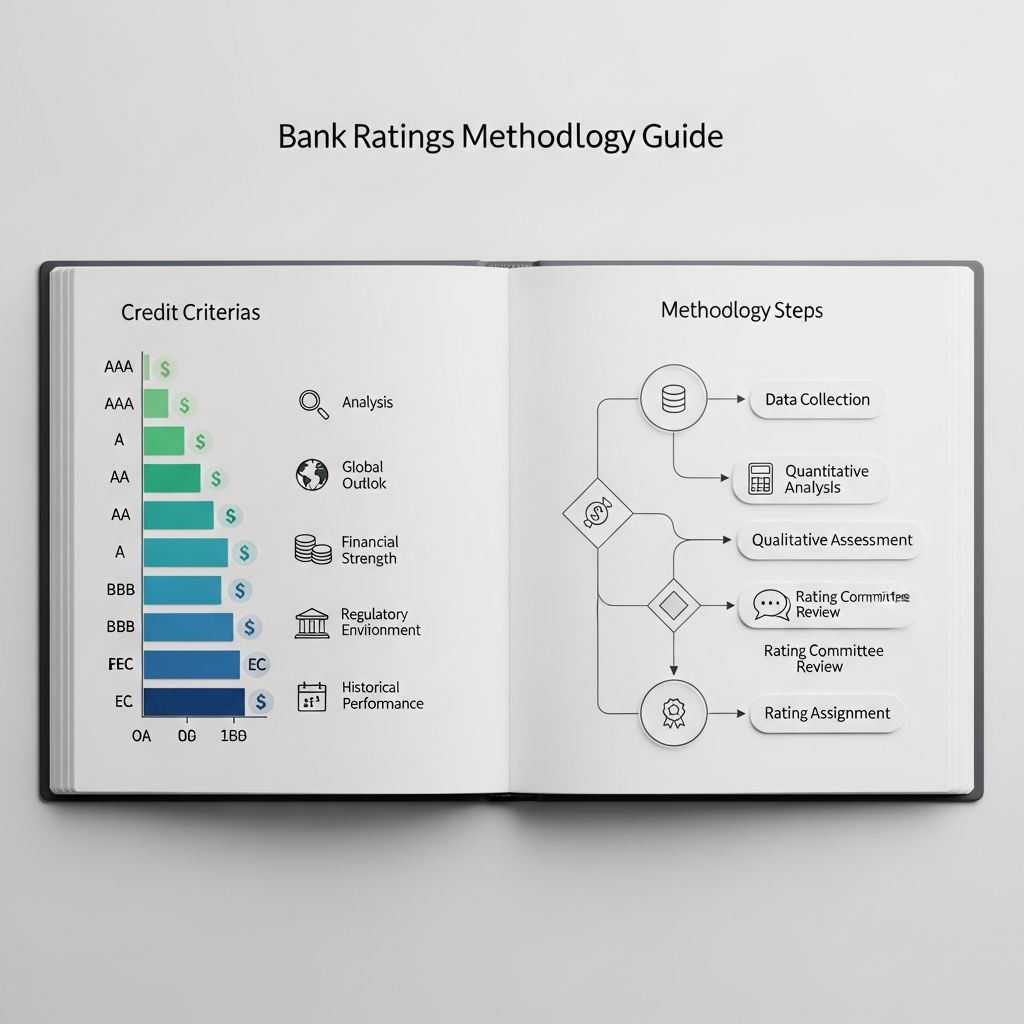
Bank ratings provide essential insights into the financial stability and creditworthiness of banking institutions. These evaluations, conducted by specialized agencies, help investors, regulators, and depositors assess risks associated with banks operating domestically or internationally.
Understanding the Purpose of Bank Ratings
Bank ratings serve as standardized opinions on a bank’s ability to meet its obligations. They analyze historical performance and project future trends to offer stable, forward-looking assessments. Agencies focus on core activities like deposit-taking and lending, evaluating both standalone strength and potential external support.
Ratings distinguish between intrinsic financial health—without external aid—and overall credit profiles that include systemic or governmental backing. This dual approach ensures a nuanced view of a bank’s resilience.
Core Components of Bank Evaluation Frameworks
Most methodologies begin with an internal assessment of the bank’s standalone creditworthiness. This involves quantitative metrics and qualitative judgments on management effectiveness and strategic positioning.
- Capitalization: Measures the adequacy of equity to absorb losses, often using risk-weighted assets ratios.
- Asset Quality: Examines loan portfolios for non-performing assets and provisions against potential defaults.
- Earnings: Evaluates profitability and capacity to generate returns that bolster capital.
- Liquidity: Assesses ability to meet short-term obligations without disrupting operations.
These elements form the foundation, adjusted for industry risks and macroeconomic conditions.
The CAMELS Rating System in Depth
The FDIC employs the CAMELS framework, a comprehensive supervisory tool rating banks from 1 (strongest) to 5 (weakest). It expands beyond basic financials to include governance and market risks.
| Factor | Description | Key Metrics |
|---|---|---|
| Capital Adequacy | Evaluates capital levels relative to risks | Tier 1 capital ratio, leverage ratio |
| Asset Quality | Reviews loan and investment portfolio health | Non-performing loans ratio, net charge-offs |
| Management | Assesses leadership and risk controls | Compliance record, strategic planning |
| Earnings | Measures income sustainability | Return on assets, efficiency ratio |
| Liquidity | Checks funding stability | Liquid assets to deposits, funding sources |
| Sensitivity to Market Risk | Analyzes exposure to interest rates, markets | Value at risk, economic value of equity |
CAMELS provides regulators with a holistic snapshot, influencing supervisory actions and public confidence.
Stand-Alone vs. All-In Ratings Explained
Agencies like Moody’s, S&P, and Fitch issue stand-alone ratings reflecting a bank’s intrinsic strength, assuming no external help. These are termed Viability Ratings (VR), Bank Financial Strength Ratings, or Individual Ratings.
All-in ratings incorporate support factors, resulting in Issuer Default Ratings (IDR). Support can come from governments, parent companies, or cooperatives, often elevating the final score for systemically important banks.
- Stand-alone: Focuses on off-balance-sheet risks, capital growth from earnings, and liquidity.
- All-in: Adjusts for sovereign floors or joint default probabilities with supporters.
Major Agencies’ Distinct Approaches
Moody’s Methodology
Moody’s starts with Bank Financial Strength Ratings, factoring in operating environment, core capital, and profitability. It introduced Joint Default Analysis in 2007 to model support probabilities, emphasizing systemic risk since 2005.
Fitch Ratings Framework
Fitch uses Individual Ratings for stand-alone profiles, mapped to Issuer Default Ratings via support assessments. It publishes separate Support Rating Floors for transparency, incorporating systemic measures like country-wide averages.
S&P Global’s BICRA System
S&P’s Banking Industry Country Risk Assessment (BICRA) scores economic and industry risks across 1-10 bands. Bank-specific anchors combine home-country industry risk with operational countries’ profiles, adjusted for management and capital.
Proposed overhauls emphasize forward-looking capital, system-wide risks, and government support tendencies.
Incorporating External Support Factors
Support ratings gauge likelihood and magnitude of aid. Government Support Ratings (GSR) or Shareholder Support Ratings (SSR) prevent defaults on senior debt. Systemic importance often leads to higher floors, as seen in post-crisis adjustments.
EthiFinance builds long-term issuer ratings from intrinsic strength plus systemic and related-party support.
Quantitative Models and Qualitative Overlays
Agencies deploy proprietary models synthesizing financial ratios with scenario analyses. Egan-Jones refines CAMEL through standardized committees and expert judgment.
Financial metrics include risk-adjusted performance, expected losses, and stress resilience. Qualitative factors cover governance, innovation, and adaptation to regulations like Basel III.
Impact of Ratings on Stakeholders
Investors use ratings for bond pricing and portfolio allocation. Higher-rated banks access cheaper funding. Regulators monitor for interventions, while depositors seek safety signals.
Ratings evolve with crises, incorporating macroprudential indicators and ESG factors, as Moody’s integrates environmental, social, and governance risks.
Challenges and Evolutions in Rating Practices
Methodologies adapt to financial innovations and geopolitical shifts. Post-2011 revisions addressed sovereign-bank links and liquidity gaps. Transparency efforts include decision trees and notching guides.
Critics note procyclicality, but agencies counter with through-the-cycle calibration for stability.
Common Bank Rating Scales
| Agency | Top Grade | Bottom Grade | Scale Type |
|---|---|---|---|
| Moody’s | Aaa | C | Alphanumeric |
| S&P/Fitch | AAA | D | Alphanumeric |
| FDIC CAMELS | 1 | 5 | Numerical |
Frequently Asked Questions
What factors most influence a bank’s stand-alone rating?
Capital strength, asset quality, earnings power, and liquidity management are primary drivers, assessed against industry benchmarks.
How do government bailouts affect ratings?
They elevate all-in ratings via support floors, especially for globally systemic banks, but not stand-alone scores.
Are bank ratings publicly available?
Yes, agencies publish them on websites, with methodologies detailed in criteria reports.
Can ratings predict bank failures?
They signal heightened risks but are opinions, not guarantees; historical data shows lower ratings correlate with distress.
How often are bank ratings updated?
Annually or upon material events, with continuous surveillance.
Practical Tips for Using Bank Ratings
- Compare across agencies for consensus.
- Review stand-alone and all-in distinctions.
- Contextualize with economic cycles.
- Monitor rating outlooks for directional changes.
References
- Banks Rating Methodology — EthiFinance Ratings. 2023-03. https://www.ethifinance.com/wp-content/uploads/2025/06/CRA_159_V1.Bank_Methodology-1.pdf
- Bank Ratings: What They Are and Why They Matter — BILL. Accessed 2026. https://www.bill.com/learning/bank-ratings
- Rating methodologies for banks — Bank for International Settlements (BIS). 2011-06. https://www.bis.org/publ/qtrpdf/r_qt1106f.pdf
- Bank ratings criteria explained — Global Institute of Credit Professionals. Accessed 2026. https://gicp.org/careers/bank-ratings-essentials/
- Banks Criteria — Fitch Ratings. Accessed 2026. https://www.fitchratings.com/criteria/banks
- Methodologies for Determining Credit Ratings — SEC.gov (Egan-Jones). 2020. https://www.sec.gov/Archives/edgar/data/1651331/000165133120000008/EJR_Ex_2_Methodologies.pdf
- How We Rate Financial Institutions — S&P Global. 2013-07-08. https://www.spglobal.com/content/dam/spglobal/ratings/en/documents/pdfs/070813_howweratebanks.pdf
Similar Articles








Read full bio of medha deb