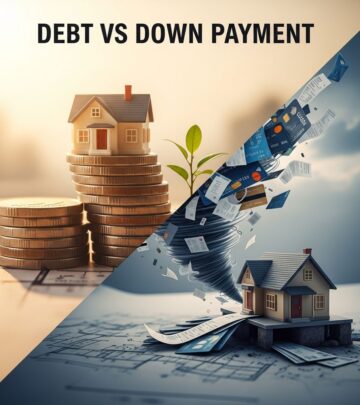
Balancing Homeownership Dreams with Student Debt
Navigate the financial crossroads between eliminating education debt and building home equity.

The intersection of student loan obligations and homeownership aspirations represents one of the most challenging financial decisions young adults face today. For millions of borrowers, the question isn’t whether to pursue these goals, but rather which deserves immediate attention and resources. This comprehensive guide examines the financial considerations that should inform this critical decision and provides practical frameworks for evaluating your unique circumstances.
Understanding the Financial Landscape of Student Debt
Student loan debt has become a defining characteristic of modern financial planning. The current federal lending environment establishes baseline interest rates that vary significantly by loan type. Federal undergraduate loans carry a 5.50% interest rate, while graduate and professional student loans reach 7.05%. This distinction matters considerably when comparing the cost of debt reduction strategies.
Private student loans present a more variable landscape. Interest rates on private student loans typically range from 4% to 15%, meaning borrowers with private lending arrangements may face substantially higher borrowing costs than their federal loan counterparts. The disparity in rates directly impacts the financial calculus of whether accelerated repayment makes economic sense.
Understanding your specific loan terms requires examining not just interest rates but also your total outstanding balance. The average student loan payment reaches $203 monthly, though individual circumstances vary widely. For borrowers carrying six-figure debt loads, monthly obligations can easily exceed several hundred dollars, creating significant constraints on discretionary income available for other financial goals.
The Down Payment Challenge in Today’s Housing Market
The traditional pathway to homeownership requires accumulating substantial liquid capital before entering the mortgage market. Homebuyers typically need to reserve between 3% to 15% of the purchase price as a down payment, depending on loan type, lender requirements, and credit profile. For a median-priced home in many markets, this translates to tens of thousands of dollars in required savings.
The down payment requirement becomes increasingly burdensome when combined with existing student loan obligations. Research demonstrates the real-world impact of this challenge: first-time homebuyers with student loan debt spend an average of 39% less on their homes than buyers without student debt. This reduction in purchasing power often reflects not superior financial discipline but rather constrained capacity to save and qualify for larger mortgages.
The temporal dimension compounds this challenge. While student loan repayment commitments extend across decades, down payment accumulation typically occurs over a compressed timeline measured in years. The competing urgencies create psychological and financial pressure that demands systematic evaluation.
Analyzing Your Debt-to-Income Ratio as a Decision Framework
Mortgage lenders employ standardized metrics to assess borrower capacity to manage additional debt obligations. The debt-to-income ratio represents a critical threshold in homeownership qualification. Most mortgage lenders require your debt-to-income ratio to remain below 43%, though many prefer ratios under 36%. Understanding how your current obligations affect this ratio provides essential guidance for strategic decision-making.
Calculating your personal debt-to-income ratio requires aggregating all monthly debt obligations—including rent, credit card minimums, car loans, and student loan payments—then dividing this total by your pretax monthly income. For example, if you carry $500 in monthly debt payments and earn $4,000 in gross monthly income, your ratio stands at 12.5%. However, if you’re planning to add a mortgage payment of $1,500, your new debt-to-income ratio would climb to 50%, exceeding lender acceptable thresholds.
This framework illuminates why student loan reduction sometimes takes priority. When existing obligations consume substantial portions of monthly income, lenders become reluctant to approve mortgages regardless of down payment size. Conversely, if your current debt-to-income ratio remains comfortably below lender thresholds—perhaps sitting at 20% or 25%—you may retain sufficient capacity to pursue both goals simultaneously through budgetary reallocation.
Evaluating Interest Rate Economics
Beyond qualitative considerations, the mathematics of different interest rates should inform your strategic direction. Consider a concrete illustration: a borrower owing $15,000 at a 10% interest rate faces substantially different economic outcomes depending on payment strategy.
Maintaining minimum payments extends repayment timelines and increases total interest paid significantly. Accelerating these payments reduces both the repayment period and cumulative interest expense. Adding just $100 monthly to a $300 student loan payment accelerates payoff by nearly four years and reduces total interest paid by approximately $4,000. This mathematical reality demonstrates that high-interest student debt functions as a financial drag on other objectives.
However, this principle requires contextual application. Federal student loans at 5.50% represent relatively modest borrowing costs compared to historical averages or private lending alternatives. If your federal loans carry rates below market mortgage rates—which they typically do—the mathematical case for prioritizing student loan elimination weakens. Conversely, private loans at 10% or higher present compelling economic arguments for accelerated repayment.
Housing Cost Constraints and Income Allocation
Financial planning frameworks establish guidelines for sustainable housing expense levels. Standard practice recommends limiting housing costs to no more than 28% of gross monthly income. This ceiling encompasses mortgage principal and interest, property taxes, homeowners insurance, and mortgage insurance premiums.
This constraint interacts with debt-to-income calculations to establish feasible mortgage amounts. A borrower earning $5,000 monthly can sustainably support housing expenses around $1,400 according to this threshold. After accounting for taxes, insurance, and potential mortgage insurance, this translates to modest mortgage capacity that may prove insufficient given down payment constraints and property prices in competitive markets.
When student loan payments consume additional income—perhaps $300 or $400 monthly—the available resources for housing expenses shrink correspondingly. Strategic evaluation requires assessing whether reducing or eliminating student loan obligations creates sufficient monthly cash flow expansion to support desired homeownership levels.
Credit Profile and Mortgage Qualification Requirements
Beyond income and debt metrics, mortgage lenders scrutinize additional dimensions of financial health. Conventional mortgages typically require a minimum credit score of 620, while government-backed loans may approve borrowers with scores as low as 580. Student loan payment history directly influences credit scores, making consistent repayment behavior crucial for mortgage qualification.
Employment history and income stability also receive lender attention. Mortgage underwriters verify that income sources are sustainable and documented through tax returns and employment verification. Career transitions, freelance income reliance, or recent employment changes can complicate approval processes regardless of debt levels or down payment size.
Additional debt beyond student loans—particularly high-interest credit card balances—further constrains mortgage qualification capacity. A borrower carrying $5,000 in credit card debt at 18% interest alongside student loans presents substantially higher risk profiles than one carrying equivalent student loan balances alone. Strategic debt elimination priorities should address these higher-rate obligations before accumulating down payment capital.
Practical Strategies for Managing Both Objectives Simultaneously
While this analysis presents student loan elimination and down payment accumulation as potentially competing priorities, most financial circumstances permit progress on both fronts through deliberate budgetary strategies.
Budget Restructuring and Discretionary Expense Reduction
Beginning with honest assessment of monthly spending patterns often reveals discretionary expenses that can be redirected toward financial goals. Entertainment subscriptions, dining expenditures, travel, and shopping habits frequently offer opportunities for meaningful reallocation without sacrificing essential living standards. Implementing bare-bones budgets that eliminate non-essential spending while maintaining necessities like groceries, utilities, and housing creates resources for both debt reduction and down payment savings.
Automating Payments for Enhanced Efficiency
Systematic approaches to debt repayment improve outcomes through multiple mechanisms. Most student loan servicers offer a 0.25% interest rate reduction to borrowers who enable automatic payments, providing immediate savings on interest expense. Beyond this direct benefit, automation reduces payment deferrals and missed deadlines that damage credit scores and extend repayment timelines.
Strategic Windfall Allocation
Tax refunds, employment bonuses, inheritance proceeds, and other financial windfalls present opportunities to accelerate progress on both goals. Rather than consuming windfalls through increased spending, dividing them between student loan acceleration and down payment accumulation creates meaningful progress without constraining monthly budgets. A $3,000 tax refund might allocate $2,000 toward student loan principal reduction and $1,000 toward down payment savings, advancing both objectives substantially.
Investigating First-Time Homebuyer Support Programs
Many states and nonprofit organizations offer first-time homebuyer programs that provide down payment assistance and closing cost support. These resources reduce the total capital required before entering the housing market, diminishing the tension between student loan elimination and down payment accumulation. Program eligibility typically depends on income thresholds, geographic location, and property characteristics rather than student loan status, making these resources accessible to debt-carrying borrowers.
Recognizing When Student Loan Priority Makes Economic Sense
Certain financial circumstances create compelling cases for prioritizing student loan elimination before pursuing down payment accumulation. Elevated interest rates on student loans—particularly private loans exceeding 8% or 10%—justify accelerated repayment because the mathematics of interest savings become overwhelming. A borrower carrying $50,000 in private loans at 12% interest faces nearly $18,000 in interest expense over ten years of standard repayment. Accelerating repayment by even two to three years generates thousands in interest savings.
Similarly, debt-to-income ratios exceeding acceptable mortgage lending thresholds create practical barriers to homeownership qualification regardless of down payment adequacy. In these circumstances, strategic student loan elimination becomes prerequisite rather than optional goal. Once ratios decline to acceptable ranges, mortgage qualification becomes feasible and down payment accumulation can accelerate.
High monthly student loan obligations that consume substantial portions of take-home pay also justify prioritization. When loan payments approach $400 or $500 monthly, the opportunity cost of redirecting these funds toward down payment savings becomes prohibitive. Eliminating these obligations creates sufficient monthly cash flow expansion to support both accelerated down payment accumulation and sustainable homeownership expenses.
Recognizing When Down Payment Priority Makes Sense
Conversely, certain circumstances support prioritizing down payment accumulation while maintaining standard student loan repayment. Manageable student loan balances at relatively modest interest rates—particularly federal loans below 6%—present less compelling cases for aggressive acceleration. The opportunity cost of foregone down payment accumulation may exceed the interest savings generated through accelerated repayment.
Additionally, favorable debt-to-income ratios that comfortably accommodate both student loan payments and proposed mortgage obligations indicate that mortgage qualification remains accessible without additional student loan elimination. When current obligations consume only 20% to 25% of gross income, adding mortgage payments typically remains within acceptable lending thresholds without requiring substantial debt reduction.
Furthermore, time-sensitive housing market circumstances may justify down payment prioritization. When real estate values appreciate rapidly, delaying home purchase to continue student loan acceleration may prove economically counterproductive. The wealth accumulation through home equity appreciation may exceed interest savings from student loan acceleration in appreciating markets.
Creating Your Personal Action Plan
Implementing these considerations requires moving from analytical framework to concrete action. Begin by documenting current financial circumstances: total student loan balance and interest rates, monthly student loan payment, total monthly debt obligations, gross monthly income, and accumulated down payment savings. This baseline assessment reveals your current debt-to-income ratio and clarifies qualification status under existing lender standards.
Next, model alternative scenarios. Calculate how your debt-to-income ratio would improve if you aggressively paid $500 monthly toward student loans rather than minimums. Project how long down payment accumulation would require if you directed $300 monthly to savings. Compare the timeline and financial outcomes of different allocation strategies.
Finally, establish sustainable systems. Automate minimum student loan payments and down payment contributions to ensure consistency. Identify discretionary expenses to eliminate or reduce. Commit to directing windfalls toward accelerating both goals. Review progress quarterly and adjust allocations as circumstances change.
References
- Saving for a Down Payment vs. Paying Off Student Loans — Experian. 2024. https://www.experian.com/blogs/ask-experian/should-you-save-for-a-down-payment-or-pay-off-student-loans/
- Student Loan Debt & Homeownership — Education Data Initiative. 2024. https://educationdata.org/student-loan-debt-homeownership
- Should you pay extra on your mortgage or student loans first? — Rocket Mortgage. 2024. https://www.rocketmortgage.com/learn/pay-extra-on-mortgage-or-student-loan
- Should You Pay Off Your Student Loans or Save for a Down Payment? — Pardeep Properties. 2024. https://pardeeproperties.com/blog/should-you-pay-off-your-student-loans-or-save-for-a-down-payment/
Similar Articles








Read full bio of medha deb