Balance Transfer Fees: How Much They Cost And When To Use Them
Understand how balance transfer fees work and whether they're worth paying

When you’re struggling with high-interest credit card debt, one strategy that often comes up is transferring that balance to a new card with a lower interest rate. However, most credit card issuers charge a fee for this service, known as a balance transfer fee. Before you proceed with a transfer, it’s essential to understand what these fees are, how they work, and whether the potential savings justify the upfront cost.
What Exactly Is a Balance Transfer Fee?
A balance transfer fee represents the cost that a credit card company charges you to move debt from one credit card to another card in your name. When you initiate a balance transfer, you’re essentially asking the new card issuer to pay off your existing debt on your behalf, and in return, they charge you a fee for this service. This fee is calculated as a percentage of the amount you’re transferring and is added directly to your new card’s balance.
The primary purpose of offering balance transfer options is to give consumers an opportunity to consolidate debt and take advantage of lower interest rates. However, the fee structure ensures that card issuers can offset some of the risk they take on by accepting your existing debt.
Typical Cost Structure of Balance Transfer Fees
Balance transfer fees typically fall within a specific range that has become standardized across the credit card industry. Most cards charge between 3% and 5% of the total amount you’re transferring. Additionally, many issuers impose a minimum fee, usually between $5 and $10, which applies regardless of how small your transfer amount is.
For example, if you transfer $5,000 with a 3% fee and a $5 minimum, you would pay $150. However, if you were transferring only $100, you’d still pay the $5 minimum rather than 3% (which would be $3).
The Range of Fees Across the Market
- Lower-tier fees: Cards charging 3% represent the more competitive end of the market
- Mid-range fees: The 4% fee point is becoming increasingly common among cards with strong 0% introductory rates
- Higher-end fees: Cards charging 5% are typically associated with longer 0% APR periods or other premium features
- Rare no-fee options: A small number of cards waive balance transfer fees entirely, though these often come from credit unions with strict membership requirements
How Balance Transfer Fees Are Calculated and Applied
Understanding the calculation process is crucial for predicting your actual costs and making an informed decision about whether to proceed. The calculation itself is straightforward: you multiply the transfer amount by the fee percentage.
Step-by-Step Calculation Example
Let’s walk through a practical example. Suppose you want to transfer $10,000 to a new credit card that charges a 5% balance transfer fee:
- Transfer amount: $10,000
- Fee percentage: 5%
- Calculation: $10,000 × 0.05 = $500
- New card balance: $10,500
It’s important to note that the fee is added to your card balance immediately upon completion of the transfer. This means you’ll be charged interest on the fee amount if it falls outside the 0% introductory period (which we’ll discuss further below).
Impact on Your Credit Limit
One often-overlooked aspect of balance transfer fees is their impact on how much you can actually transfer. Your new card has a specific credit limit, and the fee counts toward this limit. Using our previous example, if your credit limit is $10,000, you can’t transfer the full $10,000 because the $500 fee must be accommodated within that limit. This means you’d only be able to transfer $9,500 (with the remaining $500 of your limit reserved for the fee).
Introductory Balance Transfer Offers
Many credit card issuers use promotional balance transfer fees as an incentive to attract new cardholders. These introductory offers typically reduce the percentage fee for transfers completed within a limited timeframe after account opening.
Common Promotional Structures
- Time-limited offers: Cards may offer 3% for transfers made within 60 days of account opening, then revert to 5% afterward
- Extended promotional periods: Some cards offer the reduced fee for up to 6 months
- Zero-fee promotions: Occasionally, premium cards waive the balance transfer fee entirely during an introductory period
These promotional offers serve a dual purpose: they reduce your immediate costs while also creating urgency for you to apply and complete the transfer quickly. Before applying for any balance transfer card, check the specific timeframe during which you must complete your transfer to qualify for the introductory rate.
When Is a Balance Transfer Fee Worth Paying?
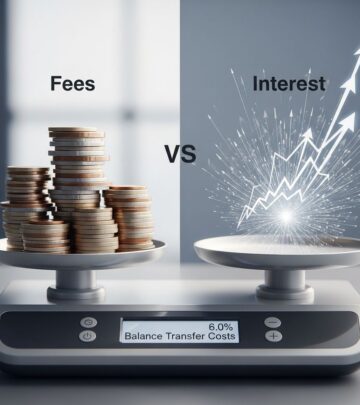
The central question most people ask is whether paying the fee makes financial sense. The answer depends on comparing the fee cost against the interest you’d save over the promotional period.
Break-Even Analysis Framework
Consider a concrete scenario: you’re transferring $10,000 to a card offering 0% APR for 18 months, with a 5% balance transfer fee ($500). Your current card charges 20% APR.
Without the transfer, if you made no payments, you’d accrue approximately $3,000 in interest charges over 18 months ($10,000 × 0.20 × 1.5 years). By transferring, you pay a one-time $500 fee but save approximately $2,500 in interest charges during the 0% period, netting you roughly $2,000 in savings.
This analysis shows that the balance transfer fee was absolutely worth paying. However, this only works if you actually pay down the balance during the promotional period.
Key Considerations in Your Decision
- Length of 0% period: Longer introductory rates give you more time to pay down the balance before interest kicks in
- Your current interest rate: The higher your current APR, the more you stand to save with a lower-rate card
- Your ability to pay: You must be disciplined enough to make consistent payments during the promotional period
- Post-promotional APR: Understand what rate will apply after the introductory period ends
- Your credit score: Your creditworthiness affects both the rates offered and the promotional terms available to you
Comparing Balance Transfer Fees: A Side-by-Side Look
| Card Feature | 3% Fee Card | 4% Fee Card | 5% Fee Card |
|---|---|---|---|
| Balance Transfer Amount | $10,000 | $10,000 | $10,000 |
| Fee Cost | $300 | $400 | $500 |
| New Card Balance | $10,300 | $10,400 | $10,500 |
| Intro 0% APR Period | 12 months | 18 months | 21 months |
| Monthly Payment (even distribution) | $858 | $578 | $500 |
As this table illustrates, while the higher-fee cards require larger upfront payments, they often compensate with longer 0% periods that can make monthly payments more manageable.
Balance Transfer Restrictions and Limitations
Before proceeding with a balance transfer, be aware of several important restrictions that most card issuers enforce.
Primary Limitations
- Same-issuer transfers prohibited: You generally cannot transfer a balance from one card to another card issued by the same company
- Credit limit constraints: The transfer amount plus fee cannot exceed your approved credit limit
- Timing restrictions: Some promotional rates apply only to transfers completed within specific windows
- Balance transfer caps: Some cards may limit balance transfers to a percentage of your credit limit
Strategic Timing for Balance Transfers
The timing of when you apply for and complete a balance transfer can significantly impact your overall cost savings.
Timing Considerations
- Apply before using the card: Complete your balance transfer within the promotional window to qualify for the lowest fees
- Avoid promotional expiration: Track the deadline carefully; missing it means paying the standard fee
- Coordinate with billing cycles: Understand how your transfer timing affects your billing date and payment schedule
- Plan your payments strategically: Aim to pay off the balance well before the 0% period ends to avoid interest charges on the remaining balance
Frequently Asked Questions About Balance Transfer Fees
Can I negotiate my balance transfer fee?
Balance transfer fees are generally set by the card issuer and are not negotiable. However, you can shop around among different cards to find the lowest fee that meets your needs. Some cards offer better promotional rates if you have excellent credit.
Is there a maximum balance transfer fee?
While there’s no regulatory maximum, the industry standard caps out around 5% for most cards. Anything beyond this is extremely rare and would only appear on specialty or high-risk cards.
What happens if I can’t pay off the balance during the 0% period?
When the promotional period ends, the regular APR applies to any remaining balance. This is why it’s crucial to understand the post-promotional rate before you transfer. You could find yourself paying significant interest on what’s left.
Are there truly zero-fee balance transfer cards?
Yes, but they’re uncommon and often come with trade-offs. Credit unions occasionally offer cards with no balance transfer fees, but membership requirements are often strict, and the 0% promotional periods may be shorter.
How does a balance transfer affect my credit score?
A balance transfer involves a hard inquiry and a new account, which temporarily lowers your score. However, if you reduce your credit utilization (by paying down the transferred balance), your score may recover and eventually improve.
Making Your Balance Transfer Decision
Before committing to a balance transfer, gather the following information about your current card and potential new cards:
- Your current card’s APR and total interest charges
- The new card’s balance transfer fee and 0% promotional period length
- The APR that will apply after the promotional period ends
- Your ability to make monthly payments toward the balance
- Any other rewards or benefits the new card offers
Once you’ve assembled this information, calculate whether the interest savings during the promotional period exceed the balance transfer fee. If the answer is yes, and you’re confident you can pay down the balance during the 0% period, a balance transfer may be an excellent strategy for managing your debt more efficiently.
References
- What Is a Balance Transfer Fee and How Does It Work? — LendingTree. 2024. https://www.lendingtree.com/credit-cards/articles/what-is-balance-transfer-fee/
- What Is a Balance Transfer Fee on a Credit Card? — NerdWallet. 2024. https://www.nerdwallet.com/credit-cards/learn/what-is-a-balance-transfer-fee-on-a-credit-card
- What Is a Balance Transfer Fee and How Does It Work? — Credit Karma. 2024. https://www.creditkarma.com/credit-cards/i/what-is-a-balance-transfer-fee
Similar Articles








Read full bio of medha deb