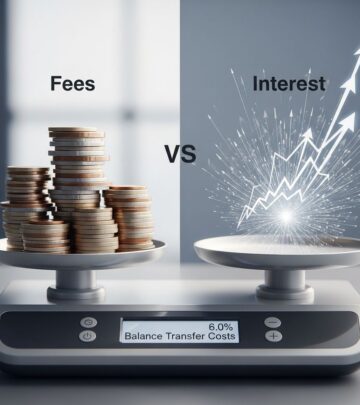
Balance Transfer Fees: Crunching the Numbers
Discover if paying a balance transfer fee saves you money on credit card debt with real calculations and expert insights.

Transferring credit card balances to a new card with a promotional 0% introductory APR can slash interest costs, but issuers often tack on a fee of 3% to 5% of the transferred amount. This upfront charge raises a key question: does the fee justify the potential savings?
Understanding the Mechanics of Balance Transfer Fees
These fees compensate issuers for the risk and processing involved in moving debt from one account to another. When you initiate a transfer, the fee—calculated as a percentage of the balance or a minimum dollar amount—is added directly to your new card’s balance. For instance, shifting $10,000 at 3% results in a $300 fee, making your starting balance $10,300.
Issuers set these rates in the card agreement’s fine print, with common ranges from 3% to 5%, though minimums like $5 or $10 apply to smaller transfers. Credit limits factor in too; the fee counts toward utilization, potentially limiting how much you can move.
- Fee calculation: Percentage of transferred amount or minimum charge, whichever is higher.
- Timing matters: Some cards waive fees for transfers within 60-120 days of account opening.
- No separate payment: The fee integrates into the new balance for gradual repayment.
Typical Costs and Variations Across Cards
Most major issuers stick to 3%-5% fees, but options exist at the edges. Credit unions occasionally offer fee-free transfers, though membership hurdles like geographic or employment ties apply. Standard cards from banks rarely waive them entirely, prioritizing promotional APRs instead.
| Transfer Amount | 3% Fee | 5% Fee |
|---|---|---|
| $1,000 | $30 (min $5-$10) | $50 |
| $5,000 | $150 | $250 |
| $10,000 | $300 | $500 |
| $20,000 | $600 | $1,000 |
This table illustrates how fees scale, emphasizing why larger debts amplify both costs and savings potential.
Step-by-Step Math: Is the Fee Worth Paying?
To evaluate, compare the fee against interest avoided. Assume a $5,000 balance at 20% APR on your old card versus a 0% intro APR for 18 months on the new one.
Monthly interest on old card: ($5,000 × 0.20) / 12 ≈ $83. Minimum payments barely dent principal, accruing over $1,500 in interest over 18 months if paying $300 monthly.
With transfer: Pay $150 fee (3%), new balance $5,150. At $300 monthly, payoff in ~17 months saves ~$1,350 net ($1,500 – $150). Tools like online calculators refine this by inputting your exact APR, balance, and promo period.
- Estimate old card interest: Balance × APR × (promo months / 12).
- Add projected payments to see principal reduction.
- Subtract fee from savings; positive result means it’s worthwhile.
Real-World Examples of Savings and Pitfalls
Consider $4,000 at 22% APR transferred with 5% fee ($200). Over 21 months at 0% APR with $200 payments, total interest saved exceeds $1,800, netting $1,600 gain. But if payoff stretches beyond promo (e.g., regular APR 18%), residual interest erodes benefits.
Pitfalls include:
- High utilization post-fee, hurting credit scores temporarily.
- Missing promo window, triggering full APR immediately.
- Multiple transfers compounding fees without proportional savings.
Factors Influencing Whether Fees Pay Off
Your situation dictates value. High existing APRs (18%-25%) and long promo periods (15-21 months) favor transfers. Short-term debt or low rates? Skip it. Credit score impacts eligibility; prime scores (670+) unlock best offers.
Other variables:
- Payment discipline: Automate to ensure full payoff pre-promo end.
- Multiple cards: Fees per transfer add up; prioritize highest-interest first.
- Credit limit: Ensure room post-fee.
Strategies to Minimize or Avoid Fees
Hunt for low-fee cards (under 3%) or intro waivers. Credit unions provide fee-free options with eligibility workarounds like family memberships. Balance check: Transfer only what you can repay in the promo window—aim for 0% utilization post-payoff.
Alternatives include personal loans at fixed low rates or debt management plans via nonprofits, bypassing fees altogether but potentially closing accounts.
Long-Term Debt Management Beyond Transfers
Transfers buy time, not solutions. Pair with budgets cutting expenses 20%-30%, boosting payments. Track via apps integrating statements and goals. Post-promo, refinance if rates drop or scores rise.
Build emergency funds (3-6 months expenses) to avoid new debt cycles. Credit counseling from accredited agencies offers free plans negotiating lower rates without transfers.
Common Myths About Balance Transfers
Myth 1: Fees always outweigh savings. Reality: Math shows otherwise for most high-interest debts.
Myth 2: 0% APR means free money. Reality: Fee and post-promo APR apply; discipline required.
Myth 3: Anyone qualifies. Reality: Good credit needed for best terms.
Frequently Asked Questions
What is the average balance transfer fee?
Typically 3%-5% of the amount, with $5-$10 minimums.
Can I avoid balance transfer fees?
Yes, via credit unions or rare promo waivers, but options are limited.
How soon must I transfer to get 0% APR?
Often within 60-120 days; check terms.
Does the fee affect my credit score?
Temporarily via utilization spike and hard inquiry.
What if I don’t pay off before promo ends?
Regular APR (15%-25%) applies to remaining balance.
Final Considerations for Smart Transfers
Weigh fees against interest meticulously. For debts over $2,000 at 18%+ APR with 12+ month promos, transfers often net savings. Simulate scenarios, read terms, and align with repayment plans for optimal results.
References
- What Is A Balance Transfer Fee? — Bankrate. 2024-10-01. https://www.bankrate.com/credit-cards/balance-transfer/what-is-a-balance-transfer-fee/
- What Is a Balance Transfer Fee and How Does It Work? — Credit Karma. 2024-09-15. https://www.creditkarma.com/credit-cards/i/what-is-a-balance-transfer-fee
- What Is a Balance Transfer Fee? — Experian. 2024-11-20. https://www.experian.com/blogs/ask-experian/what-is-a-balance-transfer-fee/
- What is a Balance Transfer on a Credit Card? — U.S. Bank. 2025-02-10. https://www.usbank.com/credit-cards/credit-card-insider/managing-credit/what-is-balance-transfer.html
- What is a Balance Transfer on a Credit Card? — Equifax. 2024-08-05. https://www.equifax.com/personal/education/credit-cards/articles/-/learn/balance-transfer-credit-card/
- What is a balance transfer fee? Can a balance transfer fee be charged on a zero-percent interest rate offer? — Consumer Financial Protection Bureau. 2023-05-12. https://www.consumerfinance.gov/ask-cfpb/what-is-a-balance-transfer-fee-can-a-balance-transfer-fee-be-charged-on-a-zero-percent-interest-rate-offer-en-53/
Similar Articles








Read full bio of Sneha Tete