Fees vs. Interest: Balance Transfer Costs Compared
Discover whether balance transfer fees or ongoing interest charges hit your wallet harder, and learn strategies to minimize debt repayment expenses.
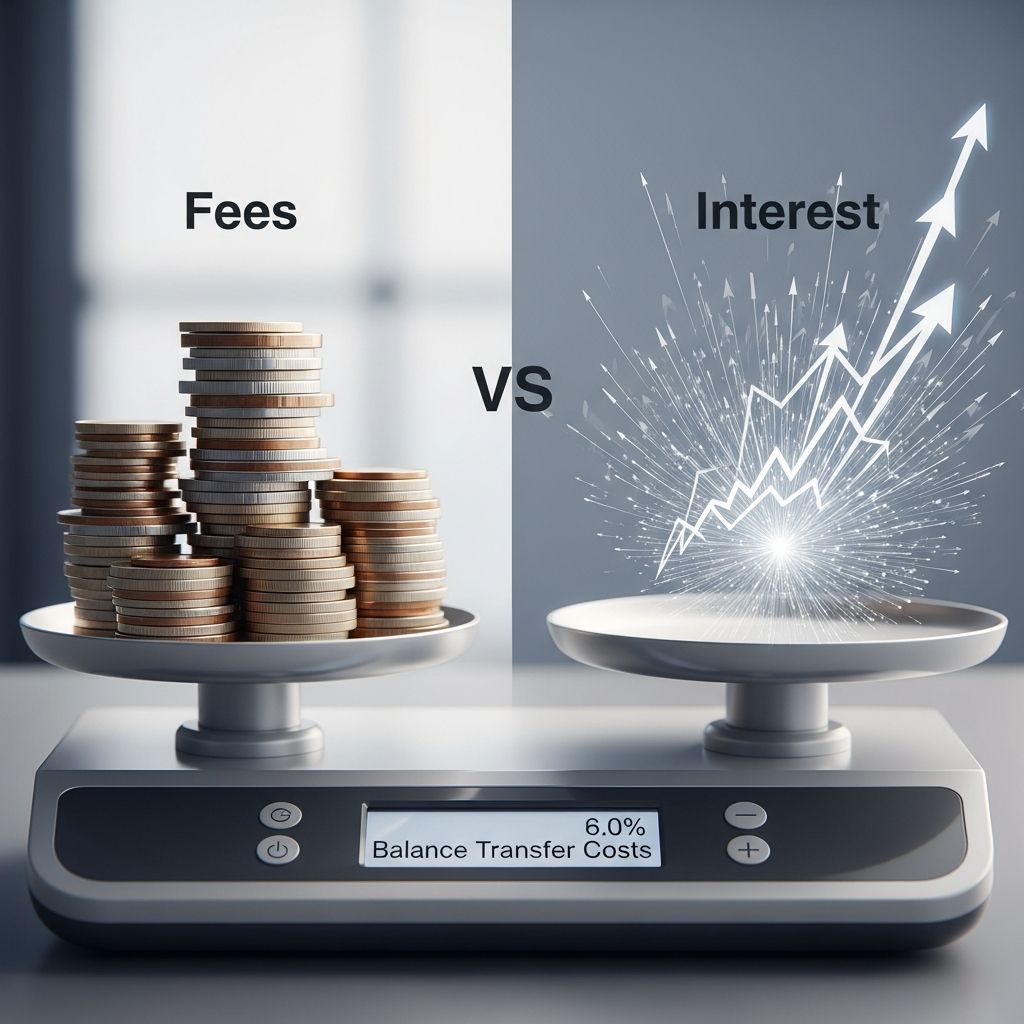
Balance transfers offer a pathway to manage credit card debt more effectively by moving balances to cards with promotional low or zero interest rates. However, these moves come with upfront costs in the form of fees, prompting many to wonder if the initial expense outweighs the savings from reduced interest. This analysis breaks down the mechanics of balance transfer fees versus traditional interest charges, providing tools to evaluate your specific situation.
Understanding Balance Transfer Fees
A balance transfer fee is a one-time charge imposed by the new credit card issuer when you shift debt from one account to another. These fees compensate the issuer for the administrative work and risk involved in acquiring the debt. Typically calculated as a percentage of the transferred amount, they range from 3% to 5%, though some offers include minimum charges of $5 to $10.
For instance, transferring $5,000 at a 3% fee adds $150 to your new balance, making it $5,150. This fee is not paid separately but folds into the total balance on the receiving card, which must fit within your available credit limit. Credit unions occasionally provide fee-free options, but these often require membership and may have restrictive terms.
- Standard rates: 3%-5% of transfer amount
- Minimums: Often $5-$10, affecting small transfers disproportionately
- Timing matters: Some cards waive fees if completed within 60-120 days of account opening
The Nature of Credit Card Interest Charges
Unlike the one-off balance transfer fee, interest accrues daily on unpaid balances at the card’s annual percentage rate (APR). Average credit card APRs hover around 20%-25%, compounding the debt rapidly if minimum payments are made. This ongoing cost can dwarf upfront fees over months or years.
Interest is calculated on the average daily balance, meaning even small unpaid portions generate charges. For a $5,000 balance at 24% APR, daily interest is roughly $3.29 ($5,000 x 0.24 / 365), totaling over $1,200 annually if unpaid.
| Balance | APR | Monthly Interest (Min Payment) | Annual Cost |
|---|---|---|---|
| $5,000 | 24% | $100 | $1,200 |
| $10,000 | 20% | $167 | $2,000 |
| $2,000 | 25% | $42 | $500 |
This table illustrates how interest escalates with balance size and rate, far exceeding typical transfer fees.
Direct Cost Comparison: Fee Now or Interest Later?
To determine which costs more, calculate total expenses over the promotional period. Balance transfer cards often feature 0% intro APR for 12-21 months, allowing interest-free payoff if completed timely. The fee is the primary hurdle, but avoiding high interest can yield net savings.
Example Scenario 1: $10,000 balance at 22% APR. Monthly interest: ~$183. Over 12 months with minimum payments (2% of balance), interest exceeds $1,500. A 3% transfer fee ($300) to a 15-month 0% card saves ~$1,200 net, assuming full payoff.
Example Scenario 2: Small $500 transfer at 5% fee ($25). If original APR is 18% and promo lasts 12 months, interest saved (~$45) barely covers the fee. Here, interest might cost less if payoff is swift without transfer.
- High balances (>$5,000): Fees usually cheaper than interest
- Short promo periods: Weigh fee against interest savings closely
- Post-promo: Standard APR applies, potentially 18%-29%
Factors Influencing Your Decision
Several variables tip the scales. Credit score affects eligibility for low-fee, long-promo cards—scores above 670 secure best offers. Transfer limits may cap at 80% of new credit line, and multiple transfers multiply fees.
Promo expiration is critical: Unpaid balances revert to high APRs, sometimes higher than original. U.S. Bank notes comparing expected interest savings against fees is essential. Consumer Financial Protection Bureau confirms fees apply even on 0% offers.
Strategies to Minimize Total Costs
Shop for cards with low fees (under 3%) and extended 0% periods. Credit Karma highlights rare $0 fee cards, often time-limited. Pay more than minimums to clear debt pre-promo end.
- Calculate break-even: Fee / (Original APR – New APR) x 12 = months to recoup
- Avoid new purchases: They accrue interest immediately, unlike transfers
- Negotiate waivers: Some issuers drop fees for excellent credit
- Bundle transfers: Combine debts to meet minimums efficiently
Tools like online calculators from Experian help simulate outcomes.
Real-World Case Studies
Consider Jane with $8,000 debt at 23% APR. Monthly interest: $153. Transfer to 3% fee card ($240) with 18-month 0% saves $2,500+ if paid off in 12 months. Mike’s $1,200 balance at 5% fee ($60) vs. 20% interest ($20/month): Net loss if not aggressive on payments.
Equifax warns high fees can erode savings for subprime scores. Success hinges on discipline and planning.
Common Pitfalls to Avoid
Don’t transfer to the same issuer—fees apply without promo benefits. Watch credit utilization spikes from fees, impacting scores temporarily. Ignore cash advance traps: Higher fees (5%+), no grace period.
- Trap 1: Minimum payments extend debt life
- Trap 2: Forgetting post-promo rates
- Trap 3: Small transfers where min fees dominate
Alternatives to Balance Transfers
If fees seem steep, consider personal loans (fixed rates 6%-36%), debt management plans via nonprofits, or 0% purchase cards. Home equity lines offer low rates but risk assets.
| Option | Cost | Pros | Cons |
|---|---|---|---|
| Balance Transfer | 3-5% fee | 0% intro APR | Time-limited |
| Personal Loan | 6-12% APR | Fixed term | Credit check |
| Debt Consolidation | Varies | Negotiated rates | Agency fees |
Frequently Asked Questions
What is a typical balance transfer fee?
Usually 3% to 5% of the amount transferred, with $5-$10 minimums.
Can I avoid balance transfer fees?
Yes, some credit unions or promo offers waive them, but options are limited.
Is a 5% fee worth it?
Compare to interest savings; worthwhile for large balances and long promos.
Does the fee count toward my credit limit?
Yes, it adds to the transferred balance.
What happens after the 0% period?
Balance shifts to standard APR, often high.
Key Takeaways for Smarter Debt Management
Balance transfer fees are upfront costs that pale against prolonged interest for most. Prioritize long promos, low fees, and aggressive repayment. Always run numbers: Savings = (Interest avoided) – Fee.
References
- What Is A Balance Transfer Fee? — Bankrate. 2023-10-15. https://www.bankrate.com/credit-cards/balance-transfer/what-is-a-balance-transfer-fee/
- What Is a Balance Transfer Fee and How Does It Work? — Credit Karma. 2024-02-20. https://www.creditkarma.com/credit-cards/i/what-is-a-balance-transfer-fee
- What Is a Balance Transfer Fee? — Experian. 2024-01-10. https://www.experian.com/blogs/ask-experian/what-is-a-balance-transfer-fee/
- What is a Balance Transfer on a Credit Card? — U.S. Bank. 2023-11-05. https://www.usbank.com/credit-cards/credit-card-insider/managing-credit/what-is-balance-transfer.html
- What is a Balance Transfer on a Credit Card? — Equifax. 2024-03-12. https://www.equifax.com/personal/education/credit-cards/articles/-/learn/balance-transfer-credit-card/
- What is a balance transfer fee? Can a balance transfer fee be charged on a zero percent interest rate offer? — Consumer Financial Protection Bureau. 2022-06-01. https://www.consumerfinance.gov/ask-cfpb/what-is-a-balance-transfer-fee-can-a-balance-transfer-fee-be-charged-on-a-zero-percent-interest-rate-offer-en-53/
Similar Articles








Read full bio of Sneha Tete