Average Vs. Median Net Worth: Key Insights For 2025
Understand the key differences between average and median net worth, why median gives a truer picture of financial health, and how to calculate and improve yours.

The distinction between average net worth and median net worth is crucial for understanding true financial standing in America. While the average is heavily skewed by ultra-wealthy households, the median provides a realistic benchmark for the typical household, revealing that half of U.S. households have a net worth below approximately $193,000 as of recent 2022-2025 data.
What Is Net Worth?
Net worth represents a household’s financial health by subtracting total liabilities from total assets. Assets include cash in savings and checking accounts, investments like retirement accounts (e.g., 401(k)s, IRAs), home equity, vehicle values, and other valuables such as stocks or real estate. Liabilities encompass mortgages, credit card debt, student loans, auto loans, and personal loans.
Calculating net worth is straightforward: list all assets, sum them, list all debts, subtract debts from assets. For example, a household with $300,000 in home equity, $100,000 in retirement savings, $20,000 in deposit accounts, minus $150,000 mortgage and $30,000 auto loan has a net worth of $240,000. Regularly tracking this metric helps monitor progress toward goals like retirement or debt freedom.
Average vs. Median: Why the Difference Matters
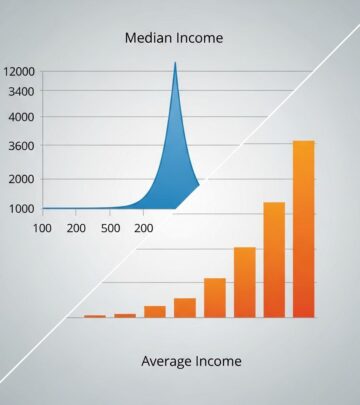
The average net worth (mean) sums all households’ net worth and divides by the number of households, making it vulnerable to outliers like billionaires. In contrast, the median net worth is the middle value when all net worths are ordered, better reflecting the typical American since it ignores extremes.
For instance, U.S. average net worth ranks high globally at around $551,350 per Credit Suisse data, but median lags at $107,740, highlighting wealth inequality. In 2022 Federal Reserve data, median household net worth was $192,700, while average soared to $1.06 million due to high-net-worth individuals. This gap underscores why median is the preferred metric for personal finance benchmarking.
| Metric | U.S. Average | U.S. Median | Source Year |
|---|---|---|---|
| All Households | $1.06M | $192,700 | 2022 |
| Global Ranking (Avg) | #2 ($551K) | – | Recent |
| Global Ranking (Med) | – | #13 ($107K) | Recent |
Average and Median Net Worth by Age
Net worth typically rises with age as earnings peak, debts pay down, and assets like homes appreciate. Younger Americans start low due to student debt and entry-level savings, while those nearing retirement hold peaks before drawdowns.
According to 2022 Federal Reserve Survey of Consumer Finances data analyzed by Harness Wealth, median net worth progresses as follows:
- Under 35: Median $39,000 (average higher due to early investors).
- 35-44: Median $135,600, boosted by homeownership.
- 45-54: Median $247,200, with retirement savings growth.
- 55-64: Median $365,000 peak accumulation.
- 65-74: Median $410,000.
- 75+: Median $335,600, as assets convert to income.
Empower’s 2025 anonymized data shows similar trends but higher averages from user dashboards:
| Age Group | Average Net Worth | Median Net Worth |
|---|---|---|
| 20s | $127,730 | $6,689 |
| 30s | $321,549 | $24,508 |
| 40s | $770,892 | $76,479 |
| 50s | $1,369,809 | $192,964 |
| 60s | $1,576,784 | $290,920 |
| 70s | $1,462,121 | $232,712 |
Money Guy’s medians align: 20-29 ($25,788), 30-39 ($91,181), up to 60-69 ($384,849). These figures emphasize compounding: starting early with 10-15% savings rate can double net worth every 7-10 years via investments.
Net Worth by State
Wealth varies dramatically by state due to housing costs, job markets, and homeownership rates. SmartAsset’s 2025 study pegs national median household net worth at $187,690, with 60% of households over $100,000 and 29% over $500,000.
Hawaii leads at $502,563 median, driven by high home equity ($531,700) and retirement savings ($159,510). Low-homeownership states like New York lag, with only 49.6% having equity.
Top states include:
- Hawaii: $502,563 (retirement: $159,510; deposits: $43,599).
- Washington: $398,881 (home equity: $376,444).
- Massachusetts: $327,953 (retirement: $152,066).
- Maine: $326,570 (80% homeownership, equity $212,680).
- Utah: $324,975.
- Maryland: $323,912.
- California: $295,838 (high equity $531,700 despite costs).
- New Jersey: $284,672.
- Montana: $273,187.
These disparities reflect real estate dominance in net worth (often 50-70%), urging renters to prioritize savings.
How to Calculate Your Net Worth
To compute yours:
- Gather assets: Bank balances, investment values (via statements), home/vehicle appraisals (Zillow/KBB tools), other (jewelry, etc.).
- List liabilities: All debts from credit reports/statements.
- Subtract: Assets – Liabilities = Net Worth.
- Track quarterly: Use apps like Personal Capital or spreadsheets.
Aim to increase 10-20% yearly through debt reduction, saving 20% income, and investing in low-fee index funds.
Strategies to Increase Your Net Worth
Building wealth requires discipline:
- Max retirement accounts: Contribute to 401(k) matches (free money), IRAs for tax advantages.
- Pay down high-interest debt: Credit cards first (avg 20% APR).
- Invest consistently: S&P 500 averages 10% annual returns historically.
- Boost income: Side hustles, career advancement.
- Live below means: 50/30/20 budget (needs/wants/savings).
- Buy home wisely: Equity builds fastest wealth component.
Avoid lifestyle inflation; automate transfers. Families in low-equity states should focus on liquid savings.
Frequently Asked Questions
What is a good net worth by age?
A ‘good’ net worth matches or exceeds medians: $25K in 20s, $135K by 40s, $365K by 60s. Percentiles help: top 50% beats median.
Why use median over average net worth?
Median resists skew from billionaires; e.g., U.S. median $193K vs. average $1M+ provides realistic benchmarks.
How does home equity affect net worth by state?
Heavily: Maine’s 80% ownership yields high medians; New York’s 50% drags it down.
Can net worth go backwards?
Yes, via market crashes, job loss, or medical debt, but recovery via budgeting/investing is common.
What net worth for retirement?
Rule: 25x annual expenses (e.g., $50K spending needs $1.25M). Adjust for Social Security.
References
- Household Net Worth is Highest in These States – 2025 Study — SmartAsset. 2025. https://smartasset.com/data-studies/net-worth-states-2025
- What Net Worth by State Really Tells Us — UNest. 2025-08-08. https://unest.co/what-net-worth-by-state-really-tells-us-and-why-it-shouldnt-define-your-familys-financial-future/
- Average Net Worth By Age – How Americans Stack Up — Money Guy. Recent. https://moneyguy.com/guide/net-worth-by-age/
- The Net Worth It Takes to Be Richer Than Most People You Know — Business Insider. 2025. https://www.businessinsider.com/net-worth-data-american-wealth-age-2025-4
- The average net worth by age in America — Empower. 2025-12-09. https://www.empower.com/the-currency/life/average-net-worth-by-age
- Average Net Worth by Age: How Do You Measure Up? — Kiplinger. 2025. https://www.kiplinger.com/retirement/average-net-worth-by-age-how-do-you-measure-up
Similar Articles








Read full bio of Sneha Tete