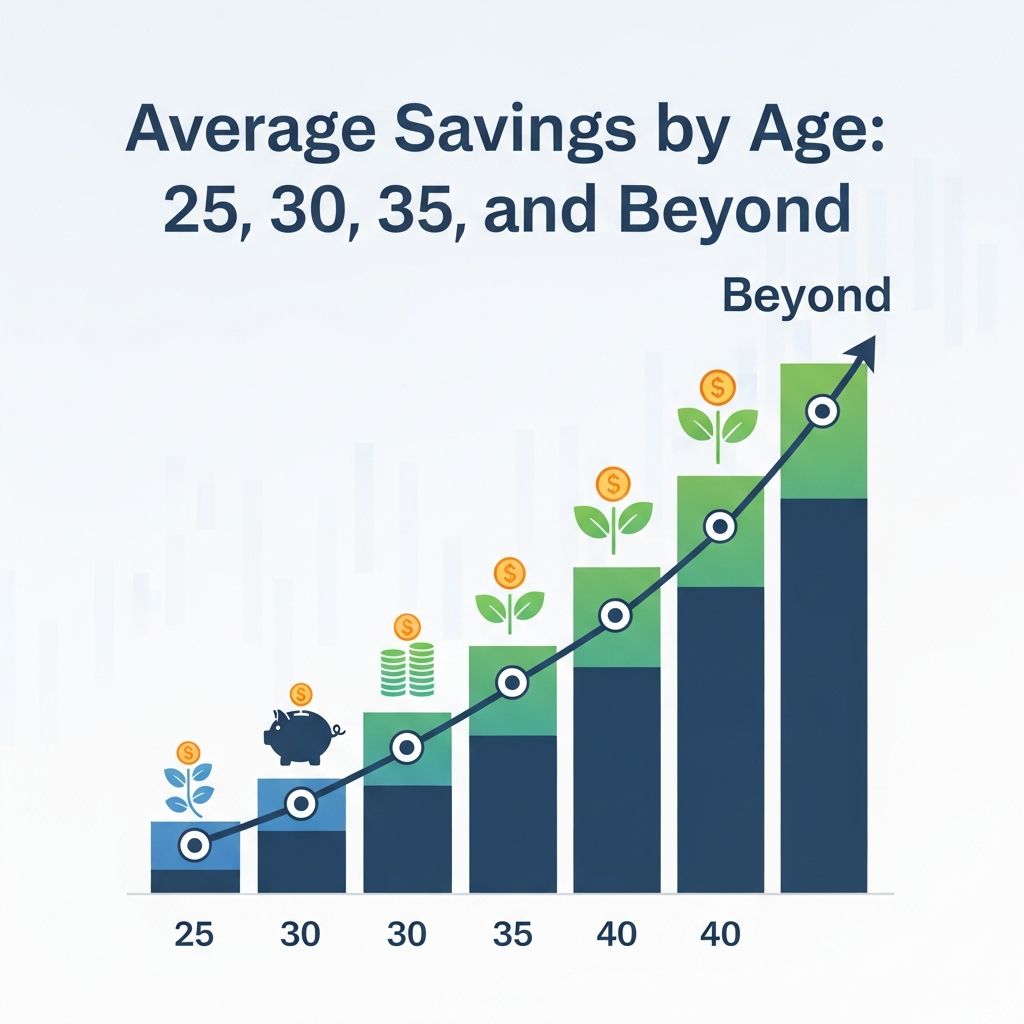
Average Savings by Age: 25, 30, 35, 40 and Beyond
Learn how much you should aim to have saved at every age and how to start catching up, no matter where you are right now.
Savings can feel confusing when you have no idea whether you are “on track” for your age. This guide walks through average savings by age, suggested savings targets, and realistic strategies to grow your money whether you are just starting or catching up later in life.
Using data from the Federal Reserve’s Survey of Consumer Finances, the typical American has tens of thousands of dollars in total savings and investments, with balances rising steadily with age. At the same time, many people save less than they think they should, especially for retirement. The goal of this article is not to make you feel behind, but to give you clear benchmarks and action steps.
Why Saving At Any Age Is Important
Saving money is about more than just building a big number in a bank account. It is the foundation of financial security, flexibility, and independence. Even small amounts saved consistently can compound into significant wealth over decades.
According to recent Federal Reserve data, the average U.S. household holds about $62,410 in savings across cash and investment accounts, though this varies widely by age and income. Many households also feel unprepared for emergencies and retirement, which is why saving steadily matters at every life stage.
Key reasons saving is crucial at any age include:
- Emergency protection: Cash savings help cover medical bills, car repairs, or job loss without going into high-interest debt.
- Retirement security: Social Security replaces only a portion of your income, so personal savings and investments are critical to maintaining your standard of living.
- Life choices: Savings give you options—changing careers, starting a business, taking time off, or moving cities—without financial panic.
- Compounding: The earlier you start, the more time your money has to grow through investment returns.
Average Savings By Age: How Much Do People Have?
The Federal Reserve publishes detailed statistics on American household finances. One way to look at savings is by average liquid financial assets: money in bank accounts, brokerage accounts, and other easily accessible investments.
Below is an illustrative table, loosely based on recent Federal Reserve survey data and other major analyses of U.S. household savings by age. These figures focus on total savings and investments, not just checking or basic savings accounts.
| Age Range | Approx. Average Financial Assets | What This Usually Includes |
|---|---|---|
| Under 35 | ~$30,000–$35,000 | Cash savings, starter retirement accounts, small brokerage balances |
| 35–44 | ~$150,000–$180,000 | Larger emergency funds, 401(k)/IRA balances, taxable investments |
| 45–54 | ~$350,000–$380,000 | Growing retirement accounts and other long-term investments |
| 55–64 | ~$550,000–$600,000 | Peak earning and saving years ahead of retirement |
| 65 and older | ~$100,000+ in liquid savings on average, often plus retirement accounts | Drawdown phase, combining savings, investments, and Social Security |
These averages can be skewed upward by very wealthy households. Many people have far less, which is why looking at targets based on your own income can be more helpful than comparing yourself only to the national average.
How Much Should You Have Saved By Age?
Instead of focusing only on what others have saved, many financial planners use income-based savings multiples. Fidelity Investments, for example, suggests aiming for certain multiples of your annual salary at key ages to stay on track for retirement.
Here is a simplified version of commonly cited retirement savings targets:
- By age 30: about 1× your annual salary saved.
- By age 40: about 3× your salary saved.
- By age 50: about 6× your salary saved.
- By age 60: about 8× your salary saved.
- By age 67: about 10× your salary saved, if you plan to retire around that age.
These are general guidelines, not strict rules. Your ideal savings target depends on when you plan to retire, your lifestyle, other sources of income, and health care needs.
Age 25: Just Getting Started With Savings
In your early to mid-20s, you may be finishing school, starting a career, or paying off debt. Many people at this age are just beginning to build savings.
Data from the Federal Reserve indicate that households under 35 often have relatively modest savings compared with older groups, but they also have the greatest time horizon for growth.
By around age 25, helpful milestones include:
- Building a starter emergency fund of at least one month of expenses, working up to three to six months over time.
- Contributing enough to a workplace retirement plan to earn the full employer match, if available.
- Opening a Roth IRA or traditional IRA if you do not have a retirement plan at work.
Even if your balance is only a few thousand dollars, the habit of saving a portion of each paycheck is what matters most at this stage.
How Much Should You Have Saved By 30?
By age 30, a widely used guideline is to aim for at least one year’s salary saved for retirement across accounts like 401(k)s, IRAs, and similar plans.
For example:
- If your salary is $50,000, a target might be $50,000 in combined retirement savings by 30.
- If your salary is $70,000, the target would be about $70,000.
In reality, many under-35 households have far less than this benchmark, especially once you look beyond high earners. Student loans, housing costs, and childcare can all squeeze your budget. If you are below the 1× target, focus on:
- Increasing your savings rate by 1–2 percentage points at a time.
- Directing windfalls (bonuses, tax refunds) into savings or investments.
- Automating contributions so saving happens before you spend.
How Much Should You Have Saved By 35?
By your mid-30s, your income may have grown, and you might be juggling multiple priorities—family, housing, retirement, and debt. According to Federal Reserve data, households in the 35–44 age range typically have substantially more financial assets than younger groups, reflecting these years as prime building years.
Rule-of-thumb targets by the mid-30s include:
- Aiming for around 2× your annual salary saved for retirement, although some guidelines focus more on the age-40 3× target.
- Maintaining a robust emergency fund of at least three to six months of essential expenses.
- Paying down high-interest consumer debt to free up cash flow for savings.
If your savings are well below these levels, it is not too late. Your 30s are often an ideal time to increase your savings rate as your career advances.
How Much Should You Have Saved By 40?
By age 40, many experts recommend targeting about 3× your annual salary in retirement savings. These years are critical for taking advantage of compounding before retirement comes into clear view.
For instance:
- If you earn $80,000, a general goal by 40 would be around $240,000 saved for retirement.
- If you earn $100,000, a target might be around $300,000.
The Federal Reserve’s data suggest that average financial assets for the 35–44 and 45–54 age brackets rise significantly, indicating many households ramp up their saving in these decades. Even so, a substantial portion of the population saves less than these benchmarks, so you are not alone if you are behind.
How Much Should You Save By 50?
In your 50s, you are often in your peak earning years. Fidelity recommends having about 6× your annual salary saved by age 50. Federal Reserve statistics show that households aged 45–54 hold several hundred thousand dollars on average in financial assets, reflecting this build-up.
By this stage, it is helpful to:
- Take advantage of catch-up contributions to retirement accounts if you are 50 or older, which allow you to contribute extra beyond standard limits.
- Reassess your investment allocation to balance growth with risk as retirement approaches.
- Review major expenses like college costs, mortgages, and healthcare to ensure they fit your long-term plan.
Even if you are below the 6× target, increasing your savings rate during your 50s can make a large impact before retirement.
How Much Should You Have Saved By 60?
By age 60, many planning frameworks suggest aiming for about 8× your annual salary in retirement savings, on the way to roughly 10× by your late 60s.
Federal Reserve data show that Americans aged 55–64 have, on average, over half a million dollars in financial assets, though the distribution is highly uneven. Many households have less, which can create pressure to work longer, reduce expenses, or adjust retirement expectations.
At this stage it is critical to:
- Estimate your expected Social Security benefits using official tools.
- Create a realistic retirement budget that includes healthcare and potential long-term care needs.
- Consider whether to delay retirement to give savings more time to grow and increase Social Security benefits.
Strategies To Grow Your Savings At Any Age
Regardless of where you are compared with the averages or targets, you can improve your situation by combining small, consistent habits with smarter use of financial tools.
1. Build And Maintain An Emergency Fund
An emergency fund is a cash cushion—typically three to six months of essential living expenses—kept in a liquid account such as a savings or money market account. This fund protects you from unexpected shocks and keeps you from relying on high-interest debt.
- Start with a goal of $500–$1,000 if you are new to saving.
- Gradually increase to one month, then three months of expenses.
- Keep it separate from your checking account to avoid temptation.
2. Automate Your Savings
Automation is one of the easiest ways to make saving consistent. Many employers and banks allow you to direct a portion of each paycheck straight into savings or investment accounts.
- Set a percentage-based transfer (for example, 10% of each paycheck).
- Increase your contribution whenever you get a raise.
- Automate contributions to retirement accounts so you never see the money in your checking account.
3. Take Full Advantage Of Employer Retirement Plans
If your employer offers a 401(k), 403(b), or similar plan with a match, that match is effectively free money. Fidelity recommends at least contributing enough to capture the full match as a baseline.
- Contribute at least the minimum required to maximize the employer match.
- Consider increasing your contribution rate by 1% each year until you reach your target savings rate.
- Use age-appropriate investments, such as target-date funds, if you prefer a simplified option.
4. Invest For The Long Term
Savings accounts are important for safety and liquidity, but long-term goals like retirement typically require investing to outpace inflation. Over long periods, diversified stock portfolios have historically earned higher returns than cash or bonds.
- For goals more than 10 years away, consider a higher allocation to stocks through low-cost index funds or target-date funds.
- For shorter-term goals (under five years), prioritize safety and liquidity over growth.
- Review your investments periodically to maintain a balance between risk and return as you age.
5. Increase Income And Control Expenses
Your savings rate is driven by the gap between what you earn and what you spend. You can enlarge this gap by:
- Negotiating raises or seeking higher-paying roles as your skills grow.
- Building side income streams where feasible.
- Reducing large recurring costs, such as housing, transportation, and subscriptions.
Even a modest increase in savings, sustained over years, can significantly change your financial trajectory due to compounding.
Frequently Asked Questions (FAQs)
Q: How much does the average person have in savings?
A: According to recent Federal Reserve data, the average American household has around $62,410 in savings across deposit and investment accounts, though this figure varies by age and income and can be skewed by high-net-worth households.
Q: What is a reasonable savings rate?
A: Many financial planners suggest saving at least 10%–15% of your gross income for long-term goals such as retirement, in addition to building and maintaining an emergency fund. If you start later in life, you may need a higher rate to reach similar targets.
Q: I’m behind on the recommended savings for my age. What should I do?
A: Being behind is common, and you still have options. Focus on increasing your savings rate gradually, boosting income, controlling major expenses, and investing appropriately for your time horizon. If you are closer to retirement, you may also consider delaying retirement, downsizing expenses, or using catch-up contributions.
Q: Should I pay off debt or save first?
A: A balanced approach often works best. Many experts recommend building a small emergency fund first, then aggressively paying down high-interest debt (like credit cards) while continuing at least minimal retirement contributions, especially if you receive an employer match.
Q: Do I need to hit every savings multiple exactly?
A: No. Savings multiples (like 1× salary by 30 or 6× by 50) are guidelines, not strict requirements. They help you estimate whether you are roughly on pace for your goals, but your ideal number depends on your lifestyle, retirement age, location, health, and other income sources.
References
- Survey of Consumer Finances (SCF) — Board of Governors of the Federal Reserve System. 2023-10-18. https://www.federalreserve.gov/scfindex.htm
- Average Savings by Age: How Much to Save in Your 20s, 30s, 40s & Beyond — Ally Bank. 2024-02-01. https://www.ally.com/stories/save/savings-by-age-how-much-to-save-in-your-20s-30s-40s-and-beyond/
- Average Retirement Savings by Age — Fidelity Investments. 2025-02-14. https://www.fidelity.com/learning-center/personal-finance/average-retirement-savings
- Guide to the Average Savings in America by Age — WSOC / Cox Media Group, summarizing Federal Reserve data. 2023-09-29. https://www.wsoctv.com/news/guide-average-savings-america-by-age/RWCPP3GLUZPI7ODJLIATVNPEPU/
- Retirement Benefits — Social Security Administration. 2024-05-01. https://www.ssa.gov/benefits/retirement/
Similar Articles








Read full bio of medha deb