Average Monthly Car Payment: 5 Strategies To Lower Yours
Discover current averages for new and used car payments, key factors influencing costs, and strategies to manage your budget effectively in today's market.

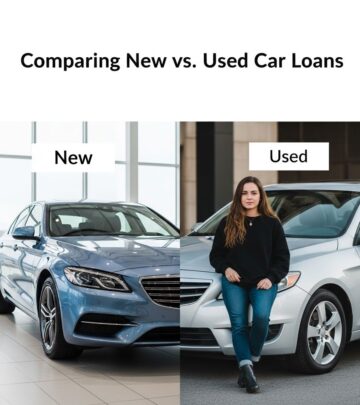
In the evolving landscape of vehicle financing, grasping the typical monthly car payment is essential for informed purchasing decisions. Recent data from Q3 2025 reveals an average of $748 for new cars and $532 for used ones, reflecting rising vehicle prices and interest rates.
Current National Averages for Vehicle Financing
Average payments have climbed steadily, with new vehicle loans hitting near-record levels. For new cars, the figure stands at $748 monthly, up 1.8% from the prior year, while used cars average $532, a 1.5% increase. Lease payments for new vehicles average $596, showing a 1.9% rise.
These figures stem from comprehensive analyses by Experian, capturing trends across millions of loans. Edmunds reports even higher peaks, with new car payments reaching $772 in Q4 2025 and used at $570.
| Vehicle Type | Average Monthly Payment (Q3 2025) | Year-over-Year Change |
|---|---|---|
| New Vehicles | $748 | +1.8% ($13) |
| Used Vehicles | $532 | +1.5% ($8) |
| New Leases | $596 | +1.9% |
This table highlights the upward trajectory, driven by higher loan amounts averaging $42,332 for new cars and $27,128 for used, alongside rates of 6.56% and 11.40%, respectively, over terms around 68-69 months.
How Credit Scores Shape Your Payment Amount
Creditworthiness plays a pivotal role in determining rates and thus monthly obligations. Superprime borrowers (781-850) enjoy the lowest payments at $727 for new cars and $527 for used, benefiting from superior rates around 4.88% and 7.43%.
Conversely, those with subprime scores (501-600) face $780-$555 payments, tied to rates exceeding 13-19%. Deep subprime (300-500) sees similar pressures despite slightly lower loan amounts.
| Credit Score Range | New Car Payment | Used Car Payment | Avg. New Rate | Avg. Used Rate |
|---|---|---|---|---|
| 781-850 (Superprime) | $727 | $527 | 4.88% | 7.43% |
| 661-780 (Prime) | $754 | $519 | 6.51% | 9.65% |
| 601-660 (Nonprime) | $793 | $543 | 9.77% | 14.11% |
| 501-600 (Subprime) | $780 | $555 | 13.34% | 19.00% |
| 300-500 (Deep Subprime) | $748 | $556 | 15.85% | 21.60% |
| Source: Experian State of the Automotive Finance Market, Q3 2025 | ||||
Loan amounts also vary: superprime new loans average $40,534, dropping to $35,286 for deep subprime, influencing total costs.
Loan Terms and Their Effect on Monthly Costs
Longer terms lower monthly payments but inflate total interest. Common durations span 24-96 months, with 60-72 months prevalent and 84-month loans surging to over 22% of new financings.
For a $25,000 loan at 9% APR:
- 48 months: $622/month, $4,862 interest
- 72 months: $451/month, $7,446 interest
This illustrates the trade-off: affordability now versus higher lifetime expense.
| Credit Range | New Loan Term (Months) | Used Loan Term (Months) |
|---|---|---|
| Superprime | ~68 | ~67 |
| Subprime | 74.30 | 66.58 |
| Deep Subprime | 72.66 | 64.56 |
| Averages from Experian Q3 2025 | ||
High-Payment Trends and Household Impacts
A concerning shift shows 20.3% of new car financings exceeding $1,000 monthly in late 2025, up from 18.9%, with used cars at 6%. Edmunds notes nearly 20% in Q2, linked to smaller down payments and 7% rates.
TransUnion data pegs used averages at $538, nearing historical new car norms, straining budgets amid delinquencies.
Strategies to Lower Your Monthly Payment
To counter these trends:
- Increase down payment: 20% reduces principal and risk perception.
- Shop rates: Compare lenders; superprime savers gain most from competition.
- Shorten term: Opt for 48-60 months to cut interest, if budget allows.
- Boost credit: Timely payments and low utilization improve scores for better terms.
- Consider used/certified pre-owned: Lower prices yield $200+ savings monthly.
Tools like calculators help project scenarios based on APR, term, and amount.
Regional and Demographic Variations
Payments differ by state, income, and model. Popular models see payments from $500-$900, with EVs often higher due to costs. Younger buyers lean longer terms, amplifying totals.
Future Outlook for Auto Financing
With rates stabilizing but prices elevated, expect averages near $750-$800. Economic shifts could ease or exacerbate pressures; monitoring Experian quarterly reports is key.
Frequently Asked Questions
What is the typical car payment for a new vehicle?
Around $748 monthly per Q3 2025 Experian data, varying by factors like credit and term.
How much more do new cars cost monthly vs. used?
New averages $748, used $532—a $216 gap, mainly from higher purchase prices.
Does credit score affect my rate significantly?
Yes; superprime gets ~5% on new loans, subprime over 13%, directly hiking payments.
Are $1,000+ payments common?
20.3% of new financings in late 2025, a record high amid luxury trends.
How can I estimate my payment?
Use formula: P = [r*PV] / [1 – (1+r)^-n], where r=monthly rate, PV=present value, n=terms. Or online calculators.
References
- State of the Automotive Finance Market Report, Q3 2025 — Experian. 2025. https://www.nerdwallet.com/auto-loans/learn/average-monthly-car-payment
- Average Car Payment and Auto Loan Statistics: 2025 — LendingTree. 2025. https://www.lendingtree.com/auto/debt-statistics/
- Average car payments in 2025: What to expect — Bankrate. 2025. https://www.bankrate.com/loans/auto-loans/average-monthly-car-payment/
- More Americans Than Ever Are Stuck With $1000-Plus Car Payments — Money.com. 2025. https://money.com/new-used-car-payments-1000-month/
- $1,000 Car Payments Hit Record Highs — Edmunds. 2025. https://www.edmunds.com/car-news/1000-car-payment-record-highs.html
- $1000 car loan payments are on the rise — Toledo Blade. 2026-01-31. https://www.toledoblade.com/business/personal-finance/2026/01/31/1-000-car-loan-payments-are-on-the-rise-stressing-household-budgets/stories/20260131004
Similar Articles








Read full bio of Sneha Tete