Average American Personal Debt: Current Statistics and Trends
Understanding personal debt in America: Statistics, trends, and what you need to know.

Understanding Average American Personal Debt
American household debt has reached unprecedented levels, reflecting the complex financial landscape facing millions of consumers. As of the third quarter of 2025, total household debt in the United States stands at $18.59 trillion, marking a significant milestone in the nation’s financial history. This figure encompasses various forms of borrowing, including mortgages, credit cards, auto loans, and student loans. Understanding these debt levels and their composition is essential for anyone seeking to navigate personal finances effectively.
The growth in household debt reflects both economic expansion and increasing consumer reliance on credit to fund major purchases and everyday expenses. Since the end of 2019, just before the pandemic recession, total household debt has increased by $4.4 trillion, demonstrating the substantial growth trajectory of American borrowing patterns.
Breaking Down the Components of Household Debt
American household debt is not monolithic; it comprises several distinct categories, each with unique characteristics and implications for borrowers:
Mortgage Debt: The Largest Component
Mortgage debt represents the largest portion of total household debt, accounting for approximately 70% of all consumer borrowing. As of the end of September 2025, mortgage balances have reached $13.07 trillion, representing an increase of $137 billion during the third quarter alone. Mortgages grew by 1.0% quarter-over-quarter in the second quarter of 2025, reflecting continued demand in the real estate market.
Credit Card Debt: Reaching New Peaks
Credit card debt has emerged as a major concern for American consumers. Outstanding credit card balances reached an all-time high of $1.23 trillion in the third quarter of 2025, up by $24 billion from the previous quarter. This represents nearly a 6% increase compared to one year ago. The national average credit card debt among cardholders carrying a balance stood at $7,321 in the first quarter of 2025, up 5.8% from $6,921 in the same period the previous year.
Interest rates on credit cards have also increased significantly. The average APR for cards accruing interest rose to 22.83% in the third quarter of 2025, up from 22.25% in the second quarter. New credit card offers averaged 24.04% APR, though this represents a slight decline from October following Federal Reserve rate cuts.
Auto Loan Debt: Stable but Substantial
Auto loan balances have remained relatively stable, holding steady at $1.66 trillion according to recent data. However, this represents approximately 9% of total household debt, making it a significant component of American consumer borrowing.
Student Loan Debt: Record Highs and Rising Delinquencies
Student loan debt has reached historic levels, hitting $1.65 trillion as of the third quarter of 2025. This represents approximately 9% of total household debt and reflects the rising cost of higher education in America. However, the most concerning trend is the sharp increase in delinquencies, with nearly 10% of all student debt reported as 90 days delinquent or more.
A particularly notable shift occurred following the resumption of student loan payments after a nearly five-year pause during the pandemic. The majority of those who became seriously delinquent in 2025 were borrowers aged 50 and older, despite Gen Z and Millennials representing more than three-quarters of all student loan holders. This suggests that older borrowers may face particular challenges in managing resumed loan obligations.
Key Debt Statistics and Trends
Quarter-by-Quarter Growth
Household debt increased by $197 billion from the second to the third quarter of 2025, demonstrating consistent growth in consumer borrowing. In the second quarter of 2025, debt levels rose 1.0% quarter-over-quarter, with total household debt reaching $18.39 trillion and increasing by $185 billion.
Credit Card Delinquency Rates
According to Federal Reserve data, only 3.05% of Americans’ total outstanding credit card balances were at least 30 days delinquent in the second quarter of 2025. This rate remained unchanged from the previous quarter, ending a streak of three consecutive quarterly decreases. While this delinquency rate is relatively low compared to historical peaks, it still represents billions of dollars in troubled debt.
Fewer Americans Carrying Credit Card Balances
Fewer than half of adult credit cardholders (46%) carried a balance on a credit card for at least one month in the past year, according to a May 2025 Federal Reserve study using 2024 data. This suggests that while many Americans use credit cards regularly, a significant portion manage to pay off their balances monthly.
Understanding Debt Service Ratios
The ratio of household debt payments to disposable personal income provides insight into consumer financial stress levels. In the first quarter of 2025, this ratio stood at 11.25, down slightly from 11.29 in the fourth quarter of 2024. Importantly, this remains below the historical average of 12.52, suggesting that consumers still have room to increase their debt payments without extreme financial strain.
However, this aggregate figure masks significant variations among different consumer groups and geographic regions. Early-stage delinquencies saw their greatest annual rise in western states, indicating potential financial stress in certain areas.
The K-Shaped Economy and Debt Distribution
While aggregate statistics show that household balance sheets remain “pretty strong,” researchers at the New York Federal Reserve have identified signs of weakness among younger borrowers and lower-income households. This reflects what economists call a “K-shaped” economic recovery, where wealthier Americans and stronger borrowers continue to strengthen their financial positions while lower-income consumers face increasing financial pressure.
This divergence means that average debt figures can mask important disparities in who carries what types of debt and experiences the most financial difficulty.
Regional Variations in Debt Burdens
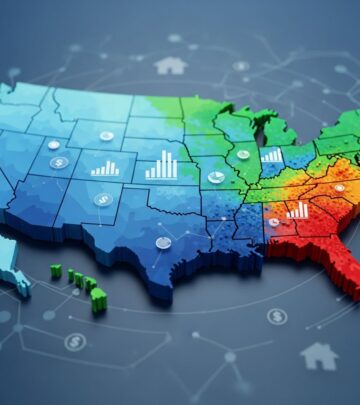
Debt-to-income ratios vary significantly by state, illustrating that the debt burden is not uniformly distributed across the country. Some states experience substantially higher debt relative to household income, while others maintain more manageable ratios. These regional differences reflect variations in housing costs, employment opportunities, wages, and local economic conditions.
The Impact of the Pandemic on Debt Levels
The pandemic fundamentally altered American debt patterns. Total household debt increased by $4.4 trillion since the end of 2019, representing an acceleration in consumer borrowing. The temporary pause on federal student loan payments created a unique situation where borrowers could reduce their outstanding debt or redirect funds to other purposes, but this has now reversed with the resumption of payments in 2025.
Interest Rate Environment and Credit Card Costs
Credit card interest rates have become increasingly burdensome for consumers carrying balances. The average APR for all credit cards reached 21.39% in the third quarter of 2025, up from 21.16% in the second quarter. For cards where interest is accruing, rates averaged 22.83%, making it increasingly expensive to maintain credit card balances.
These elevated rates mean that consumers who carry balances face higher monthly payments and slower principal reduction, potentially extending the time needed to become debt-free.
Types of Credit Cards and Their Interest Rates
Different credit card categories carry varying interest rates. Student credit cards averaged 22.64% APR in Q3 2025, while dining rewards cards averaged 23.76%. Secured credit cards, typically offered to those with poor credit, carried the highest rates at 26.32%. These variations reflect the different risk profiles of cardholders and the card issuers’ assessment of default risk.
Future Outlook for American Household Debt
The trajectory of household debt suggests continued growth in the near term, though the rate of increase may moderate. Recent Federal Reserve rate cuts have begun to lower average APRs on new credit card offers, which could provide some relief to consumers taking on new credit. However, the resumption of student loan payments continues to pressure household finances, particularly among older borrowers who are experiencing elevated delinquency rates.
Frequently Asked Questions
Q: What is the current average household debt in America?
A: As of the third quarter of 2025, total household debt in the United States stands at $18.59 trillion, up $197 billion from the previous quarter.
Q: What types of debt are included in household debt statistics?
A: Household debt includes mortgages, auto loans, credit cards, student loans, and other consumer credit. Mortgages represent the largest component at approximately 70% of total debt.
Q: What is the average credit card debt for those carrying a balance?
A: The national average credit card debt among cardholders with unpaid balances in Q1 2025 was $7,321, up 5.8% from $6,921 in Q1 2024.
Q: How many Americans carry credit card balances?
A: Fewer than half of adult credit cardholders (46%) carried a balance on a credit card for at least one month in the past year according to May 2025 Federal Reserve data.
Q: What is the average credit card APR in 2025?
A: The average APR for all credit cards in Q3 2025 was 21.39%, while the average for cards accruing interest was 22.83%. New credit card offers averaged 24.04% APR.
Q: How much has student loan debt increased?
A: Student loan debt has reached a record $1.65 trillion, with nearly 10% of all student debt now 90 days delinquent or more.
Q: What percentage of credit card debt is delinquent?
A: As of Q2 2025, 3.05% of Americans’ total outstanding credit card balances were at least 30 days delinquent.
Q: How much have mortgage balances increased?
A: Mortgage balances have reached $13.07 trillion as of September 2025, up $137 billion during Q3 alone.
References
- Americans’ household debt hits new record high, according to report — ABC News. 2025-10-09. https://abcnews.go.com/Business/americans-household-debt-hits-new-record-high-report/story?id=127221208
- Where is debt growing? — Bank of America Institute. 2025-08-08. https://institute.bankofamerica.com
- 2025 Credit Card Debt Statistics — LendingTree. 2025-11-01. https://www.lendingtree.com/credit-cards/study/credit-card-debt-statistics/
- Household Debt and Credit Report — Federal Reserve Bank of New York. 2025-11-15. https://www.newyorkfed.org/microeconomics/hhdc
- State-Level Debt-to-Income Ratio, 1999 – 2025:Q1 — Federal Reserve. 2025-11-01. https://www.federalreserve.gov/releases/z1/dataviz/household_debt/state/map/
Similar Articles








Read full bio of medha deb