Auto Loan Debt Surge 2026
Unpacking the record-breaking $1.67 trillion in U.S. auto debt, rising payments, and delinquency risks in 2026.

Vehicle financing has become a cornerstone of American consumer spending, but recent data reveals unprecedented levels of auto loan debt. As of Q4 2025, total outstanding auto debt reached $1.667 trillion, marking a significant escalation and positioning it as the second-largest household debt category after mortgages. This surge reflects higher vehicle prices, extended loan terms, and persistent interest rate pressures, creating challenges for millions of borrowers.
Current Landscape of U.S. Auto Debt
The scale of auto loan obligations underscores broader economic strains. Americans originated $180.8 billion in new auto loans during Q4 2025 alone, with younger demographics driving much of the activity. This figure highlights sustained demand for vehicles despite affordability hurdles. Over the past decade, auto debt has grown by 56.7%, from $1.064 trillion in Q4 2015 to its current peak, with minimal interruptions except during the early pandemic period.
Breaking down the debt composition, auto loans account for 8.9% of total consumer debt, trailing only housing-related obligations. Recent quarters show steady climbs: from $1.616 trillion in Q1 2024 to $1.667 trillion in Q4 2025. Such growth raises concerns about household financial stability, particularly as inflation and living costs remain elevated.
Record-High Monthly Payments
Average monthly payments for vehicles have hit historic highs. New car payments averaged $767 in Q4 2025, a 2.8% increase from the prior year, while used and leased vehicles saw rises of 1.7% and 1.5%, reaching $537 and $613 respectively. These figures stem from pricier cars, with new vehicle loan amounts averaging around $40,634 in early 2024, alongside interest rates climbing to 6.73% for new and 11.91% for used models.
Longer loan durations exacerbate the burden. Terms stretching to 84-96 months, or even 120 months in some cases, lower initial payments but trap borrowers in prolonged debt cycles. High loan-to-value ratios, sometimes exceeding 140% for subprime borrowers, further compound risks by lending beyond vehicle worth.
Demographic Breakdown of Borrowers
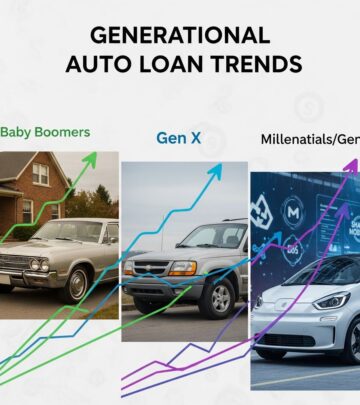
Age plays a pivotal role in auto debt patterns. In Q4 2025, individuals aged 18-49 originated $108.1 billion in new loans, dwarfing the $72.3 billion from those 50 and older. Younger borrowers, often facing student debt and entry-level incomes, allocate a larger debt share to autos—17% of total obligations for 18-29 year-olds at the end of 2023.
Average loan balances also vary. Subprime loans averaged $26,813 in late 2025, up 10% year-over-year, while overall originations hit $31,962. This indicates riskier lending to lower-credit groups amid competitive auto sales.
Quarterly Debt and Origination Trends
| Quarter | Outstanding Debt ($T) | Originations ($B) |
|---|---|---|
| Q4 2025 | 1.667 | 180.8 |
| Q3 2025 | 1.655 | 183.9 |
| Q2 2025 | 1.655 | 187.9 |
| Q1 2025 | 1.642 | 165.6 |
| Q4 2024 | 1.655 | 175.1 |
This table illustrates the stability and slight uptick in debt levels, with originations fluctuating around $170-180 billion quarterly.
Rising Delinquency Rates Signal Warning
Delinquency metrics paint a troubling picture. Serious delinquencies (90+ days past due) reached 5.2% of auto debt in Q4 2025, up 7.7% from the previous year, per Federal Reserve data. Subprime segments face even steeper issues, with 60+ day delinquencies hitting a 32-year record high in early 2026. TransUnion forecasts minimal change, projecting 1.54% serious delinquency by year-end 2026, a slight rise from 1.51% in 2025.
While 30-day delinquencies dipped to 7.7%, the trend toward severe defaults among riskier loans underscores financial stress. Factors include post-pandemic loan vintages, high costs, and economic uncertainty.
Interest Rates and Loan Terms Evolution
Interest rates have surged, averaging 6.73% for new autos and 11.91% for used in 2024, fueling higher payments. Extended terms—now commonplace at 72+ months—offer short-term relief but increase total interest paid and negative equity risks. Subprime borrowers, with lower scores, face the brunt, often financing depreciating assets at inflated values.
- New vehicle loans: Avg. $40,634 amount, $735 monthly payment in 2024.
- Used vehicle loans: Higher rates at 11.91%, avg. debt rising steadily.
- Leases: $613 avg. payment, growing 1.5% YoY.
Historical Context and Future Outlook
Auto debt crossed $1 trillion in 2016 and has since ballooned, surpassing student loans. From $720 billion in 2004 to $1.62 trillion by late 2023, the trajectory shows no signs of reversal. Projections for 2026 suggest continued pressure, with delinquencies stable but elevated, and potential car price softening due to reduced demand—though lending innovations may prolong high values.
Equifax reported $1.589 trillion in loans plus leases totaling $1.685 trillion by late 2025. As pandemic-era loans mature, their poor performance will linger, per industry observers.
Strategies for Managing Auto Debt
Borrowers can mitigate risks through proactive steps:
- Shop for competitive rates via credit unions or banks before dealerships.
- Opt for shorter terms to reduce interest, even if payments rise initially.
- Build emergency funds covering 3-6 months of payments.
- Refinance when rates drop or credit improves.
- Consider certified pre-owned vehicles for better value retention.
Understanding personal debt-to-income ratios is crucial; auto loans should ideally not exceed 15% of monthly income.
Broader Economic Implications
The auto sector’s debt dynamics influence everything from consumer spending to repossession rates. With younger Americans heavily invested, ripple effects could hit housing and savings goals. Policymakers monitor this closely, as sustained delinquencies might signal recessionary pressures.
Frequently Asked Questions
What is the average auto loan payment in 2026?
New cars average $767 monthly, used $537, and leases $613 as of Q4 2025.
Has auto debt ever been this high before?
Total debt at $1.667 trillion marks a record, up 56.7% in a decade.
Why are delinquencies rising?
High payments, long terms, subprime lending, and economic stress contribute.
Will car prices drop in 2026?
Possible due to lower demand, but extended financing may delay declines.
How does auto debt compare to other debts?
Second to mortgages at 8.9% of total consumer debt.
References
- Average Car Payment and Auto Loan Statistics: 2026 — LendingTree. 2026. https://www.lendingtree.com/auto/debt-statistics/
- The Auto Loan Crisis Just Hit a 32-Year Record — CarEdge. 2026. https://caredge.com/guides/auto-loan-crisis-32-year-record
- Auto Loan Debt Statistics 2026 — ConsumerAffairs. 2026. https://www.consumeraffairs.com/finance/auto-loan-debt-statistics.html
- Americans Now Have 1.59 Trillion In Outstanding Automotive Debt — The Autopian. 2025. https://www.theautopian.com/americans-now-have-1-59-trillion-in-outstanding-automotive-debt/
- Car-loan delinquencies will see little movement in 2026: TransUnion — WardsAuto. 2025. https://www.wardsauto.com/news/car-loan-delinquencies-will-see-little-movement-in-2026-transunion/807842/
Similar Articles








Read full bio of medha deb